

https://upload.wikimedia.org/wikipedia/commons/thumb/c/c8/Axios_logo_%282020%29.svg/1200px-Axios_logo_%282020%29.svg.png
Latest articles(17551 total)

Christa Pike survived lethal injection. How your state carries out executions Data: Death Penalty Information Center; Note: New Hampshire abolished the death penalty but retains one prisoner on death row; Map: Erin Davis/AxiosChrista Pikes survival after two lethal injection doses has put state execution protocols nationwide under new scrutiny.The big picture: How prisoners are executed varies by state, with lethal injection, electrocution, lethal gas and firing squads among the methods authorized.Lethal injections are the most common U.S. execution method, accounting for roughly 89 of the 1,683 executions carried out since 1976, per the Death Penalty Information Center.By the numbers: More than two dozen states have lethal injection as a primary method. Lethal gas is authorized in Alabama, Arizona, Arkansas, California, Louisiana, Mississippi, Missouri, Oklahoma and Wyoming.Electrocution is allowed in Alabama, Arkansas, Florida, Kentucky, Louisiana, Mississippi, Oklahoma, South Carolina and Tennessee.Firing squad is allowed in Idaho, Mississippi, Oklahoma, South Carolina and Utah. Idaho is the only state where it is the primary method.Context: Some states let prisoners choose among the different execution methods.Zoom out: The Supreme Court requires states to keep the death penalty only for the most heinous murders.Pike, convicted of killing a classmate three decades ago, survived two rounds of lethal injection drugs earlier this week in what would have been the first execution of a woman in Tennessee in 200 years.Pike was still alive as of Friday, remaining on a ventilator and unconscious, AP reports.
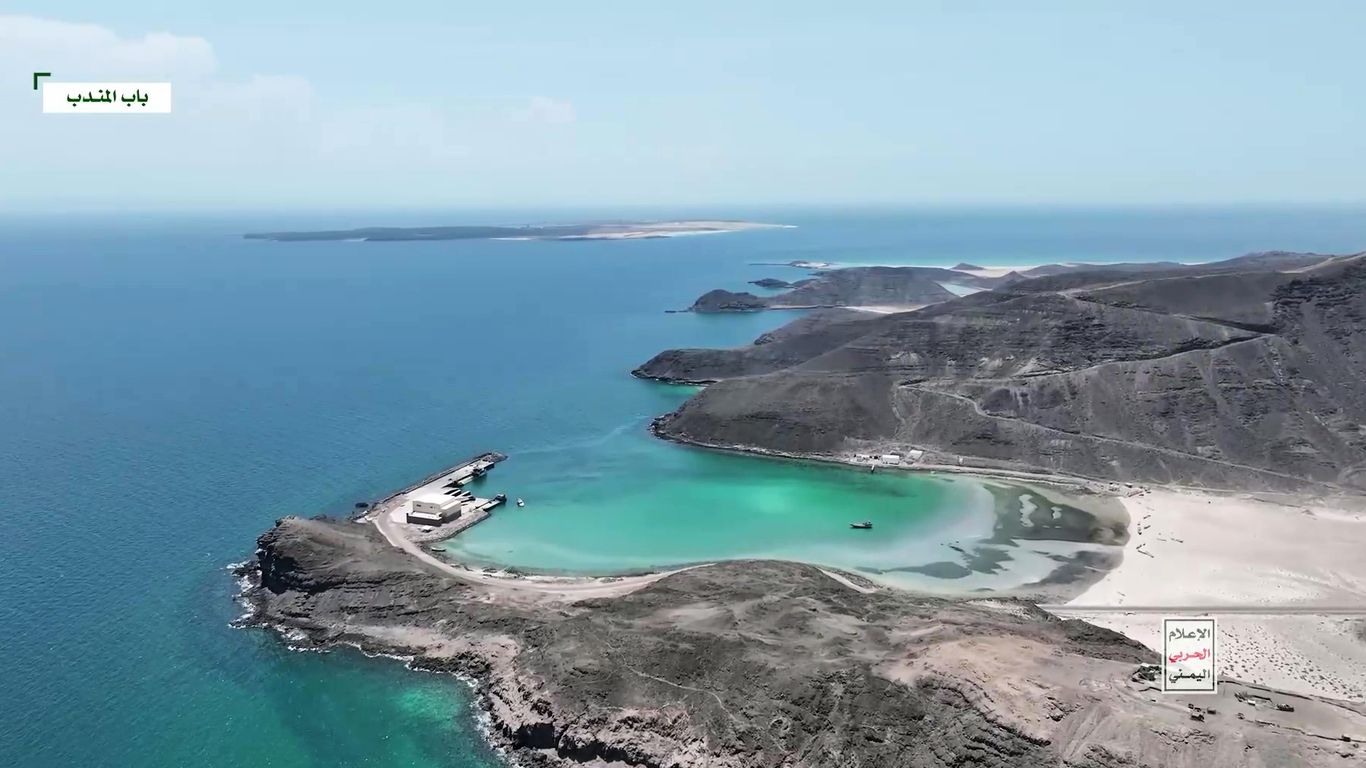
Saudis plan major offensive against the Houthis, but U.S. wont join for now Saudi Arabia and Yemeni government forces are planning a major counteroffensive against Iran-backed Houthis in the coming days — an effort to push them away from areas on the Red Sea coast that control the Strait of Bab al-Mandeb, two U.S. officials say. Why it matters: For the second time in recent weeks, the U.S. rebuffed Saudi pleas to join the operation and conduct airstrikes. But U.S. officials say that could change if the operation runs into problems. The Bab al-Mandeb Strait is a vital artery for global trade and Saudi oil exports. Control over it gives the Houthis and their Iranian backer a powerful new point of leverage over the U.S., its Gulf allies and the world economy.Driving the news: In recent weeks, the Houthis took over key areas of the southern Red Sea coast that control the strait. They also increased missile and drone attacks against Saudi Arabia. The Saudis retaliated with airstrikes against Houthi targets. Behind the scenes: A U.S. official said the Saudis have been planning the operation for weeks and that plans were approved by Saudi leadership several days ago.The operation will include ground forces loyal to the internationally recognized government in Yemen with Saudi air cover. On Thursday, Saudi Defense Minister Prince Khalid Bin Salman called Defense Secretary Pete Hegseth to brief him on the planned operation and ask again for U.S. airstrikes against Houthi targets, the U.S. official said. A U.S. official said that the U.S. "is not going to take kinetic action for now."Last week, President Trump was close to ordering a strike on the Houthis after a request from Saudi Crown Prince Mohammed bin Salman (MBS), but eventually decided to hold off. Between the lines: Trump is caught between wanting to help his friend and ally MBS, and avoiding getting entangled in a new front in the Middle East.The U.S. Central Command (CENTCOM) also had serious reservations about launching strikes in Yemen and saw it as a distraction from its focus on Iran, a U.S. official said. Zoom in: U.S. officials say the U.S. military is helping the Saudis with everything short of direct combat, mainly intelligence and targeting data. One U.S. official said that in the last two weeks, the U.S. military provided the Saudis with more than 200 Houthi targets to strike. The official said the strikes significantly increased pressure on the Houthis.
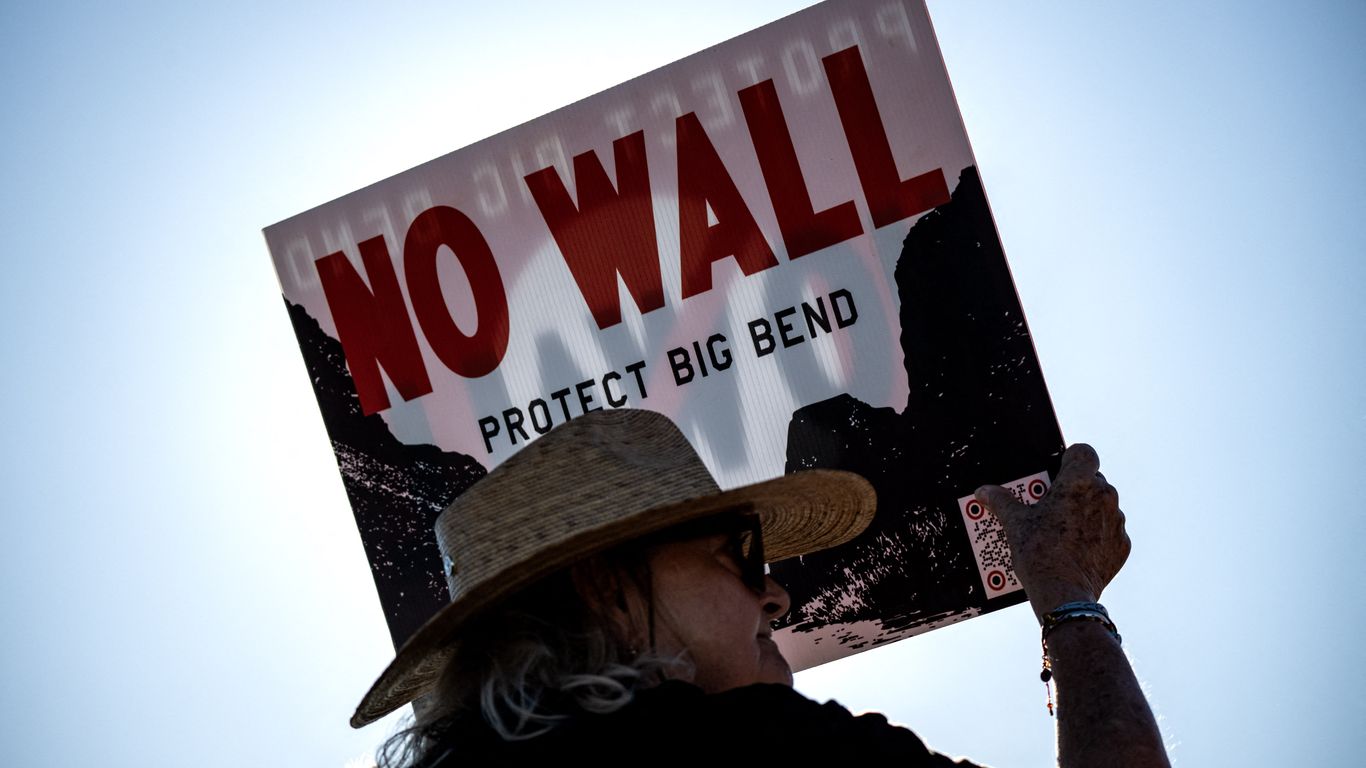
Big Bend border wall construction blocked by judge A federal judge blocked the Trump administration from pursuing border wall construction in the Big Bend region in Texas on FridayThe big picture: The construction inside the national park sparked local outrage and environmental concerns, with Fridays decision handing the Department of Homeland Security a loss in its quest to rapidly expand the Southwestern border wall.Driving the news: The administration is barred, for now, from building border barrier or infrastructure — or engaging in any "construction or ground disturbing activities" — in the Big Bend sector, U.S. District Judge Kathleen Cardone said in a brief order.The administration paused border wall construction in the park back in August, with U.S. Customs and Border Protection Commissioner Rodney Scott saying hed visit and discuss with local stakeholders.This is a breaking news story and will be updated.
Christa Pike survived lethal injection. How your state carries out executions Data: Death Penalty Information Center; Note: New Hampshire abolished the death penalty but retains one prisoner on death row; Map: Erin Davis/AxiosChrista Pikes survival after two lethal injection doses has put state execution protocols nationwide under new scrutiny.The big picture: How prisoners are executed varies by state, with lethal injection, electrocution, lethal gas and firing squads among the methods authorized.Lethal injections are the most common U.S. execution method, accounting for roughly 89 of the 1,683 executions carried out since 1976, per the Death Penalty Information Center.By the numbers: More than two dozen states have lethal injection as a primary method. Lethal gas is authorized in Alabama, Arizona, Arkansas, California, Louisiana, Mississippi, Missouri, Oklahoma and Wyoming.Electrocution is allowed in Alabama, Arkansas, Florida, Kentucky, Louisiana, Mississippi, Oklahoma, South Carolina and Tennessee.Firing squad is allowed in Idaho, Mississippi, Oklahoma, South Carolina and Utah. Idaho is the only state where it is the primary method.Context: Some states let prisoners choose among the different execution methods.Zoom out: The Supreme Court requires states to keep the death penalty only for the most heinous murders.Pike, convicted of killing a classmate three decades ago, survived two rounds of lethal injection drugs earlier this week in what would have been the first execution of a woman in Tennessee in 200 years.Pike was still alive as of Friday, remaining on a ventilator and unconscious, AP reports.
Saudis plan major offensive against the Houthis, but U.S. wont join for now Saudi Arabia and Yemeni government forces are planning a major counteroffensive against Iran-backed Houthis in the coming days — an effort to push them away from areas on the Red Sea coast that control the Strait of Bab al-Mandeb, two U.S. officials say. Why it matters: For the second time in recent weeks, the U.S. rebuffed Saudi pleas to join the operation and conduct airstrikes. But U.S. officials say that could change if the operation runs into problems. The Bab al-Mandeb Strait is a vital artery for global trade and Saudi oil exports. Control over it gives the Houthis and their Iranian backer a powerful new point of leverage over the U.S., its Gulf allies and the world economy.Driving the news: In recent weeks, the Houthis took over key areas of the southern Red Sea coast that control the strait. They also increased missile and drone attacks against Saudi Arabia. The Saudis retaliated with airstrikes against Houthi targets. Behind the scenes: A U.S. official said the Saudis have been planning the operation for weeks and that plans were approved by Saudi leadership several days ago.The operation will include ground forces loyal to the internationally recognized government in Yemen with Saudi air cover. On Thursday, Saudi Defense Minister Prince Khalid Bin Salman called Defense Secretary Pete Hegseth to brief him on the planned operation and ask again for U.S. airstrikes against Houthi targets, the U.S. official said. A U.S. official said that the U.S. "is not going to take kinetic action for now."Last week, President Trump was close to ordering a strike on the Houthis after a request from Saudi Crown Prince Mohammed bin Salman (MBS), but eventually decided to hold off. Between the lines: Trump is caught between wanting to help his friend and ally MBS, and avoiding getting entangled in a new front in the Middle East.The U.S. Central Command (CENTCOM) also had serious reservations about launching strikes in Yemen and saw it as a distraction from its focus on Iran, a U.S. official said. Zoom in: U.S. officials say the U.S. military is helping the Saudis with everything short of direct combat, mainly intelligence and targeting data. One U.S. official said that in the last two weeks, the U.S. military provided the Saudis with more than 200 Houthi targets to strike. The official said the strikes significantly increased pressure on the Houthis.
Big Bend border wall construction blocked by judge A federal judge blocked the Trump administration from pursuing border wall construction in the Big Bend region in Texas on FridayThe big picture: The construction inside the national park sparked local outrage and environmental concerns, with Fridays decision handing the Department of Homeland Security a loss in its quest to rapidly expand the Southwestern border wall.Driving the news: The administration is barred, for now, from building border barrier or infrastructure — or engaging in any "construction or ground disturbing activities" — in the Big Bend sector, U.S. District Judge Kathleen Cardone said in a brief order.The administration paused border wall construction in the park back in August, with U.S. Customs and Border Protection Commissioner Rodney Scott saying hed visit and discuss with local stakeholders.This is a breaking news story and will be updated.
Christa Pike survived lethal injection. How your state carries out executions Data: Death Penalty Information Center; Note: New Hampshire abolished the death penalty but retains one prisoner on death row; Map: Erin Davis/AxiosChrista Pikes survival after two lethal injection doses has put state execution protocols nationwide under new scrutiny.The big picture: How prisoners are executed varies by state, with lethal injection, electrocution, lethal gas and firing squads among the methods authorized.Lethal injections are the most common U.S. execution method, accounting for roughly 89 of the 1,683 executions carried out since 1976, per the Death Penalty Information Center.By the numbers: More than two dozen states have lethal injection as a primary method. Lethal gas is authorized in Alabama, Arizona, Arkansas, California, Louisiana, Mississippi, Missouri, Oklahoma and Wyoming.Electrocution is allowed in Alabama, Arkansas, Florida, Kentucky, Louisiana, Mississippi, Oklahoma, South Carolina and Tennessee.Firing squad is allowed in Idaho, Mississippi, Oklahoma, South Carolina and Utah. Idaho is the only state where it is the primary method.Context: Some states let prisoners choose among the different execution methods.Zoom out: The Supreme Court requires states to keep the death penalty only for the most heinous murders.Pike, convicted of killing a classmate three decades ago, survived two rounds of lethal injection drugs earlier this week in what would have been the first execution of a woman in Tennessee in 200 years.Pike was still alive as of Friday, remaining on a ventilator and unconscious, AP reports.
Saudis plan major offensive against the Houthis, but U.S. wont join for now Saudi Arabia and Yemeni government forces are planning a major counteroffensive against Iran-backed Houthis in the coming days — an effort to push them away from areas on the Red Sea coast that control the Strait of Bab al-Mandeb, two U.S. officials say. Why it matters: For the second time in recent weeks, the U.S. rebuffed Saudi pleas to join the operation and conduct airstrikes. But U.S. officials say that could change if the operation runs into problems. The Bab al-Mandeb Strait is a vital artery for global trade and Saudi oil exports. Control over it gives the Houthis and their Iranian backer a powerful new point of leverage over the U.S., its Gulf allies and the world economy.Driving the news: In recent weeks, the Houthis took over key areas of the southern Red Sea coast that control the strait. They also increased missile and drone attacks against Saudi Arabia. The Saudis retaliated with airstrikes against Houthi targets. Behind the scenes: A U.S. official said the Saudis have been planning the operation for weeks and that plans were approved by Saudi leadership several days ago.The operation will include ground forces loyal to the internationally recognized government in Yemen with Saudi air cover. On Thursday, Saudi Defense Minister Prince Khalid Bin Salman called Defense Secretary Pete Hegseth to brief him on the planned operation and ask again for U.S. airstrikes against Houthi targets, the U.S. official said. A U.S. official said that the U.S. "is not going to take kinetic action for now."Last week, President Trump was close to ordering a strike on the Houthis after a request from Saudi Crown Prince Mohammed bin Salman (MBS), but eventually decided to hold off. Between the lines: Trump is caught between wanting to help his friend and ally MBS, and avoiding getting entangled in a new front in the Middle East.The U.S. Central Command (CENTCOM) also had serious reservations about launching strikes in Yemen and saw it as a distraction from its focus on Iran, a U.S. official said. Zoom in: U.S. officials say the U.S. military is helping the Saudis with everything short of direct combat, mainly intelligence and targeting data. One U.S. official said that in the last two weeks, the U.S. military provided the Saudis with more than 200 Houthi targets to strike. The official said the strikes significantly increased pressure on the Houthis.
Big Bend border wall construction blocked by judge A federal judge blocked the Trump administration from pursuing border wall construction in the Big Bend region in Texas on FridayThe big picture: The construction inside the national park sparked local outrage and environmental concerns, with Fridays decision handing the Department of Homeland Security a loss in its quest to rapidly expand the Southwestern border wall.Driving the news: The administration is barred, for now, from building border barrier or infrastructure — or engaging in any "construction or ground disturbing activities" — in the Big Bend sector, U.S. District Judge Kathleen Cardone said in a brief order.The administration paused border wall construction in the park back in August, with U.S. Customs and Border Protection Commissioner Rodney Scott saying hed visit and discuss with local stakeholders.This is a breaking news story and will be updated.
Its October, but Republicans are already retreating in N.C. With one month until Election Day, some big GOP spenders are giving up on North Carolina and prioritizing other states. Why it matters: Its a sign that Republicans believe Michael Whatley cant win and that the seat will flip to Democrats, who need four pickups to regain control of the Senate.Driving the news: Several key Republican super PACs have canceled October ad campaigns in North Carolina as polls show Whatley several points behind former Democratic Gov. Roy Cooper.By the numbers: Last month, Republicans spent $53 million on North Carolinas Senate race, while Democrats spent $44 million, the firm AdImpact tracked.PACs backing the candidates had reserved ads totaling over $33 million for each candidate in October.Yes, but: That calculation was made on Thursday. The latest: On Friday, Senate Leadership Fund said it would redirect money meant for Whatley, Semafor and other national outlets reported. Its a major blow for the campaign. Senate Leadership Fund dropped $17 million on North Carolina in September, nearly a third of Whatleys total, according to AdImpact analysis. The PAC paid for the misleading ad that tied Cooper to a South Carolina murder suspects release from prison, The News & Observer reported. What theyre saying: Whatley campaign spokesperson DJ Griffin said they were betting on undecided voters breaking for Republicans."We feel confident we have the resources to highlight Career Politician Roy Coopers 40 Years of Failures and win in November," Griffin said in an email.An unidentified source told Semafor it was Senate Leadership Funds job to "maintain the majority and this move reflects the most effective and efficient use of resources."State of play: Neither Prosperity Action nor Old North Action plan to spend in North Carolina in October, Politico reported.Money is needed in races in Kansas, Texas and Alaska, a GOP operative told the publication, calling Whatley "a good man who took one for the team."Between the lines: The reduced spending could affect down-ballot Republicans in North Carolina.Several congressional races and North Carolina General Assembly seats are in play. The bottom line: Its been over a decade since a Democrat represented North Carolina in the U.S. Senate, and Republicans are bracing for that to change this election cycle.
Christa Pike survived lethal injection. How your state carries out executions Data: Death Penalty Information Center; Note: New Hampshire abolished the death penalty but retains one prisoner on death row; Map: Erin Davis/AxiosChrista Pikes survival after two lethal injection doses has put state execution protocols nationwide under new scrutiny.The big picture: How prisoners are executed varies by state, with lethal injection, electrocution, lethal gas and firing squads among the methods authorized.Lethal injections are the most common U.S. execution method, accounting for roughly 89 of the 1,683 executions carried out since 1976, per the Death Penalty Information Center.By the numbers: More than two dozen states have lethal injection as a primary method. Lethal gas is authorized in Alabama, Arizona, Arkansas, California, Louisiana, Mississippi, Missouri, Oklahoma and Wyoming.Electrocution is allowed in Alabama, Arkansas, Florida, Kentucky, Louisiana, Mississippi, Oklahoma, South Carolina and Tennessee.Firing squad is allowed in Idaho, Mississippi, Oklahoma, South Carolina and Utah. Idaho is the only state where it is the primary method.Context: Some states let prisoners choose among the different execution methods.Zoom out: The Supreme Court requires states to keep the death penalty only for the most heinous murders.Pike, convicted of killing a classmate three decades ago, survived two rounds of lethal injection drugs earlier this week in what would have been the first execution of a woman in Tennessee in 200 years.Pike was still alive as of Friday, remaining on a ventilator and unconscious, AP reports.
Saudis plan major offensive against the Houthis, but U.S. wont join for now Saudi Arabia and Yemeni government forces are planning a major counteroffensive against Iran-backed Houthis in the coming days — an effort to push them away from areas on the Red Sea coast that control the Strait of Bab al-Mandeb, two U.S. officials say. Why it matters: For the second time in recent weeks, the U.S. rebuffed Saudi pleas to join the operation and conduct airstrikes. But U.S. officials say that could change if the operation runs into problems. The Bab al-Mandeb Strait is a vital artery for global trade and Saudi oil exports. Control over it gives the Houthis and their Iranian backer a powerful new point of leverage over the U.S., its Gulf allies and the world economy.Driving the news: In recent weeks, the Houthis took over key areas of the southern Red Sea coast that control the strait. They also increased missile and drone attacks against Saudi Arabia. The Saudis retaliated with airstrikes against Houthi targets. Behind the scenes: A U.S. official said the Saudis have been planning the operation for weeks and that plans were approved by Saudi leadership several days ago.The operation will include ground forces loyal to the internationally recognized government in Yemen with Saudi air cover. On Thursday, Saudi Defense Minister Prince Khalid Bin Salman called Defense Secretary Pete Hegseth to brief him on the planned operation and ask again for U.S. airstrikes against Houthi targets, the U.S. official said. A U.S. official said that the U.S. "is not going to take kinetic action for now."Last week, President Trump was close to ordering a strike on the Houthis after a request from Saudi Crown Prince Mohammed bin Salman (MBS), but eventually decided to hold off. Between the lines: Trump is caught between wanting to help his friend and ally MBS, and avoiding getting entangled in a new front in the Middle East.The U.S. Central Command (CENTCOM) also had serious reservations about launching strikes in Yemen and saw it as a distraction from its focus on Iran, a U.S. official said. Zoom in: U.S. officials say the U.S. military is helping the Saudis with everything short of direct combat, mainly intelligence and targeting data. One U.S. official said that in the last two weeks, the U.S. military provided the Saudis with more than 200 Houthi targets to strike. The official said the strikes significantly increased pressure on the Houthis.
Big Bend border wall construction blocked by judge A federal judge blocked the Trump administration from pursuing border wall construction in the Big Bend region in Texas on FridayThe big picture: The construction inside the national park sparked local outrage and environmental concerns, with Fridays decision handing the Department of Homeland Security a loss in its quest to rapidly expand the Southwestern border wall.Driving the news: The administration is barred, for now, from building border barrier or infrastructure — or engaging in any "construction or ground disturbing activities" — in the Big Bend sector, U.S. District Judge Kathleen Cardone said in a brief order.The administration paused border wall construction in the park back in August, with U.S. Customs and Border Protection Commissioner Rodney Scott saying hed visit and discuss with local stakeholders.This is a breaking news story and will be updated.
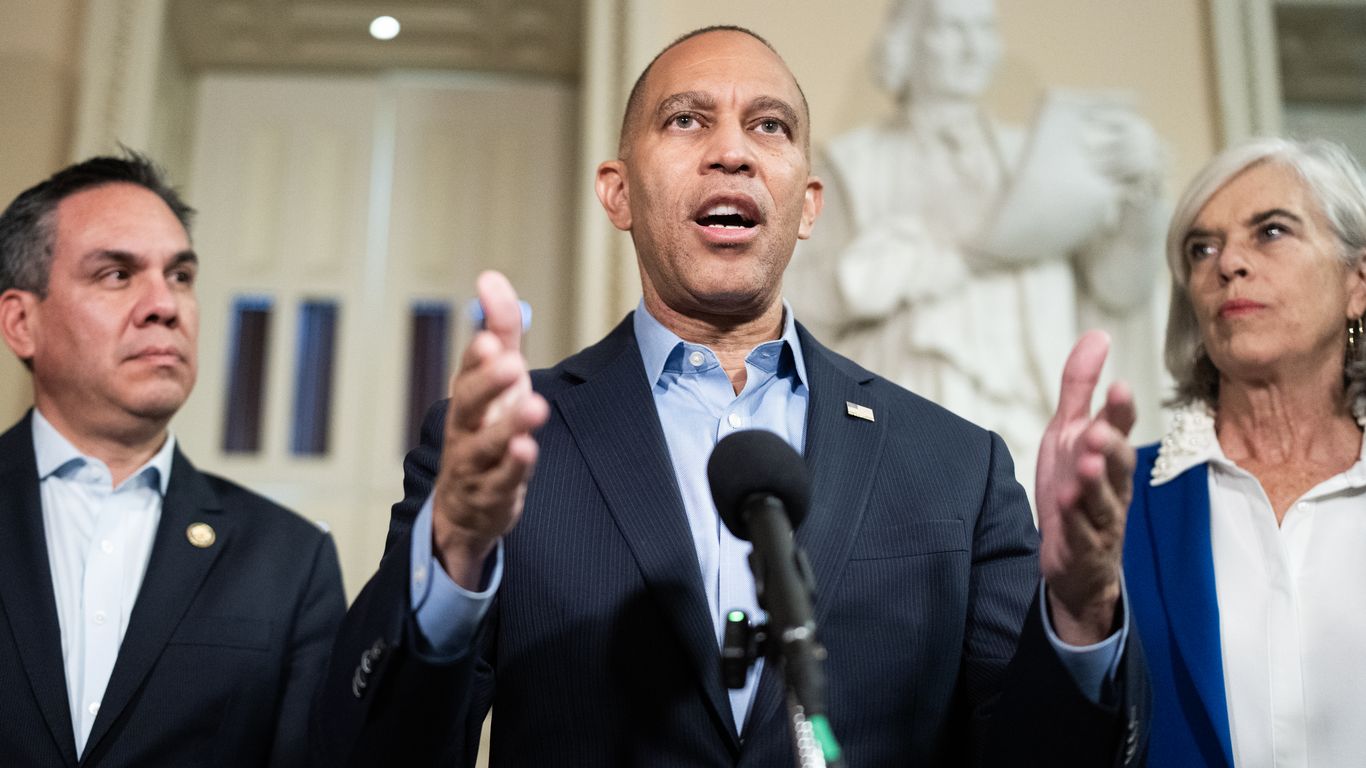
House Democrats want to win big. It could cost them. Democrats dream election scenario risks becoming a nightmare as their candidates in Republican-leaning districts strain to assert their independence from party leadership.Why it matters: Add them to the sizable cohort of outspoken leftists promising to be a thorn in the side of House Democratic leaders, and you get all the ingredients for an unruly majority."When I see things that I dont think are right, whether theyre within my own party or within another party, Im going to call it out," Jake Johnson, a Democratic House candidate in Minnesota, told Axios in an interview.Montana Democrat Sam Forstag, when asked about the approach he would take on Capitol Hill, said showing a willingness to work across the aisle and "buck your own party" have "got to be a part of it.""There is a tremendous amount of frustration with the D.C. political establishment, and ... a lot of cynicism that things arent going to change," said Colorado candidate Eileen Laubacher.State of play: Democrats got an early taste last month when Reps. Jared Golden (D-Maine) and Marie Gluesenkamp Perez (D-Wash.) repeatedly broke with party leadership on key procedural votes.The defections from a pair of independent-minded frontliners unlocked a new fear for House Democrats: That safe-seat progressives arent the only rebellious freshmen they will have to worry about next year.Its a salient concern as Democrats put more Republican-leaning seats on their radar in anticipation of a "blue wave" on Election Day.There has been a huge spike in ads from Democrats in those districts repudiating their own party or the two-party system as a whole, Axios reported last week.What theyre saying: "I will stand up to Republicans, I will also stand up to Democrats. I talk a lot about this," said Michigan swing-district candidate Christina Hines.Johnson said its "no wonder people have historically low levels of confidence in Congress" because they "see a bunch of people put on red shirts and blue shirts ... and its just not working."Forstag pointed to housing as an issue where he has broken with Democrats in his state, telling Axios: "When it comes to zoning reform, you know who Ive seen be the biggest impediment to progress? Oftentimes, Democrats.""You bet your ass Im going to work with Republicans," he said.Between the lines: This swing-district independent streak is bound to come in conflict with the rebellions that safe-seat insurgents are planning.Left-leaning Democratic lawmakers and candidates have told Axios they want votes on core policy issues such as Medicare for All, abolishing ICE and cutting off aid to Israel.The kind of candidate that gets elected to a seat President Trump carried by double digits in 2024 is not going to want to take those votes — in fact, they may be more likely to fund ICE and Israel.Yes, but: Some of these red-seat candidates are quite openly progressive and partisan.The common denominator: Theyre hearing voters frustration about party leadership and, if elected, they would arrive on Capitol Hill with a mandate to shake up the system and remain independent.Missouri candidate Fred Wellman, who told Axios he is "very Democrat" and "fairly progressive," said he was "disappointed" that House Minority Leader Hakeem Jeffries (D-N.Y.) met with Jared Kushner in August.Wellman said he will "make a decision when I get there" about whether to vote for Jeffries as speaker and doesnt "intend to be a rubber stamp."Zoom in: Democratic operatives told Axios that this leadership-skeptic attitude extends, in some cases, to candidates not wanting party leaders to come campaign for them."Theres very little appetite for anyone in Democratic leadership," said one consultant of the battleground-district House campaigns they are working with.Matt Herdman, an adviser to Maine Democrat Matt Dunlap, offered Axios a curt response when asked if they would welcome Jeffries to their district: "They havent offered and we havent asked."The bottom line: None of this rebelliousness has thus far turned off the Democratic Congressional Campaign Committee, which Jeffries and his leadership allies control.The House Democratic campaign arm has been spending heavily to support Gluesenkamp Perez even after some of her colleagues called for her to be cut off.Fittingly, Gluesenkamp Perez declared in a coordinated ad with the DCCC released Tuesday: "I dont answer to any political party or any president."
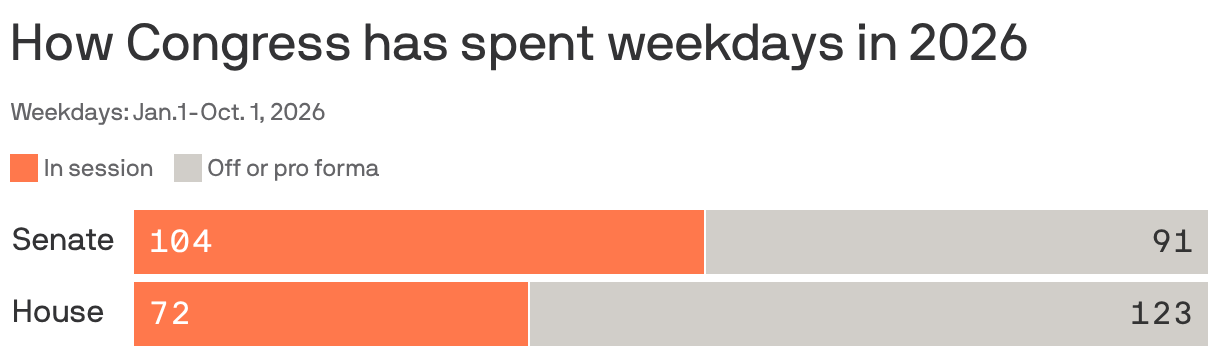
Senate crushes House on congressional work days Source: Ballotpedia, Congressional Record; Chart: Stef Kight/AxiosThe Senate is well on its way to claiming the congressional attendance trophy this year, spending 32 more weekdays in session so far than the House.Why it matters: Senate Majority Leader John Thune (R-S.D.) and House Speaker Mike Johnson (R-La.) have been torched by members for all the time off — not to mention Democrats, who taunt them for their truancy.The Senate left town late Wednesday — two weeks after its House counterparts — putting both chambers out of town until after the Nov. 3 midterms."I suppose I left the House two years too soon," Sen. Jim Banks (R-Ind.) told Axios, joking about how many fewer days the House has worked compared to the Senate this Congress.By the numbers: The Senate has been in session for 104 weekdays so far this year, compared with just 72 for the House, according to an analysis of congressional calendars by Ballotpedia and Axios.The Senate has spent nearly 664 hours in session, compared with about 378 hours for the House as of Sept. 14, according to data in the Congressional Record. The House isnt catching up anytime soon: Under the chambers current calendars, the Senate is on pace to finish the year with about 126 weekdays in session, compared with 92 for the House.Zoom in: Some of the Houses time off was unplanned.Johnson has repeatedly sent members home early when his razor-thin majority has run into trouble on the floor, or GOP rebels have blocked passage of a procedural "rule."Decisions to cut D.C. workweeks short have been met with some backlash. "Canceling yet another day of votes is unacceptable," Rep. Ralph Norman (R-S.C.) wrote on X after Johnson canceled a session day. "The founders did not envision taking this much time off and still getting paid."The other side: Johnson repeatedly argues that his chamber has already done its job."This House has been the second most productive in terms of legislation in the history of the institution since 1789," Johnson told reporters this month, saying the House had passed more than 900 pieces of legislation and roughly 700 were awaiting Senate action.Johnsons 900-plus figure includes resolutions that cant become law. The Washington Post found the House had passed 732 bills capable of becoming law through Aug. 31.By the numbers: The House passed more measures than the Senate (380 to 269), but the Senate held more "yea" or "nay" votes (231 to 216) between Jan. 3 and the end of August.House members introduced more legislation overall, but the Senate was more productive per capita — 22 pieces of legislation per senator compared to nine per House member.The House has passed 21 bills sent over by the Senate, and the Senate has passed 20 bills sent by the House.The Senate spends significant floor time confirming nominees — which is outside of the Houses portfolio.
Its October, but Republicans are already retreating in N.C. With one month until Election Day, some big GOP spenders are giving up on North Carolina and prioritizing other states. Why it matters: Its a sign that Republicans believe Michael Whatley cant win and that the seat will flip to Democrats, who need four pickups to regain control of the Senate.Driving the news: Several key Republican super PACs have canceled October ad campaigns in North Carolina as polls show Whatley several points behind former Democratic Gov. Roy Cooper.By the numbers: Last month, Republicans spent $53 million on North Carolinas Senate race, while Democrats spent $44 million, the firm AdImpact tracked.PACs backing the candidates had reserved ads totaling over $33 million for each candidate in October.Yes, but: That calculation was made on Thursday. The latest: On Friday, Senate Leadership Fund said it would redirect money meant for Whatley, Semafor and other national outlets reported. Its a major blow for the campaign. Senate Leadership Fund dropped $17 million on North Carolina in September, nearly a third of Whatleys total, according to AdImpact analysis. The PAC paid for the misleading ad that tied Cooper to a South Carolina murder suspects release from prison, The News & Observer reported. What theyre saying: Whatley campaign spokesperson DJ Griffin said they were betting on undecided voters breaking for Republicans."We feel confident we have the resources to highlight Career Politician Roy Coopers 40 Years of Failures and win in November," Griffin said in an email.An unidentified source told Semafor it was Senate Leadership Funds job to "maintain the majority and this move reflects the most effective and efficient use of resources."State of play: Neither Prosperity Action nor Old North Action plan to spend in North Carolina in October, Politico reported.Money is needed in races in Kansas, Texas and Alaska, a GOP operative told the publication, calling Whatley "a good man who took one for the team."Between the lines: The reduced spending could affect down-ballot Republicans in North Carolina.Several congressional races and North Carolina General Assembly seats are in play. The bottom line: Its been over a decade since a Democrat represented North Carolina in the U.S. Senate, and Republicans are bracing for that to change this election cycle.
Christa Pike survived lethal injection. How your state carries out executions Data: Death Penalty Information Center; Note: New Hampshire abolished the death penalty but retains one prisoner on death row; Map: Erin Davis/AxiosChrista Pikes survival after two lethal injection doses has put state execution protocols nationwide under new scrutiny.The big picture: How prisoners are executed varies by state, with lethal injection, electrocution, lethal gas and firing squads among the methods authorized.Lethal injections are the most common U.S. execution method, accounting for roughly 89 of the 1,683 executions carried out since 1976, per the Death Penalty Information Center.By the numbers: More than two dozen states have lethal injection as a primary method. Lethal gas is authorized in Alabama, Arizona, Arkansas, California, Louisiana, Mississippi, Missouri, Oklahoma and Wyoming.Electrocution is allowed in Alabama, Arkansas, Florida, Kentucky, Louisiana, Mississippi, Oklahoma, South Carolina and Tennessee.Firing squad is allowed in Idaho, Mississippi, Oklahoma, South Carolina and Utah. Idaho is the only state where it is the primary method.Context: Some states let prisoners choose among the different execution methods.Zoom out: The Supreme Court requires states to keep the death penalty only for the most heinous murders.Pike, convicted of killing a classmate three decades ago, survived two rounds of lethal injection drugs earlier this week in what would have been the first execution of a woman in Tennessee in 200 years.Pike was still alive as of Friday, remaining on a ventilator and unconscious, AP reports.
Saudis plan major offensive against the Houthis, but U.S. wont join for now Saudi Arabia and Yemeni government forces are planning a major counteroffensive against Iran-backed Houthis in the coming days — an effort to push them away from areas on the Red Sea coast that control the Strait of Bab al-Mandeb, two U.S. officials say. Why it matters: For the second time in recent weeks, the U.S. rebuffed Saudi pleas to join the operation and conduct airstrikes. But U.S. officials say that could change if the operation runs into problems. The Bab al-Mandeb Strait is a vital artery for global trade and Saudi oil exports. Control over it gives the Houthis and their Iranian backer a powerful new point of leverage over the U.S., its Gulf allies and the world economy.Driving the news: In recent weeks, the Houthis took over key areas of the southern Red Sea coast that control the strait. They also increased missile and drone attacks against Saudi Arabia. The Saudis retaliated with airstrikes against Houthi targets. Behind the scenes: A U.S. official said the Saudis have been planning the operation for weeks and that plans were approved by Saudi leadership several days ago.The operation will include ground forces loyal to the internationally recognized government in Yemen with Saudi air cover. On Thursday, Saudi Defense Minister Prince Khalid Bin Salman called Defense Secretary Pete Hegseth to brief him on the planned operation and ask again for U.S. airstrikes against Houthi targets, the U.S. official said. A U.S. official said that the U.S. "is not going to take kinetic action for now."Last week, President Trump was close to ordering a strike on the Houthis after a request from Saudi Crown Prince Mohammed bin Salman (MBS), but eventually decided to hold off. Between the lines: Trump is caught between wanting to help his friend and ally MBS, and avoiding getting entangled in a new front in the Middle East.The U.S. Central Command (CENTCOM) also had serious reservations about launching strikes in Yemen and saw it as a distraction from its focus on Iran, a U.S. official said. Zoom in: U.S. officials say the U.S. military is helping the Saudis with everything short of direct combat, mainly intelligence and targeting data. One U.S. official said that in the last two weeks, the U.S. military provided the Saudis with more than 200 Houthi targets to strike. The official said the strikes significantly increased pressure on the Houthis.
Big Bend border wall construction blocked by judge A federal judge blocked the Trump administration from pursuing border wall construction in the Big Bend region in Texas on FridayThe big picture: The construction inside the national park sparked local outrage and environmental concerns, with Fridays decision handing the Department of Homeland Security a loss in its quest to rapidly expand the Southwestern border wall.Driving the news: The administration is barred, for now, from building border barrier or infrastructure — or engaging in any "construction or ground disturbing activities" — in the Big Bend sector, U.S. District Judge Kathleen Cardone said in a brief order.The administration paused border wall construction in the park back in August, with U.S. Customs and Border Protection Commissioner Rodney Scott saying hed visit and discuss with local stakeholders.This is a breaking news story and will be updated.
House Democrats want to win big. It could cost them. Democrats dream election scenario risks becoming a nightmare as their candidates in Republican-leaning districts strain to assert their independence from party leadership.Why it matters: Add them to the sizable cohort of outspoken leftists promising to be a thorn in the side of House Democratic leaders, and you get all the ingredients for an unruly majority."When I see things that I dont think are right, whether theyre within my own party or within another party, Im going to call it out," Jake Johnson, a Democratic House candidate in Minnesota, told Axios in an interview.Montana Democrat Sam Forstag, when asked about the approach he would take on Capitol Hill, said showing a willingness to work across the aisle and "buck your own party" have "got to be a part of it.""There is a tremendous amount of frustration with the D.C. political establishment, and ... a lot of cynicism that things arent going to change," said Colorado candidate Eileen Laubacher.State of play: Democrats got an early taste last month when Reps. Jared Golden (D-Maine) and Marie Gluesenkamp Perez (D-Wash.) repeatedly broke with party leadership on key procedural votes.The defections from a pair of independent-minded frontliners unlocked a new fear for House Democrats: That safe-seat progressives arent the only rebellious freshmen they will have to worry about next year.Its a salient concern as Democrats put more Republican-leaning seats on their radar in anticipation of a "blue wave" on Election Day.There has been a huge spike in ads from Democrats in those districts repudiating their own party or the two-party system as a whole, Axios reported last week.What theyre saying: "I will stand up to Republicans, I will also stand up to Democrats. I talk a lot about this," said Michigan swing-district candidate Christina Hines.Johnson said its "no wonder people have historically low levels of confidence in Congress" because they "see a bunch of people put on red shirts and blue shirts ... and its just not working."Forstag pointed to housing as an issue where he has broken with Democrats in his state, telling Axios: "When it comes to zoning reform, you know who Ive seen be the biggest impediment to progress? Oftentimes, Democrats.""You bet your ass Im going to work with Republicans," he said.Between the lines: This swing-district independent streak is bound to come in conflict with the rebellions that safe-seat insurgents are planning.Left-leaning Democratic lawmakers and candidates have told Axios they want votes on core policy issues such as Medicare for All, abolishing ICE and cutting off aid to Israel.The kind of candidate that gets elected to a seat President Trump carried by double digits in 2024 is not going to want to take those votes — in fact, they may be more likely to fund ICE and Israel.Yes, but: Some of these red-seat candidates are quite openly progressive and partisan.The common denominator: Theyre hearing voters frustration about party leadership and, if elected, they would arrive on Capitol Hill with a mandate to shake up the system and remain independent.Missouri candidate Fred Wellman, who told Axios he is "very Democrat" and "fairly progressive," said he was "disappointed" that House Minority Leader Hakeem Jeffries (D-N.Y.) met with Jared Kushner in August.Wellman said he will "make a decision when I get there" about whether to vote for Jeffries as speaker and doesnt "intend to be a rubber stamp."Zoom in: Democratic operatives told Axios that this leadership-skeptic attitude extends, in some cases, to candidates not wanting party leaders to come campaign for them."Theres very little appetite for anyone in Democratic leadership," said one consultant of the battleground-district House campaigns they are working with.Matt Herdman, an adviser to Maine Democrat Matt Dunlap, offered Axios a curt response when asked if they would welcome Jeffries to their district: "They havent offered and we havent asked."The bottom line: None of this rebelliousness has thus far turned off the Democratic Congressional Campaign Committee, which Jeffries and his leadership allies control.The House Democratic campaign arm has been spending heavily to support Gluesenkamp Perez even after some of her colleagues called for her to be cut off.Fittingly, Gluesenkamp Perez declared in a coordinated ad with the DCCC released Tuesday: "I dont answer to any political party or any president."
Senate crushes House on congressional work days Source: Ballotpedia, Congressional Record; Chart: Stef Kight/AxiosThe Senate is well on its way to claiming the congressional attendance trophy this year, spending 32 more weekdays in session so far than the House.Why it matters: Senate Majority Leader John Thune (R-S.D.) and House Speaker Mike Johnson (R-La.) have been torched by members for all the time off — not to mention Democrats, who taunt them for their truancy.The Senate left town late Wednesday — two weeks after its House counterparts — putting both chambers out of town until after the Nov. 3 midterms."I suppose I left the House two years too soon," Sen. Jim Banks (R-Ind.) told Axios, joking about how many fewer days the House has worked compared to the Senate this Congress.By the numbers: The Senate has been in session for 104 weekdays so far this year, compared with just 72 for the House, according to an analysis of congressional calendars by Ballotpedia and Axios.The Senate has spent nearly 664 hours in session, compared with about 378 hours for the House as of Sept. 14, according to data in the Congressional Record. The House isnt catching up anytime soon: Under the chambers current calendars, the Senate is on pace to finish the year with about 126 weekdays in session, compared with 92 for the House.Zoom in: Some of the Houses time off was unplanned.Johnson has repeatedly sent members home early when his razor-thin majority has run into trouble on the floor, or GOP rebels have blocked passage of a procedural "rule."Decisions to cut D.C. workweeks short have been met with some backlash. "Canceling yet another day of votes is unacceptable," Rep. Ralph Norman (R-S.C.) wrote on X after Johnson canceled a session day. "The founders did not envision taking this much time off and still getting paid."The other side: Johnson repeatedly argues that his chamber has already done its job."This House has been the second most productive in terms of legislation in the history of the institution since 1789," Johnson told reporters this month, saying the House had passed more than 900 pieces of legislation and roughly 700 were awaiting Senate action.Johnsons 900-plus figure includes resolutions that cant become law. The Washington Post found the House had passed 732 bills capable of becoming law through Aug. 31.By the numbers: The House passed more measures than the Senate (380 to 269), but the Senate held more "yea" or "nay" votes (231 to 216) between Jan. 3 and the end of August.House members introduced more legislation overall, but the Senate was more productive per capita — 22 pieces of legislation per senator compared to nine per House member.The House has passed 21 bills sent over by the Senate, and the Senate has passed 20 bills sent by the House.The Senate spends significant floor time confirming nominees — which is outside of the Houses portfolio.
Its October, but Republicans are already retreating in N.C. With one month until Election Day, some big GOP spenders are giving up on North Carolina and prioritizing other states. Why it matters: Its a sign that Republicans believe Michael Whatley cant win and that the seat will flip to Democrats, who need four pickups to regain control of the Senate.Driving the news: Several key Republican super PACs have canceled October ad campaigns in North Carolina as polls show Whatley several points behind former Democratic Gov. Roy Cooper.By the numbers: Last month, Republicans spent $53 million on North Carolinas Senate race, while Democrats spent $44 million, the firm AdImpact tracked.PACs backing the candidates had reserved ads totaling over $33 million for each candidate in October.Yes, but: That calculation was made on Thursday. The latest: On Friday, Senate Leadership Fund said it would redirect money meant for Whatley, Semafor and other national outlets reported. Its a major blow for the campaign. Senate Leadership Fund dropped $17 million on North Carolina in September, nearly a third of Whatleys total, according to AdImpact analysis. The PAC paid for the misleading ad that tied Cooper to a South Carolina murder suspects release from prison, The News & Observer reported. What theyre saying: Whatley campaign spokesperson DJ Griffin said they were betting on undecided voters breaking for Republicans."We feel confident we have the resources to highlight Career Politician Roy Coopers 40 Years of Failures and win in November," Griffin said in an email.An unidentified source told Semafor it was Senate Leadership Funds job to "maintain the majority and this move reflects the most effective and efficient use of resources."State of play: Neither Prosperity Action nor Old North Action plan to spend in North Carolina in October, Politico reported.Money is needed in races in Kansas, Texas and Alaska, a GOP operative told the publication, calling Whatley "a good man who took one for the team."Between the lines: The reduced spending could affect down-ballot Republicans in North Carolina.Several congressional races and North Carolina General Assembly seats are in play. The bottom line: Its been over a decade since a Democrat represented North Carolina in the U.S. Senate, and Republicans are bracing for that to change this election cycle.
Christa Pike survived lethal injection. How your state carries out executions Data: Death Penalty Information Center; Note: New Hampshire abolished the death penalty but retains one prisoner on death row; Map: Erin Davis/AxiosChrista Pikes survival after two lethal injection doses has put state execution protocols nationwide under new scrutiny.The big picture: How prisoners are executed varies by state, with lethal injection, electrocution, lethal gas and firing squads among the methods authorized.Lethal injections are the most common U.S. execution method, accounting for roughly 89 of the 1,683 executions carried out since 1976, per the Death Penalty Information Center.By the numbers: More than two dozen states have lethal injection as a primary method. Lethal gas is authorized in Alabama, Arizona, Arkansas, California, Louisiana, Mississippi, Missouri, Oklahoma and Wyoming.Electrocution is allowed in Alabama, Arkansas, Florida, Kentucky, Louisiana, Mississippi, Oklahoma, South Carolina and Tennessee.Firing squad is allowed in Idaho, Mississippi, Oklahoma, South Carolina and Utah. Idaho is the only state where it is the primary method.Context: Some states let prisoners choose among the different execution methods.Zoom out: The Supreme Court requires states to keep the death penalty only for the most heinous murders.Pike, convicted of killing a classmate three decades ago, survived two rounds of lethal injection drugs earlier this week in what would have been the first execution of a woman in Tennessee in 200 years.Pike was still alive as of Friday, remaining on a ventilator and unconscious, AP reports.
Saudis plan major offensive against the Houthis, but U.S. wont join for now Saudi Arabia and Yemeni government forces are planning a major counteroffensive against Iran-backed Houthis in the coming days — an effort to push them away from areas on the Red Sea coast that control the Strait of Bab al-Mandeb, two U.S. officials say. Why it matters: For the second time in recent weeks, the U.S. rebuffed Saudi pleas to join the operation and conduct airstrikes. But U.S. officials say that could change if the operation runs into problems. The Bab al-Mandeb Strait is a vital artery for global trade and Saudi oil exports. Control over it gives the Houthis and their Iranian backer a powerful new point of leverage over the U.S., its Gulf allies and the world economy.Driving the news: In recent weeks, the Houthis took over key areas of the southern Red Sea coast that control the strait. They also increased missile and drone attacks against Saudi Arabia. The Saudis retaliated with airstrikes against Houthi targets. Behind the scenes: A U.S. official said the Saudis have been planning the operation for weeks and that plans were approved by Saudi leadership several days ago.The operation will include ground forces loyal to the internationally recognized government in Yemen with Saudi air cover. On Thursday, Saudi Defense Minister Prince Khalid Bin Salman called Defense Secretary Pete Hegseth to brief him on the planned operation and ask again for U.S. airstrikes against Houthi targets, the U.S. official said. A U.S. official said that the U.S. "is not going to take kinetic action for now."Last week, President Trump was close to ordering a strike on the Houthis after a request from Saudi Crown Prince Mohammed bin Salman (MBS), but eventually decided to hold off. Between the lines: Trump is caught between wanting to help his friend and ally MBS, and avoiding getting entangled in a new front in the Middle East.The U.S. Central Command (CENTCOM) also had serious reservations about launching strikes in Yemen and saw it as a distraction from its focus on Iran, a U.S. official said. Zoom in: U.S. officials say the U.S. military is helping the Saudis with everything short of direct combat, mainly intelligence and targeting data. One U.S. official said that in the last two weeks, the U.S. military provided the Saudis with more than 200 Houthi targets to strike. The official said the strikes significantly increased pressure on the Houthis.
Big Bend border wall construction blocked by judge A federal judge blocked the Trump administration from pursuing border wall construction in the Big Bend region in Texas on FridayThe big picture: The construction inside the national park sparked local outrage and environmental concerns, with Fridays decision handing the Department of Homeland Security a loss in its quest to rapidly expand the Southwestern border wall.Driving the news: The administration is barred, for now, from building border barrier or infrastructure — or engaging in any "construction or ground disturbing activities" — in the Big Bend sector, U.S. District Judge Kathleen Cardone said in a brief order.The administration paused border wall construction in the park back in August, with U.S. Customs and Border Protection Commissioner Rodney Scott saying hed visit and discuss with local stakeholders.This is a breaking news story and will be updated.
House Democrats want to win big. It could cost them. Democrats dream election scenario risks becoming a nightmare as their candidates in Republican-leaning districts strain to assert their independence from party leadership.Why it matters: Add them to the sizable cohort of outspoken leftists promising to be a thorn in the side of House Democratic leaders, and you get all the ingredients for an unruly majority."When I see things that I dont think are right, whether theyre within my own party or within another party, Im going to call it out," Jake Johnson, a Democratic House candidate in Minnesota, told Axios in an interview.Montana Democrat Sam Forstag, when asked about the approach he would take on Capitol Hill, said showing a willingness to work across the aisle and "buck your own party" have "got to be a part of it.""There is a tremendous amount of frustration with the D.C. political establishment, and ... a lot of cynicism that things arent going to change," said Colorado candidate Eileen Laubacher.State of play: Democrats got an early taste last month when Reps. Jared Golden (D-Maine) and Marie Gluesenkamp Perez (D-Wash.) repeatedly broke with party leadership on key procedural votes.The defections from a pair of independent-minded frontliners unlocked a new fear for House Democrats: That safe-seat progressives arent the only rebellious freshmen they will have to worry about next year.Its a salient concern as Democrats put more Republican-leaning seats on their radar in anticipation of a "blue wave" on Election Day.There has been a huge spike in ads from Democrats in those districts repudiating their own party or the two-party system as a whole, Axios reported last week.What theyre saying: "I will stand up to Republicans, I will also stand up to Democrats. I talk a lot about this," said Michigan swing-district candidate Christina Hines.Johnson said its "no wonder people have historically low levels of confidence in Congress" because they "see a bunch of people put on red shirts and blue shirts ... and its just not working."Forstag pointed to housing as an issue where he has broken with Democrats in his state, telling Axios: "When it comes to zoning reform, you know who Ive seen be the biggest impediment to progress? Oftentimes, Democrats.""You bet your ass Im going to work with Republicans," he said.Between the lines: This swing-district independent streak is bound to come in conflict with the rebellions that safe-seat insurgents are planning.Left-leaning Democratic lawmakers and candidates have told Axios they want votes on core policy issues such as Medicare for All, abolishing ICE and cutting off aid to Israel.The kind of candidate that gets elected to a seat President Trump carried by double digits in 2024 is not going to want to take those votes — in fact, they may be more likely to fund ICE and Israel.Yes, but: Some of these red-seat candidates are quite openly progressive and partisan.The common denominator: Theyre hearing voters frustration about party leadership and, if elected, they would arrive on Capitol Hill with a mandate to shake up the system and remain independent.Missouri candidate Fred Wellman, who told Axios he is "very Democrat" and "fairly progressive," said he was "disappointed" that House Minority Leader Hakeem Jeffries (D-N.Y.) met with Jared Kushner in August.Wellman said he will "make a decision when I get there" about whether to vote for Jeffries as speaker and doesnt "intend to be a rubber stamp."Zoom in: Democratic operatives told Axios that this leadership-skeptic attitude extends, in some cases, to candidates not wanting party leaders to come campaign for them."Theres very little appetite for anyone in Democratic leadership," said one consultant of the battleground-district House campaigns they are working with.Matt Herdman, an adviser to Maine Democrat Matt Dunlap, offered Axios a curt response when asked if they would welcome Jeffries to their district: "They havent offered and we havent asked."The bottom line: None of this rebelliousness has thus far turned off the Democratic Congressional Campaign Committee, which Jeffries and his leadership allies control.The House Democratic campaign arm has been spending heavily to support Gluesenkamp Perez even after some of her colleagues called for her to be cut off.Fittingly, Gluesenkamp Perez declared in a coordinated ad with the DCCC released Tuesday: "I dont answer to any political party or any president."
Senate crushes House on congressional work days Source: Ballotpedia, Congressional Record; Chart: Stef Kight/AxiosThe Senate is well on its way to claiming the congressional attendance trophy this year, spending 32 more weekdays in session so far than the House.Why it matters: Senate Majority Leader John Thune (R-S.D.) and House Speaker Mike Johnson (R-La.) have been torched by members for all the time off — not to mention Democrats, who taunt them for their truancy.The Senate left town late Wednesday — two weeks after its House counterparts — putting both chambers out of town until after the Nov. 3 midterms."I suppose I left the House two years too soon," Sen. Jim Banks (R-Ind.) told Axios, joking about how many fewer days the House has worked compared to the Senate this Congress.By the numbers: The Senate has been in session for 104 weekdays so far this year, compared with just 72 for the House, according to an analysis of congressional calendars by Ballotpedia and Axios.The Senate has spent nearly 664 hours in session, compared with about 378 hours for the House as of Sept. 14, according to data in the Congressional Record. The House isnt catching up anytime soon: Under the chambers current calendars, the Senate is on pace to finish the year with about 126 weekdays in session, compared with 92 for the House.Zoom in: Some of the Houses time off was unplanned.Johnson has repeatedly sent members home early when his razor-thin majority has run into trouble on the floor, or GOP rebels have blocked passage of a procedural "rule."Decisions to cut D.C. workweeks short have been met with some backlash. "Canceling yet another day of votes is unacceptable," Rep. Ralph Norman (R-S.C.) wrote on X after Johnson canceled a session day. "The founders did not envision taking this much time off and still getting paid."The other side: Johnson repeatedly argues that his chamber has already done its job."This House has been the second most productive in terms of legislation in the history of the institution since 1789," Johnson told reporters this month, saying the House had passed more than 900 pieces of legislation and roughly 700 were awaiting Senate action.Johnsons 900-plus figure includes resolutions that cant become law. The Washington Post found the House had passed 732 bills capable of becoming law through Aug. 31.By the numbers: The House passed more measures than the Senate (380 to 269), but the Senate held more "yea" or "nay" votes (231 to 216) between Jan. 3 and the end of August.House members introduced more legislation overall, but the Senate was more productive per capita — 22 pieces of legislation per senator compared to nine per House member.The House has passed 21 bills sent over by the Senate, and the Senate has passed 20 bills sent by the House.The Senate spends significant floor time confirming nominees — which is outside of the Houses portfolio.
Its October, but Republicans are already retreating in N.C. With one month until Election Day, some big GOP spenders are giving up on North Carolina and prioritizing other states. Why it matters: Its a sign that Republicans believe Michael Whatley cant win and that the seat will flip to Democrats, who need four pickups to regain control of the Senate.Driving the news: Several key Republican super PACs have canceled October ad campaigns in North Carolina as polls show Whatley several points behind former Democratic Gov. Roy Cooper.By the numbers: Last month, Republicans spent $53 million on North Carolinas Senate race, while Democrats spent $44 million, the firm AdImpact tracked.PACs backing the candidates had reserved ads totaling over $33 million for each candidate in October.Yes, but: That calculation was made on Thursday. The latest: On Friday, Senate Leadership Fund said it would redirect money meant for Whatley, Semafor and other national outlets reported. Its a major blow for the campaign. Senate Leadership Fund dropped $17 million on North Carolina in September, nearly a third of Whatleys total, according to AdImpact analysis. The PAC paid for the misleading ad that tied Cooper to a South Carolina murder suspects release from prison, The News & Observer reported. What theyre saying: Whatley campaign spokesperson DJ Griffin said they were betting on undecided voters breaking for Republicans."We feel confident we have the resources to highlight Career Politician Roy Coopers 40 Years of Failures and win in November," Griffin said in an email.An unidentified source told Semafor it was Senate Leadership Funds job to "maintain the majority and this move reflects the most effective and efficient use of resources."State of play: Neither Prosperity Action nor Old North Action plan to spend in North Carolina in October, Politico reported.Money is needed in races in Kansas, Texas and Alaska, a GOP operative told the publication, calling Whatley "a good man who took one for the team."Between the lines: The reduced spending could affect down-ballot Republicans in North Carolina.Several congressional races and North Carolina General Assembly seats are in play. The bottom line: Its been over a decade since a Democrat represented North Carolina in the U.S. Senate, and Republicans are bracing for that to change this election cycle.
Christa Pike survived lethal injection. How your state carries out executions Data: Death Penalty Information Center; Note: New Hampshire abolished the death penalty but retains one prisoner on death row; Map: Erin Davis/AxiosChrista Pikes survival after two lethal injection doses has put state execution protocols nationwide under new scrutiny.The big picture: How prisoners are executed varies by state, with lethal injection, electrocution, lethal gas and firing squads among the methods authorized.Lethal injections are the most common U.S. execution method, accounting for roughly 89 of the 1,683 executions carried out since 1976, per the Death Penalty Information Center.By the numbers: More than two dozen states have lethal injection as a primary method. Lethal gas is authorized in Alabama, Arizona, Arkansas, California, Louisiana, Mississippi, Missouri, Oklahoma and Wyoming.Electrocution is allowed in Alabama, Arkansas, Florida, Kentucky, Louisiana, Mississippi, Oklahoma, South Carolina and Tennessee.Firing squad is allowed in Idaho, Mississippi, Oklahoma, South Carolina and Utah. Idaho is the only state where it is the primary method.Context: Some states let prisoners choose among the different execution methods.Zoom out: The Supreme Court requires states to keep the death penalty only for the most heinous murders.Pike, convicted of killing a classmate three decades ago, survived two rounds of lethal injection drugs earlier this week in what would have been the first execution of a woman in Tennessee in 200 years.Pike was still alive as of Friday, remaining on a ventilator and unconscious, AP reports.
Saudis plan major offensive against the Houthis, but U.S. wont join for now Saudi Arabia and Yemeni government forces are planning a major counteroffensive against Iran-backed Houthis in the coming days — an effort to push them away from areas on the Red Sea coast that control the Strait of Bab al-Mandeb, two U.S. officials say. Why it matters: For the second time in recent weeks, the U.S. rebuffed Saudi pleas to join the operation and conduct airstrikes. But U.S. officials say that could change if the operation runs into problems. The Bab al-Mandeb Strait is a vital artery for global trade and Saudi oil exports. Control over it gives the Houthis and their Iranian backer a powerful new point of leverage over the U.S., its Gulf allies and the world economy.Driving the news: In recent weeks, the Houthis took over key areas of the southern Red Sea coast that control the strait. They also increased missile and drone attacks against Saudi Arabia. The Saudis retaliated with airstrikes against Houthi targets. Behind the scenes: A U.S. official said the Saudis have been planning the operation for weeks and that plans were approved by Saudi leadership several days ago.The operation will include ground forces loyal to the internationally recognized government in Yemen with Saudi air cover. On Thursday, Saudi Defense Minister Prince Khalid Bin Salman called Defense Secretary Pete Hegseth to brief him on the planned operation and ask again for U.S. airstrikes against Houthi targets, the U.S. official said. A U.S. official said that the U.S. "is not going to take kinetic action for now."Last week, President Trump was close to ordering a strike on the Houthis after a request from Saudi Crown Prince Mohammed bin Salman (MBS), but eventually decided to hold off. Between the lines: Trump is caught between wanting to help his friend and ally MBS, and avoiding getting entangled in a new front in the Middle East.The U.S. Central Command (CENTCOM) also had serious reservations about launching strikes in Yemen and saw it as a distraction from its focus on Iran, a U.S. official said. Zoom in: U.S. officials say the U.S. military is helping the Saudis with everything short of direct combat, mainly intelligence and targeting data. One U.S. official said that in the last two weeks, the U.S. military provided the Saudis with more than 200 Houthi targets to strike. The official said the strikes significantly increased pressure on the Houthis.