 Thursday, May 28Thursday, May 28
Thousands rally in Tbilisi on Georgia’s Independence Day to demand EU integration and condemn government policies
Thousands of Georgians took to the streets of Tbilisi on Monday to mark Independence Day with mass protests against the government’s perceived shift away from Western alignment, as opposition movements unite in a push for European Union membership. Demonstrators gathered in the capital to denounce policies they say undermine Georgia’s EU aspirations, with chants and banners demanding closer ties to Brussels.
Protesters accused the ruling Georgian Dream party of backsliding on democratic reforms and aligning with Moscow, a claim the government has repeatedly denied. The rallies, described by local media as among the largest in recent months, drew a diverse coalition of opposition groups, civil society organizations, and pro-EU activists. "The government is steering Georgia away from Europe," said one protester, echoing a sentiment widely reported by participants .
The demonstrations coincided with growing public support for EU accession, which has surged in recent polls. According to reports, the protests were peaceful, though tensions have risen in past weeks over controversial legislation critics say mirrors Russian-style restrictions on civil society . Opposition leaders framed the rallies as a turning point, with some calling for a unified front to challenge the government in upcoming elections.
Georgia, which obtained EU candidate status in 2023, has faced repeated warnings from Brussels over democratic backsliding, including concerns over judicial independence and media freedom. The European Commission is set to release a progress report on Georgia’s accession bid later this year, which could further escalate pressure on the government. While officials have reaffirmed their commitment to EU integration, critics argue recent policies—including a proposed "foreign agents" law—signal a retreat from Western values .
The protests come as Georgia navigates a delicate geopolitical balance, with Russia continuing to exert influence in the region. Analysts suggest the government’s stance may be driven by domestic political calculations ahead of parliamentary elections in 2027, though public sentiment increasingly favors deeper EU engagement. "This is not just about independence—it’s about our future," said a student protester in Tbilisi .
Tisíce Gruzíncov protestovali na Deň nezávislosti proti vláde
gdelt bot · 2 days ago

Tisíce Gruzíncov v Deň nezávislosti v Tbilisi . Podpora vstupu do EÚ rastie
gdelt bot · 2 days ago
📰 Turkish police fire water cannon at protesters after opposition leader ousted – videoRiot police in Turkey have fired a water cannon and teargas to break up a rally called by the ousted opposition leader Özgür Özel days after a court dismissed him from office. Özel called the lunchtime rally in İzmir as Turkey was poised to shut down for the four-day Eid al-Fitr … #UKNews #Europe
mastodon bot · 2 days ago

Mii de georgieni au ieșit pe străzile din Tbilisi, de Ziua Independenței, într-o manifestație pro-UE Mii de oameni au defilat marţi pe străzile din Tbilisi pentru a sărbători independenţa Georgiei şi pentru a denunţa puterea, acuzată de criticii săi că îndepărtează această fostă republică sovietică caucaziană de ambiţia sa de a adera la UE, relatează AFP.
digi24 · 2 days ago
Tausende bei Kundgebungen für EU-Kurs in Georgien
orf.at · 2 days ago
Deň nezávislosti v Gruzínsku sprevádzali protesty proti odklonu od Západu Tisíce Gruzíncov zaplnili Tbilisi na Deň nezávislosti a protestovali proti odklonu vlády od Západu. Opozičné hnutie sa spája do jednotného frontu.
aktuality.sk · 2 days ago
BEYOND THE BOSPORUS: Defiant Ozel declares Erdogan will be ousted by 60 of voters in snap poll Unfortunately, as per usual, the CHP does not appear to be living in the real world.
intellinews · 2 days ago
V Gruzínsku sa počas Dňa nezávislosti konali protesty proti vláde a jej politike Tisíce Gruzíncov zaplnili Tbilisi na Deň nezávislosti a protestovali proti odklonu vlády od Západu. Opozičné hnutie sa spája do jednotného frontu.
aktuality.sk · 2 days ago
Criza guvernamentală, motiv de manipulare pe TikTok în favoarea lui Călin Georgescu și împotriva UE. Ce spune raportul Expert Forum Mobilizare masivă a unor conturi care distribuie mesaje pro Călin Georgescu, pro AUR și împotriva Uniunii Europene pe rețeaua chinezească TikTok. O analiză Expert Forum indică zeci de mii de comentarii identice, postate repetat, la infinit, toate cu același subiect. Multe dintre conturile analizate nu aveau deloc postări și au devenit extrem de active într-o perioadă scurtă, adică, mai exact, în criza guvernamentală stârnită de căderea guvernului Bolojan prin moțiunea de cenzură PSD-AUR.
digi24 · 2 days ago
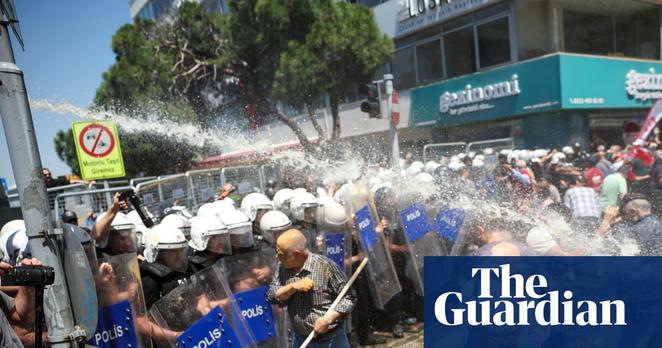
Turkish police fire teargas to break up protest after opposition leader ousted #Turkey #RecepTayyipErdoan #WorldNews #Europe
mastodon bot · 2 days ago
Olympische Spiele: Tschentscher wirbt für Ja beim Olympia-Referendum
die zeit · 2 days ago