Loading…
 Saturday, August 29Saturday, August 29
3 months · 11 summary articles
NATO leaders gather in Ankara as alliance faces historic test of unity amid U.S. pressure and rising European defense ambitions
NATO leaders convened in Ankara on Saturday for a two-day summit overshadowed by deep transatlantic tensions, as the alliance seeks to project unity despite sharp disagreements over defense spending and the future of U.S. commitments to Europe. The gathering comes at a “turbulent time” for European security, Swedish Prime Minister Ulf Kristersson said, with the war in Ukraine dominating the agenda and allied nations scrambling to fill gaps left by recent U.S. military cuts.
European NATO allies have largely replaced the assets Washington has withdrawn from contingency plans for a potential war in Europe, NATO’s Deputy Supreme Allied Commander Europe Sir John Stringer told Bloomberg Television . “European allies have definitely stepped up in terms of backfilling the adjustment in the U.S. forces in Europe,” Stringer said, calling it “a demonstration of a stronger Europe and a stronger NATO.” The reassurance follows U.S. Secretary of Defense Pete Hegseth’s June announcement of a six-month review of American forces in Europe, signaling further reductions may be imminent.
The summit’s draft declaration, finalized by NATO ambassadors on Friday, labels Russia a direct threat to Euro-Atlantic security and pledges €70 billion ($80 billion) in annual military aid to Ukraine for 2026 and 2027 . Kristersson emphasized the urgency of the moment, noting that European security “is currently spelled Ukraine.” Sweden’s defense spending has more than doubled since 2021, and the government now aims to reach a 5% of GDP target by 2030—far exceeding NATO’s 2% guideline.
Yet divisions within the alliance are widening. Lithuanian President Gitanas Nausėda warned that NATO risks fracturing into two or three camps if member states fail to align on defense spending, with some nations pushing toward 5% of GDP while others linger near the 2% threshold . “This would naturally lead to the division of the Alliance,” he said, adding that such a split would undermine the principle of collective defense. Poland’s shifting stance toward Ukraine and Lithuania’s concerns over U.S. pressure to increase spending have further exposed cracks.
French President Emmanuel Macron and Turkish counterpart Recep Tayyip Erdoğan are expected to hold a bilateral meeting on the sidelines, with Ankara positioning itself as a bridge between Europe and the U.S. Erdoğan has framed the summit as an opportunity to showcase Turkey’s growing defense industry, while Italy’s Giorgia Meloni discussed closer defense cooperation with the Turkish leader ahead of the talks . German Chancellor Friedrich Merz, meanwhile, assured President Donald Trump that Berlin is ready to take on greater responsibility for European security, as NATO increasingly shifts toward a more European-led model .
The summit’s focus on boosting Europe’s defense industrial capacity reflects a broader reckoning with the realities of modern warfare. After five years of Russia’s war in Ukraine, NATO’s assumptions about battlefield dominance have been upended by drone warfare, electronic attacks, and rapid industrial innovation. “Every stage of the war has challenged long-held assumptions,” wrote a commentator who has covered the conflict from both Ukrainian and NATO perspectives . “The future battlefield will look very different from the one NATO was trained for.”
As leaders depart Ankara, the alliance’s ability to maintain cohesion will hinge on balancing U.S. demands for burden-sharing with Europe’s fiscal constraints and divergent strategic priorities. With Trump’s unpredictable rhetoric continuing to unsettle allies, the summit’s success may be measured less by its declarations than by whether it can prevent further fragmentation in an already strained transatlantic relationship.
Follow us for live European news

South Korean president to attend NATO summit in Türkiye President Lee Jae Myung will attend the NATO summit in Ankara and deliver a keynote speech at the invitation of Secretary General Mark Rutte. He will also participate in a defence industry forum, marking South Koreas continued engagement with the alliance.
yenisafak · about 2 months ago
Swedish PM says NATO summit in Ankara comes at turbulent time Swedish Prime Minister Ulf Kristersson said NATOs upcoming summit in Ankara will convene during a "turbulent time" for European and global security, as allied leaders prepare to discuss boosting defense industrial capacity and maintaining long-term military assistance to Ukraine.
yenisafak · about 2 months ago
Bulgarian PM vows to defend national interest on EU Russia sanctions Bulgarian Prime Minister Rumen Radev said on Friday that Sofia will introduce reservations on the European Unions proposed 21st sanctions package against Russia, citing concerns over energy security and potential arbitration costs involving Russian oil major Lukoil.
yenisafak · about 2 months ago
Președintele Lituaniei avertizează că NATO s-ar putea diviza din cauza cheltuielilor pentru apărare: „Nu este deloc benefic Președintele Lituaniei, Gitanas Nauseda, a avertizat vineri că NATO riscă să se divizeze dacă unele state membre nu vor respecta obiectivul alianței de a aloca 5 din produsul intern brut pentru apărare, relatează Politico.
digi24 · about 2 months ago
Cabinet decides to extend Deputy Ministry for European Affairs through December 2026 to preserve expertise The Cabinet decided during its latest session to extend the operations of the Deputy Ministry for European Affairs until December 31, 2026. The decision has been forwarded to Parliament, accompanied by a letter requesting an urgent review of the matter due to pressing time constraints. The issue was reportedly discussed during a meeting of party […]
in-cyprus · about 2 months ago
Property issue can only be solved through sincerity The Greek Cypriot leadership continues efforts to instrumentalise the law for political purposes in matters relating to property, Turkish Cypriot leader Tufan Erhurman said on Saturday. The property issue is not only a problem for Greek Cypriots, but also for Turkish Cypriots – and the solution is through sincerity, he said. Erhurman said that the […]
cyprus mail · about 2 months ago
Erdoğan, Meloni discuss defense ties and NATO summit President Recep Tayyip Erdoğan and Italian Prime Minister Giorgia Meloni held a phone call to discuss bilateral relations and regional issues. Erdoğan said Ankara seeks closer cooperation with Italy, particularly in the defense industry, and expressed hope that next weeks NATO summit in Ankara will strengthen allied unity.
yenisafak · about 2 months ago
NATO structures fracture from within over budget disputes and Polish shift on Ukraine
gdeltproject.org · about 2 months ago

„Du kannst niemals den Trump-Faktor ausschalten – Die Nato setzt auf einen historischen Schritt Vor dem Nato-Gipfel in Ankara fürchten europäische Diplomaten die Launen des US-Präsidenten. Damit die unabhängiger von den USA wird, sind bereits konkete Schritte geplant. Vor allem auf Deutschland kommt eine Menge zu.
welt.de · about 2 months ago
Ankara tightens security, air traffic for NATO summit Türkiye has ramped up security in Ankara ahead of the July 7-8 NATO summit, deploying more than 56,000 police and gendarmerie personnel. Temporary flight restrictions will be in place at Esenboğa Airport, with exemptions for aircraft carrying foreign leaders and official delegations.
yenisafak · about 2 months ago
Turkish defense, aerospace exports top $11B for first time Türkiyes defense and aerospace exports surpassed $11 billion on a 12-month basis for the first time, with June exports rising 29.6 year-on-year to $802.8 million. The sectors first-half exports reached $4.67 billion, up 29.5 from the same period last year.
yenisafak · about 2 months ago
NATO leaders to gather in Ankara, aiming to smooth over tensions with Trump
gdeltproject.org · about 2 months ago
Lithuanian lawmaker says China open to normalising relations - The Baltic Times VILNIUS - China appears inclined to negotiate on normalising relations with Lithuania, the chairman of the Seimas foreign affairs committee said......
baltic times · about 2 months ago
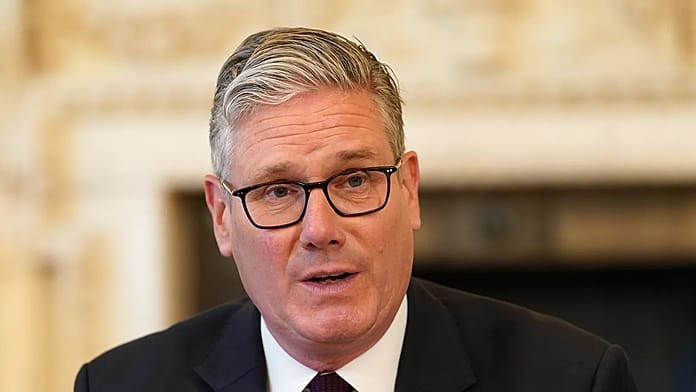
Keir Starmer calls decision to resign as British PM intensely personal Starmer also said the next prime minister would not be able to spend any less time focusing on diplomacy and international affairs, citing the impact of the wars in Ukraine and Iran on the cost of living.
euronews · about 2 months ago
Outgoing UK PM Starmer says successor cannot spend less time on foreign affairs Outgoing Prime Minister Keir Starmer said whoever succeeds him would have to devote as much time to international crises and diplomacy as he did, rejecting suggestions Britains next leader could focus more heavily on domestic issues. Starmer, who announced last month that he would step down after two years in office, said in a BBC […]
cyprus mail · about 2 months ago
Four US presidents steered European NATO into decline in furtherance of US proxy war against Russia.
gdeltproject.org · about 2 months ago
Europe has replaced most US cuts within NATO, top commander says
gdeltproject.org · about 2 months ago
BiHs Membership in NATO is a Common Interest of Bosnia and Herzegovina and the Alliance The Chairman of the Presidency of Bosnia and Herzegovina, Denis Bećirović, met with the new Commander of the NATO Headquarters in Sarajevo, Brigadier General James C. Fowler, when he stated that the full membership of BiH in the European Union and NATO are key strategic goals of the country, while Fowler said that NATO remains […] The post BiHs Membership in NATO is a Common Interest of Bosnia and Herzegovina and the Alliance appeared first on Sarajevo Times.
sarajevo times · about 2 months ago

Ukraine is showing NATO the future of warfare #Europa #Europe #NATO #OTAN
mastodon bot · about 2 months ago

The European Commission is overstepping its role on defense and foreign affairs, former EU top diplomat Josep Borrell has told POLITICO. The European External Action Service must take the lead on those issues, he said. 🔗 politico.eu/article/eu-f...
bluesky_Politico Europe · about 2 months ago
We do not accept partition as a solution The division of the island cannot be a solution to the Cyprus problem, Interior Minister Constantinos Ioannou said on Saturday, speaking at an event for the fallen and missing in Serres, Greece. Fifty-two years later, the Greek Cypriot community continues to experience the tragic consequences of the barbaric Turkish invasion. Fifty-two years later, the refugees […]
cyprus mail · about 2 months ago
Belarusian president calls for new stage in Myanmar ties Belarusian President Alexander Lukashenko called for launching a "new stage" in relations with Myanmar during talks with his counterpart Min Aung Hlaing in Naypyidaw, saying the well-being of their peoples would anchor bilateral cooperation and that the two countries should build ties serving as a regional example.
yenisafak · about 2 months ago
Erdogan, Trump share strong will to lift CAATSA sanctions: Fidan Turkish Foreign Minister Hakan Fidan said on Thursday that President Recep Tayyip Erdogan and US President Donald Trump share a "strong will" to lift sanctions imposed on Türkiye under the Countering Americas Adversaries Through Sanctions Act (CAATSA), adding that both governments are taking steps to resolve the issue.
yenisafak · about 2 months ago
Trump set to put NATO unity to the test at Türkiye summit
gdeltproject.org · about 2 months ago

Comment of the Embassy of #Russia in the Netherlands to Izvestia newspaper (3 July 2026) Military infrastructure deployment in the Netherlands in the interests of #Ukraine and #NATO • We note the ongoing modernisation of local air bases, military logistics facilities and transport network. • Capacities for hosting allied forces and conducting joint exercises are being expanded.
mastodon bot · about 2 months ago
Former NATO chief proudest of Sweden, Finland accession Former NATO Secretary General Jens Stoltenberg has told Anadolu that Sweden and Finlands entry into the alliance was the decision he is most proud of during his decade‑long tenure. He thanked President Erdoğan for his cooperation and said his main expectation for the Ankara summit is to demonstrate unity.
yenisafak · about 2 months ago
Belgian defense minister: NATO needs Türkiye, praises Turkish tech Belgian Defense Minister Theo Francken has told Anadolu that Türkiye is a very important ally and should be included in Europes defense programs. He praised Turkish technology, said Europe can learn a lot from Ankara, and stressed that unity is essential ahead of the NATO summit.
yenisafak · about 2 months ago
Danish FM stresses dialogue with China in Copenhagen talks Danish Foreign Minister Lars Lokke Rasmussen hosted his Chinese counterpart Wang Yi in Copenhagen on Thursday, stressing that dialogue with Beijing remains indispensable despite policy disagreements as the two diplomats discussed bilateral trade and the Russia-Ukraine war.
yenisafak · about 2 months ago
Germanys Merz rejects Trumps NATO burden-sharing criticism Chancellor Friedrich Merz has pushed back against President Trumps claims that Germany is not contributing enough to NATO defense. Merz said Germany is doubling its defense budget within four years and making its largest-ever military investment, insisting we have nothing to be ashamed of.
yenisafak · about 2 months ago
Namibia seeks deeper strategic partnership with Türkiye, says SWAPO youth leader In an interview with Yeni Şafak, Namibian MP and SWAPO Youth League Secretary Ephraim Nekongo emphasized the importance of strengthening Namibia–Türkiye relations, highlighting opportunities for cooperation in agriculture, infrastructure, youth development, and technology.
yenisafak · about 2 months ago