
Bayeux Tapestry arrives in London for first time in nearly a millennium
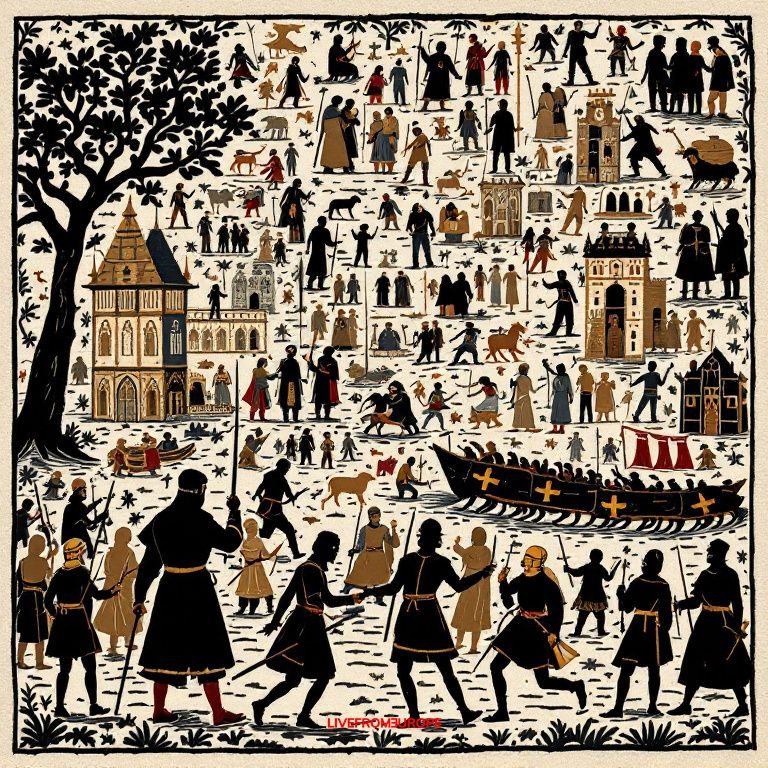
The Bayeux Tapestry has arrived in London for the first time in nearly a millennium, transported under heavy security from its home in Normandy to the British Museum, where it will go on public display from 10 September 2026 until 11 July 2027.
The 70-metre embroidered linen, woven in wool thread in the 11th century, depicts the Norman Conquest of England, culminating in the Battle of Hastings in 1066 when William, Duke of Normandy, defeated King Harold II. It left Bayeux late on Thursday in a custom-built, vibration-dampened aluminium crate designed to maintain constant temperature and humidity, then crossed the Channel via the Eurotunnel under armed escort. The container, roughly the size of a small car, was lowered from a lorry at the British Museum just after 02:50 on Friday, witnessed by museum director Nicholas Cullinan, French Ambassador to the UK, and other dignitaries. “It feels extraordinary that after so much work and planning and care and thought that it’s actually happening,” Cullinan said. “It’s the first time in 1,000 years that such an important piece of British – French too – history is going to be on these shores.”
The loan, agreed between French President Emmanuel Macron and UK Prime Minister Sir Keir Starmer last year, marks a rare diplomatic gesture of confidence and trust. The French government closed the Bayeux Museum in 2026 for renovations, making this the first public outing of the tapestry since it was last displayed in Bayeux in 1983. Transport preparations included multiple test runs using a full-scale replica to calibrate shock absorption and environmental controls. The British Treasury has underwritten an £800 million insurance policy in case of severe damage, underscoring the gravity of the operation. “The enormous insurance sum underlines only how seriously we take ensuring the work returns in good condition,” said British diplomat Peter Ricketts, who oversaw the UK side of the transfer.
Security was paramount throughout. Details of the journey were kept secret; the crate was moved in a climate-controlled truck with police escort, and the final leg into the museum’s loading bay occurred in the early hours. Cullinan described the public response as unprecedented: 100,000 tickets sold within hours of going on sale earlier this month. “It was like trying to get tickets to Glastonbury,” he said. “I don’t take for granted that people care that much about a 1,000-year-old embroidery. I think that’s an amazing thing.”
The tapestry, already fragile with 30 rips and nearly 10,000 holes, will be displayed in a purpose-built, flat vitrine designed to minimise stress on the fibres. Experts had warned of risks in a 2021 study, but Macron’s decision to lend the artefact was finalised a year ago. The exhibition’s curator, Millie Horton-Insch, said witnessing the crate’s arrival brought her to tears. “When you consider the object within it, how old it is, how close to the events it depicts it was made, by people who lived through those events, it’s really profound.”
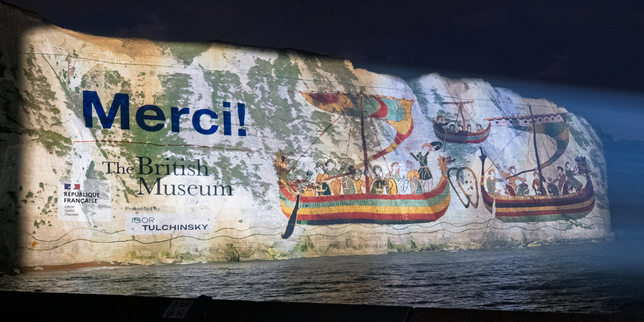
The loan is seen as a symbolic homecoming for a work that narrates a defining moment in both French and British history. Macron marked the occasion by projecting an image of the tapestry onto the white cliffs of Dover with the words “merci beaucoup.” The British Museum now prepares to unveil the tapestry to the public, offering a once-in-a-generation opportunity to view one of the most significant surviving artefacts of medieval Europe.
Follow us for live European news
- 3
- 2
- 2
- 1
- 1
2 further sources not geolocated
Articles

Teppich von Bayeux tritt Reise von Frankreich nach London an Der 68 Meter lange bestickte Teppich gehört zum UNESCO-Welterbe und erzählt die Geschichte von William dem Eroberer, der den Ärmelkanal überquerte und den englischen König Harold II. in der Schlacht von Hastings im Jahr 1066 besiegte.
die presse · about 3 hours ago
Bayeux Tapestry delivered to British Museum in dead of night The famous artefact depicting events leading up to the Norman Conquest of England will go on display in September.
bbc · about 3 hours ago

Meghan bringing Archie and Lilibet to UK on private trip
bluesky_The Times · about 3 hours ago

La tapisserie de Bayeux est arrivée au British Museum à Londres pour un prêt historique : "Cest un moment unique" Près de mille ans après les événements quelle raconte, la célèbre broderie médiévale sapprête à soffrir un nouveau public outre-Manche. ...
la libre · about 3 hours ago

The medieval Bayeux Tapestry began a hugely complicated journey on Thursday that will see it leave France for the first time in more than 900 years for an exhibition in the British capital. u.afp.com/SKEr
bluesky_AFP English · about 3 hours ago
Finanzplatz London: Bankentürme sind wieder „in – Canary Wharf feiert ein Comeback Das Finanzzentrum im Osten Londons war nach der Pandemie abgeschrieben. Jetzt boomt das Finanzgeschäft und die Banker kehren zurück.
handelsblatt · about 3 hours ago
Bayeux Tapestry arrives safely in UK after nearly 1,000 years The medieval Bayeux Tapestry arrived in London after almost 1,000 years early on Friday. The tapestry is on loan from France for a year and will be exhibited at the British Museum. Its journey has been surrounded by secrecy due to security concerns.
france24 · about 3 hours ago

The masterpieces dazzle in Buckingham Palaces glorious Picture Gallery
bluesky_The Times · about 4 hours ago
British Museum director on Bayeux Tapestry loan: A gesture of confidence, friendship and, above all, trust France has just delivered the Bayeux Tapestry to the United Kingdom, where it will remain on display until 2027. The unprecedented gesture crowns 1,000 years of shared history, writes Nicholas Cullinan, director of the British Museum.
le monde · about 4 hours ago

A guide to second-hand shopping in London — by our expert stylist
bluesky_The Times · about 4 hours ago
Look de touristes à Paris : «Mon chapeau et tout ce que je porte viennent de marques chinoises à lexception de mon bijou» Visiter Paris demande davoir un bon look pour crapahuter. Dans le cinquième épisode de notre série, Silvia, de Shanghai, sillonne Paris avec son ombrelle et ses lunettes noires.
liberation · about 5 hours ago
Teppich von Bayeux trat Reise nach London an
orf.at · about 5 hours ago
Luxury square that shows Londons mansions are not selling In Knightsbridges Montpelier Square, property prices have tumbled from a decade ago as foreign buyers look elsewhere
financial times · about 5 hours ago

A luxury guide to the perfect mens capsule wardrobe
bluesky_The Times · about 7 hours ago