 Thursday, May 21Thursday, May 21
The US naval blockade of Iranian ports, particularly in the Strait of Hormuz, has severely disrupted Iran’s oil exports, contributing to soaring inflation—now exceeding 50%—and widespread economic distress. The blockade, part of *Operation Economic Fury*, has led to mass job losses and a deepening crisis in Iran, despite a fragile ceasefire pausing direct military conflict .
The closure of the Strait of Hormuz has forced a rerouting of global oil supplies, with Syria emerging as an alternative energy corridor. Hundreds of Iraqi oil trucks are transporting crude overland to Europe via Syria, bypassing the blocked strait .
The geopolitical fallout from the Hormuz blockade and broader Middle East tensions has accelerated global shifts away from oil and gas. Investors are increasingly funding clean energy projects, driven by concerns over energy security rather than just climate change. This transition is seen as an unintended consequence of US actions, potentially benefiting China, a leader in renewable energy manufacturing .
The EU has invoked its mutual defense clause (Article 42.7) in response to energy shortages, citing the convergence of the Iran conflict, the Russia-Ukraine war, and LNG sanctions. Energy rationing is already underway in parts of Asia, with June 2026 projected as a critical crisis point . European sentiment toward the US has soured due to its role in escalating tensions, including the Hormuz blockade, which has further destabilized global energy markets .
#### more lfe-news on this topic
Trump may not be a fan of clean energy but Iran war is accelerating global shift from oil and gas | Heather Stewart Unintended consequence of US presidents actions will be boon for China, the leading renewables manufacturerOperation Epic Fury has thus far achieved none of Donald Trumps war aims, but it may well accelerate the global transition towards the clean energy he loves to hate.Last week brought the latest exchange of verbal blows in the standoff over the strait of Hormuz. Iran is choking like a stuffed pig on the oil it is unable to export because of the US blockade, Trump claimed. Continue reading...
theguardian · 18 days ago

Cubas economy collapses, prices soar Many Cubans who lived through the Special Period of the 1990s, when Soviet support collapsed, say the current crisis is even worse. Cuba is facing a deep economic and energy emergency, with daily life becoming increasingly difficult across the island. Because Cuba imports up to 80 of the food it consumes, essential goods are becoming harder and harder to find. Gabrielle Nadler reports.
france24 · 18 days ago
Inflation surging past 50 in Iran The fragile ceasefire may have paused the fighting, but the economic fallout in Iran continues. A US naval blockade of Iranian ports has sharply reduced the Irans oil exports, while the cost of everyday goods has continued to rise. Across the country, people are now bracing for further price increases and growing job losses. Liza Kaminov reports.
france24 · 18 days ago
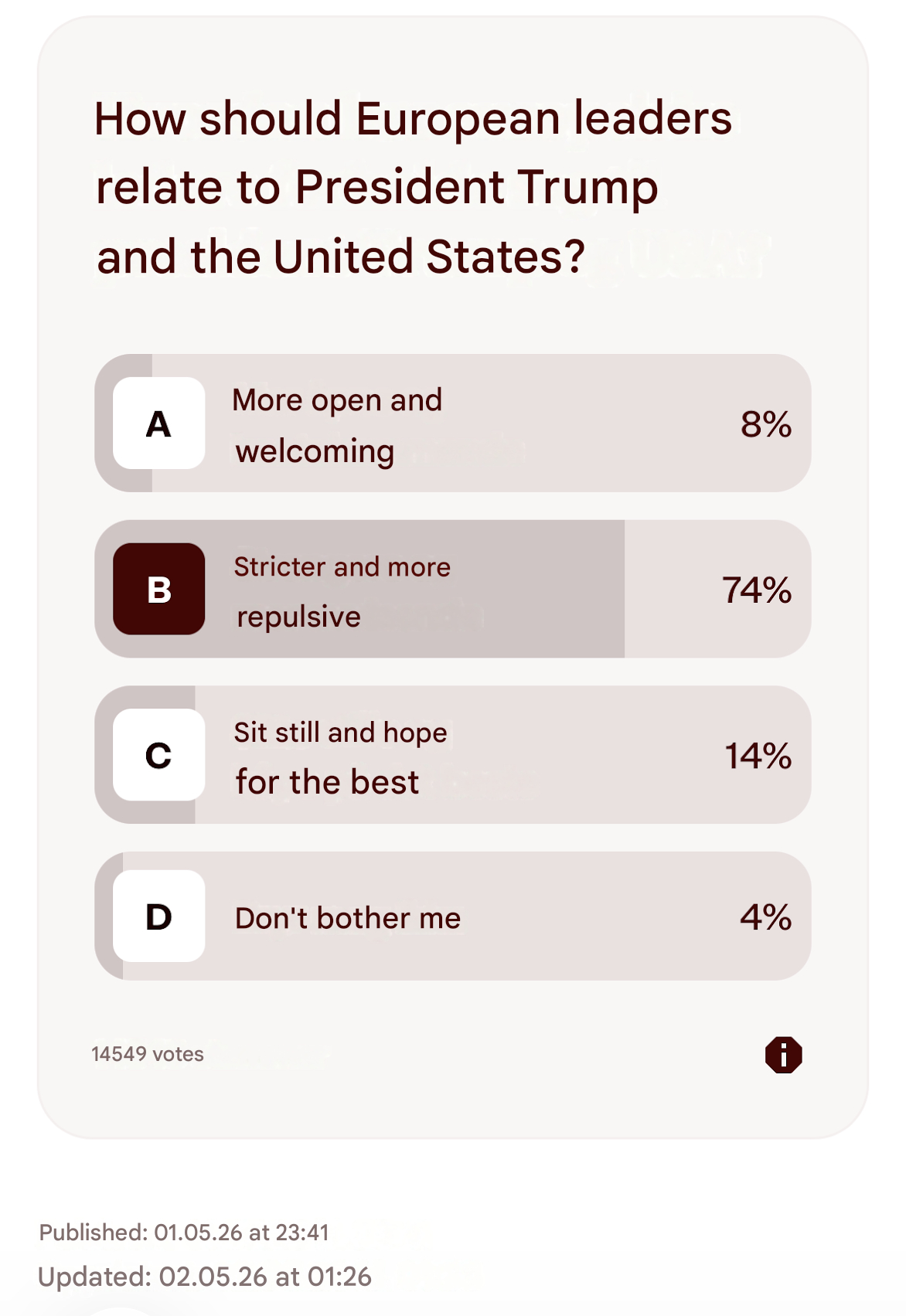
Heres👇 a screenshot of the mood in #Europe towards the Trump admin, after they changed sides in the #Ukraine war, threatened partners with war, and closed the Strait of Hormuz. Russias decade long strategy to divide Europe and the #US is being implemented by the US itself. At record speed.
mastodon bot · 18 days ago
Millions of jobs lost as Iranians battle Operation Economic Fury A fragile ceasefire may have paused the US-Israeli war on Iran, but the economic cost is crippling life in Tehran.
aljazeera · 18 days ago
Investors pile into clean energy as Iran war drives push for energy security Renewables funds attract biggest flows for five years, as focus shifts from climate change to geopolitical crisis
financial times · 18 days ago
Why Russias Northern Sea Route remains a risky bet for global shipping Russia wants its Northern Sea Route to become an important artery of global trade. However, the arctic shortcut between Europe and Asia is fraught with both political and environmental hurdles.
deutsche welle europe · 18 days ago

⚡ NEWSSyria Emerges as Alternative Oil Corridor Amid Hormuz BlockadeSyria is serving as an alternative energy corridor for oil, receiving hundreds of Iraqi oil trucks hauling crude overland to Europe. This shift occurs as the Strait of Hormuz is effectively blocked, forcing a rerouting of...📰 #Shipping #EU #Geopolitics #GeoWire
mastodon bot · 18 days ago
Syria becomes alternative energy corridor for oil as Hormuz effectively blo Syria is receiving hundreds of Iraqi oil trucks hauling crude overland as an alternative energy corridor to Europe.
aljazeera · 18 days ago

⚡The #EU 🇪🇺 is preparing new sanctions against individuals responsible for the illegal deportation of #Ukrainian 🇺🇦 children. In the draft, the #EU 🇪🇺 describes Moscows actions as serious violations of international law and a violation of the fundamental rights of the child with the aim of destroying #Ukrainian 🇺🇦 identity. This move highlights ongoing efforts to address breaches of international norms. Follow for verified updates
mastodon bot · 18 days ago
Opinion: The future of the China-US-Russia triangle after Pelosis visit to Taiwan Since February 24, 2022, the international communitys focus was concentrated entirely on the war in Ukraine and the growing Russia – West confrontation. It seemed that nothing could change the situation until the end of hostilities in Ukraine. However, on August 2 and 3, almost everyones attention shifted from Ukraine to Taiwan. As the Speaker of the US House of Representatives, Nancy Pelosi, stated her intention to visit Taiwan, up to half a million people were watching the trajectory of her plane on air flight tracking sites. The negative reaction of China, including the warning of President Xi during his conversation with President Biden that those who played with fire would be perished by it, created hype around this visit. Many were discussing the possibility of Chinese military jets closing the airspace over Taiwan and preventing Pelosis plane from landing in Taiwan, while some enthusiasts were even contemplating the possibility of a US-China direct military clash. As Pelosi landed in Taiwan and met with the Taiwanese President, the global social media was full of amateur assessments about the strategic victory of the US and the confirmation of the US global hegemony. However, as the dust settles down, and information noise and manipulation eventually decreases, a more serious assessment is needed to understand the real consequences of this visit.
commonspace · 18 days ago

The EU just invoked its mutual defense clause—Article 42.7—over an energy shortage. Thats how seriously governments are treating the convergence of the Iran conflict, Russia-Ukraine war, and LNG sanctions. Energy rationing is already underway in parts of Asia. June 2026 is the projected crisis point. #Geopolitics #SupplyChain #EU
mastodon bot · 18 days ago