 Saturday, June 20Saturday, June 20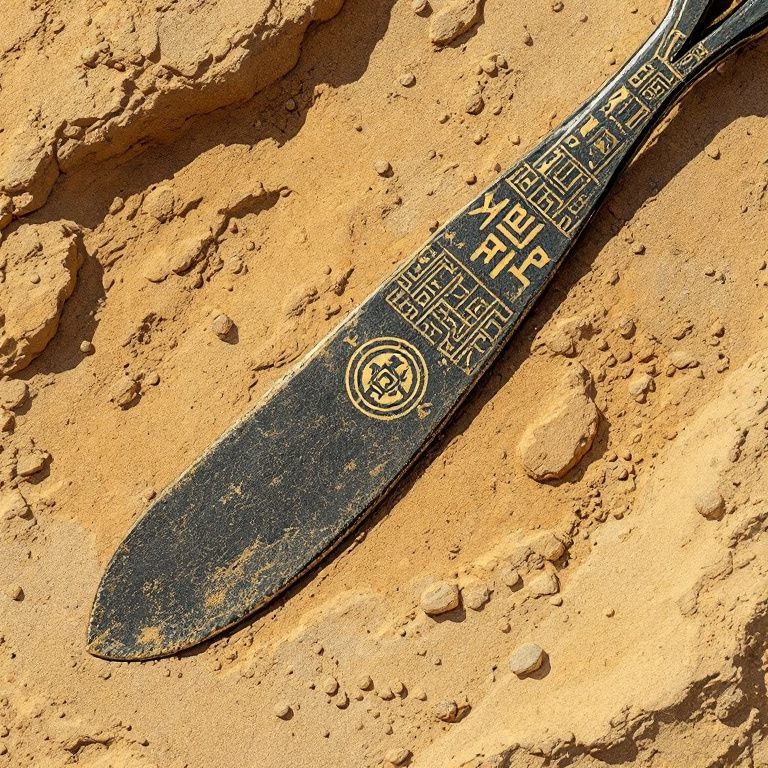
A 2,400-year-old bronze utensil unearthed in southern Italy has left archaeologists struggling to explain its purpose, origin, and the advanced metallurgical techniques that produced it. The artefact, discovered on 15 June 2026 during excavations at the ancient Greek settlement of Metapontum, features intricate geometric engravings and a handle shaped like a stylised animal head. Radiocarbon analysis conducted by the University of Bari places the object between 450 and 350 BCE, a period when the region was a thriving Magna Graecia colony.
The utensil’s design defies conventional classification. Measuring 18.7 centimetres in length and weighing 420 grams, it bears no resemblance to known Greek, Roman, or indigenous Italic tools. “We have compared it with every known bronze implement from the Mediterranean basin,” said Professor Elena Rossi, lead archaeologist at the site. “Nothing matches its form or craftsmanship.” The artefact’s surface shows signs of deliberate patination, suggesting it may have been ritually buried or deposited as an offering.
Metallurgical tests conducted at the National Research Council’s laboratory in Rome revealed an unusually high tin content—18%—which would have made the bronze exceptionally hard yet brittle. “This composition is atypical for the period,” noted Dr Marco Bianchi, a specialist in ancient metallurgy. “It implies either a lost alloying technique or the recycling of imported metal.” The utensil’s hollow interior, revealed through 3D scanning, contains traces of organic residue, possibly food or medicinal substances, though further analysis is pending.
The discovery has reignited debate over the technological exchange between Magna Graecia and non-European cultures. Some scholars speculate a connection to the Etruscans or even Carthaginian traders, though no direct evidence supports such links. “The engravings resemble motifs found in Scythian art,” observed Dr Lucia Moretti, an art historian at the University of Naples. “But the object’s function remains entirely speculative.”
Local authorities have temporarily halted excavations to allow for a full forensic review, with results expected by August 2026. Meanwhile, the utensil has been transferred to the National Archaeological Museum in Taranto for safekeeping. “This find challenges our understanding of ancient craftsmanship,” said Superintendent Dr Antonio Ferrara. “It may force us to rewrite parts of Mediterranean prehistory.”

Heritage dish has history in edible utensils Mexican tacos are among the most enduring expressions of the countrys culinary heritage, with origins tracing back to pre-Hispanic Mesoamerica, where corn tortillas formed a staple of indigenous diets long before the arrival of Europeans. Archaeological evidence and historical accounts suggest that early forms of tacos were used as edible utensils, with soft tortillas wrapping […]
cyprus mail · about 2 hours ago
5 Mysteries From the Ancient World That Remain Unexplained Certain mysteries from the ancient world remain largely unexplained today and continue to puzzle scientists and researchers. For instance, circular megalithic constructions have appeared in Europe, Asia, and South America at various times during an era when there were no means of long-distance travel, let alone crossing entire oceans. Unable to scientifically explain the origins […]
greek reporter · about 2 hours ago
The Kritios Boy, a Masterpiece of Ancient Greek Art The Kritios Boy, a statue displayed at the Acropolis Museum is one of the most important works of ancient Greek art and the most characteristic of the so-called Severe Style. The statues torso was found in 1865 to 1866 southeast of the Parthenon,while the head was found in 1888 near the south walls of the […]
greek reporter · about 2 hours ago

A gem found in a Mars meteorite has scientists puzzled
news.yahoo.com · about 2 hours ago
In Nepals highlands, climate change threatens Tibets Bon faith In Lubra, Nepals last Bon village, climate-driven floods are destroying homes and land, endangering ancient traditions.
aljazeera · about 2 hours ago
O piramidă veche de peste 1.000 de ani s-a prăbușit în Mexic. Explicația specialiștilor O parte dintr-o piramidă antică din Mexic, veche de peste un mileniu, s-a prăbușit după o perioadă marcată de secetă severă și fenomene meteorologice extreme.
adevarul · about 2 hours ago