 Thursday, May 28Thursday, May 28
Researcher reconstructs the exact sound of ancient Greek music after 2,000 years of silence.
Dan C. Baciu of Münster University of Applied Sciences has decoded the tuning and intonation of 61 surviving ancient Greek and Roman compositions, revealing how music accompanied ceremonies, plays, and feasts in classical Athens. Using advanced acoustic analysis, Baciu’s work offers the first scientifically grounded recreation of the melodies that once filled the Odeon of Herodes Atticus and the Theatre of Dionysus, according to a study published this week .
The findings challenge long-held assumptions about ancient Greek scales, demonstrating a more complex system of microtonal intervals than previously believed. Baciu’s team collaborated with archaeologists to match musical fragments with surviving instruments, including the *aulos* (a double-reed pipe) and the *kithara* (a lyre-like string instrument). "This isn’t just about notes—it’s about the emotional weight of a culture that saw music as inseparable from philosophy, politics, and religion," Baciu said in an interview with *Greek Reporter*.
Meanwhile, UNESCO has urged the UK and Greece to accelerate negotiations over the Parthenon Marbles, calling the reunification of the 2,500-year-old sculptures a "moral and cultural imperative." In a decision issued on May 22, the Intergovernmental Committee emphasized the need for "concrete steps" toward returning the contested artifacts to Athens, where they would be displayed in the Acropolis Museum alongside the surviving sections of the Parthenon frieze . The move follows years of stalled talks, though Greek officials have signaled renewed optimism after recent diplomatic engagements with London.
In Athens, the Swiss government has strengthened cultural ties with Greece by opening a new embassy that doubles as a hub for archaeology and research. The "Swiss House" in Athens unites the Swiss School of Archaeology—known for its excavations at Eretria and Delphi—with diplomatic and cultural initiatives under one roof. Foreign Minister Ignazio Cassis, who inaugurated the facility on Friday, described it as "a bridge between two nations that share a deep respect for antiquity" . The project reflects Switzerland’s growing role in preserving Mediterranean heritage, including joint efforts to digitize ancient Greek manuscripts.
Elsewhere, new research into ancient Greek sculptures has upended the popular image of pristine white marble. A study published in *Greek Reporter* reveals that many statues were originally painted in vivid colors, with eyes inlaid with glass or stone to create a "piercing gaze" that conveyed divine presence or emotional intensity . Archaeologists at the Acropolis Museum have used ultraviolet light to detect traces of pigment on the Parthenon’s metopes, suggesting that the temple’s friezes were once a riot of blues, reds, and golds.
As Athens prepares to host Iron Maiden’s *Run For Your Lives* concert at the Olympic Stadium tonight, the city’s ancient and modern identities collide. The band’s setlist includes *Flight of Icarus*, a nod to Greek mythology, while their stage design incorporates motifs from the Parthenon—a choice that has drawn both praise and criticism from purists . The event underscores Greece’s ongoing struggle to balance tourism, cultural preservation, and contemporary expression.
Looking ahead, the Greek government is expected to announce a new initiative to protect underwater archaeological sites, including shipwrecks from the Battle of Salamis (480 BCE). The plan, set to be unveiled next month, will expand marine surveys in the Saronic Gulf, where sonar scans have already identified dozens of ancient vessels. "These wrecks are time capsules of Athenian naval power," said a spokesperson for the Ministry of Culture. "Their preservation is as critical as that of the Acropolis itself."

Great organ restored at Saint Peters Cathedral in Geneva Visitors will be able to attend the inauguration of the restored Metzler organ at St Peters Cathedral to mark the 490th anniversary of the Reformation in Geneva. +Get the most important news from Switzerland in your inbox Two concerts are scheduled for May 29 and May 31, said the Protestant Church of Geneva. Another will follow a week later. As part of the Church Assembly, a Black Church show will take place on May 30. A discussion will accompany the songs. + The organ that went back to the future The following day, a theatrical adaptation of the book The Walking Man will explore the relationship between movement and immobility. + Calvin auditorium appeals for organ donations Adapted from French by AI/ts How we work We select the most relevant news for an international audience and use automatic translation tools to translate them into English. A journalist then reviews the translation for clarity and accuracy before publication. Providing you with automatically translated news ...
swissinfo · 5 days ago
Study Reconstructs Sound of Ancient Greek Music with Exact Tuning and Intonation More than two thousand years after ancient Greek and Roman music, a researcher has taken a major step toward revealing their exact tuning and intonation during ceremonies, plays, and feasts of the classical world. Dan C. Baciu of Münster University of Applied Sciences has analyzed 61 surviving pieces to reconstruct how these compositions likely sounded. […]
greek reporter · 5 days ago
Foreign minister opens new Swiss embassy in Athens Swiss Foreign Minister Ignazio Cassis has inaugurated the new Swiss embassy in Athens. It is designed as a Swiss House for Culture, Research and Diplomacy and brings together the embassy, the Swiss School of Archaeology and a cultural foundation under one roof. +Get the most important news from Switzerland in your inbox This is the first time that diplomacy, culture and science have come together in a vibrant space, Cassis tweeted. Cassis also held talks with Greek Foreign Minister Giórgos Gerapetrítis in Athens on Friday, said foreign ministry spokesman Nicolas Bideau. The two counterparts discussed bilateral relations, economic, scientific and cultural cooperation and the Swiss-Greek cooperation programme as part of Switzerlands second contribution to European cohesion. + Swiss court: refugee families must return to Greece Cassis also met Greek Defence Minister Nikos Dendias to discuss regional security issues. This took place within the framework of the Organisation for ...
swissinfo · 5 days ago
The Lost Gold Treasure of Ali Pasha Still Haunts Greece For more than a century, stories of a hidden fortune buried somewhere in the mountains of Greece have captivated treasure hunters, historians, and adventurers alike. At the center of the mystery is Ali Pasha of Ioannina, the powerful Ottoman ruler whose rumored hoard of gold and jewels continues to fuel excavations, legends, and speculation across […]
greek reporter · 5 days ago
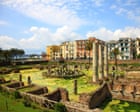
The train is my time machine: a tour of Naples hidden ancient wonders A new film about this corner of southern Italy reveals rarely visited villas, seismic landscapes and a civilisation buried mid-sentence – all accessible by trainOne by one, the visitors descend through a tight tunnel cut through volcanic rock into the damp foundations of the Teatro Romano buried beneath Herculaneum, with the weight of 2,000 years of city above them. This is a time machine, the guide says, and we are going back. It is pitch black as film-maker Gianfranco Rosis camera finds torchlight catching the tourists transparent waterproof capes, making them appear like ghosts.Released on the streaming platform Mubi this March, Rosis documentary Pompei: Below the Clouds threads a needle from classical antiquity to the present day. Presented in ashen black and white, without narration or interviews, it places the viewer inside the region surrounding Naples and leaves us there, each scene presenting a place and a moment in the areas long history. Continue reading...
theguardian · 6 days ago
UNESCO Calls on UK and Greece to Intensify Parthenon Marbles Talks The Intergovernmental Committee of UNESCO has issued a formal call to intensify efforts for the reunification of the Parthenon Marbles. Concluding its session on Friday (May 22, 2026), the committees decision marks a highly positive development for Athens long-standing diplomatic goals. The permanent return and reunification of the Parthenon Sculptures has been on UNESCOs agenda […]
greek reporter · 6 days ago
Iron Maiden Return to Athens for Massive Run For Your Lives Concert Legendary British heavy metal band Iron Maiden are set to return to Athens this Saturday, May 23, as part of their Run For Your Lives World Tour, bringing one of the most anticipated rock events of the year to the Olympic Stadium (OAKA). The concert marks the bands latest appearance in Greece during their global […]
greek reporter · 6 days ago
The Piercing Gaze of Ancient Greek Sculptures There is that image many of us have in our mind of Greek sculptures—noble looking with gleaming white marble and perhaps a bit of an emptiness about the eyes. However, that might be at least slightly inaccurate. In thinking about these works of art, what we actually need to envision is something different. Imagine wandering […]
greek reporter · 6 days ago
Why Ancient Greeks Thought Dolphins Were Sacred They have been around for millions of years, roaming the powerful seas and yet it wasnt until the first seafarers started sailing that the first myths about these divine creatures started to emerge. Without a doubt, dolphins held an irresistible charm for people in ancient Greece, one of the worlds first and greatest seafaring nations. […]
greek reporter · 6 days ago
Scientists Finally Solve Why Gold Never Rusts Scientists have known for centuries that gold does not rust the way iron and other common metals do, but the exact cause has been debated for just as long. A study published in Physical Review Letters by two researchers at Tulane University now points to a specific atomic process as the primary explanation. Santu Biswas, […]
greek reporter · 6 days ago
Ancient DNA Reveals a Hidden Migration Network Across Peru Before the Inca Ancient DNA extracted from human remains in Peru shows that long-distance migration along the Pacific coast began centuries before the Inca Empire expanded into the region. A study published in Nature Communications traces this movement to at least the 13th century, offering new insight into how coastal communities formed and connected long before any imperial […]
greek reporter · 6 days ago
Zeibekiko Dance Dispute Reignites Cultural Debate Between Greece and Turkey A newspaper has triggered a new cultural dispute between Greece and Turkey after claiming that Greeks are attempting to appropriate the zeibekiko (Greek: Ζεϊμπέκικο), a dance that Turkish media says has roots in Anatolia. The Istanbul-based newspaper placed the issue on its front page, asking whether the zeibekiko should be considered a Greek or Turkish […]
greek reporter · 6 days ago