
NATO summit in Ankara ends with praise for Turkey's leadership amid U.S. tensions
Story Timeline
3 months · 3 summary articles
NATO summit in Ankara avoids major conflict but leaves tensions over defense spending and Ukraine aid unresolved
NATO summit in Ankara ends with praise for Turkey's leadership amid U.S. tensions
Turkish-hosted NATO summit convenes as Erdoan asserts regional leadership amid rising tensions
Follow-up
The 36th NATO Heads of State and Government Summit in Ankara concluded on Wednesday with global media hailing Türkiye’s rising strategic importance, even as deep divisions over defense spending and U.S. leadership cast a shadow over the alliance’s future. International outlets from *The New York Times* to *Politico* and European broadsheets framed President Recep Tayyip Erdoğan as the summit’s clear winner, crediting his diplomatic acumen and Türkiye’s expanding defense sector for securing high-profile commitments, including a potential thaw in F-35 sales and U.S. support for lifting CAATSA sanctions.
U.S. President Donald Trump’s attendance—described by *Politico* as the primary reason for his presence—underscored Ankara’s diplomatic weight, with the American leader praising Erdoğan’s leadership and calling their relationship “probably better than ever.” German media, including *Die Welt* and *Süddeutsche Zeitung*, echoed this sentiment, declaring Türkiye an “indispensable regional power” and questioning whether it had become a “new power factor” in Euro-Atlantic security.
Yet beneath the summit’s outward unity, tensions simmered. Trump’s disruptive rhetoric—threatening to cut trade with Spain over defense spending and reviving demands to seize Greenland from NATO member Denmark—raised alarms about the alliance’s cohesion. While NATO Secretary-General Mark Rutte and European leaders sought to project a united front, Rutte acknowledged the U.S. as the alliance’s dominant actor, noting that America alone accounts for half of NATO’s economy and military power.
The summit’s outcomes reflected this duality. NATO reaffirmed its “ironclad commitment” to collective defense under Article 5, but the alliance’s future strategic direction remains uncertain amid shifting U.S. priorities and European efforts to fill the gap left by Washington’s increasingly transactional approach. Defense Minister Yaşar Güler emphasized Türkiye’s role in showcasing advanced defense cooperation, including a forum to enhance industrial collaboration among allies.
European leaders, while relieved by Trump’s softened tone—including his pledge to support Ukraine’s licensed production of Patriot missile interceptors—warned of deeper structural fissures. Former Pentagon official Jim Townsend cautioned that Trump’s volatility risks undermining NATO’s deterrence credibility, telling *Reuters*: “Even if Trump is kind, the damage is already done.”
Türkiye’s diplomatic triumph extended beyond defense. Presidential Communications Director Burhanettin Duran hailed the summit as proof of Ankara’s “active leadership” in strengthening transatlantic bonds, while German Chancellor Friedrich Merz declared the gathering the “dawn of a new, more European NATO,” acknowledging Trump’s criticism of European underinvestment.
Yet political obstacles persist. Serhat Süha Çubukçuoğlu of TRENDS Research noted that Türkiye’s defense sector gains are tempered by EU-related vetoes, such as its exclusion from the SAFE program despite NATO membership. Meanwhile, European media debated whether the summit’s unity was a fleeting illusion, with *La Repubblica* quoting Kremlin spokesman Dmitry Peskov as cautiously welcoming Trump’s diplomatic overtures while warning of “erroneous assessments” on long-range missiles.
As NATO leaders depart Ankara, the alliance faces a paradox: a summit hailed as a success for Türkiye’s leadership and transatlantic unity, yet one that exposed the fragility of a 32-member bloc increasingly divided over burden-sharing, strategic priorities, and the very future of U.S. engagement.
Follow us for live European news
Articles

NATO Ankara summit highlights Türkiyes peace role: Communications chief Presidential Communications Director Burhanettin Duran said the NATO Ankara Summit demonstrated Ankaras active leadership in strengthening international security and the transatlantic bond through intensive high-level diplomatic engagements with Western allies.
yenisafak · 3 months ago
NATO a trecut cu bine la Ankara peste o nouă „furtună Trump, dar urmează alta: Revizuirea prezenţei trupelor americane în Europa NATO a trecut cu bine peste o nouă furtună provocată de Donald Trump, dar membrii europeni ai alianţei militare se pregătesc pentru şi mai multe turbulenţe în relaţiile cu preşedintele SUA. Faptul că un summit NATO, care a început cu un lider american ordonând întreruperea relaţiilor comerciale cu un stat membru, Spania, şi mustrând alte ţări, a fost salutat pe scară largă ca un succes după ce, câteva ore mai târziu, acesta şi-a reafirmat angajamentul faţă de alianţă, spune multe despre starea relaţiilor dintre SUA şi Europa, comentează Reuters.
digi24 · 3 months ago
Merz says Ankara summit marks dawn of new, more European NATO German Chancellor Friedrich Merz on Wednesday praised the Ankara summit as the dawn of a new era for NATO in which European nations assume greater responsibility for their own defense, acknowledging that US President Donald Trump was right to criticize years of European underinvestment.
yenisafak · 3 months ago
Erdogan hosts Syrias Sharaa at NATO summit in Ankara Turkish President Recep Tayyip Erdogan and Syrian President Ahmad al-Sharaa discussed strengthening bilateral ties and regional stability during a closed-door meeting in Ankara on Wednesday, with the summit taking place as Ankara hosts NATO leaders for a two-day gathering focused on defense and security.
yenisafak · 3 months ago
Turkish FM: NATO Ankara summit concluded successfully Foreign Minister Hakan Fidan declared the NATO summit in Ankara a success, noting that all allies attended at the leaders level as a sign of confidence in Türkiye and President Erdoğan. He said the summit laid the foundations for a stronger Europe within a stronger NATO under the NATO 3.0 vision.
yenisafak · 3 months ago
Ankara Summit: Türkiyes strategic weight in NATOs transformation The NATO Ankara Summit takes place at a critical juncture where, beyond Türkiyes hosting, it will play a key role in determining how the Alliance will shape its future in the face of the challenges of the new era. Taking place in a context where the restructuring of the transatlantic alliance is being debated under intense American pressure, the summit constitutes a turning point that will determine the strategic orientations of allies in the new period. Earlier this year, while it was being discussed
yenisafak · 3 months ago
Trump lauds Erdogan as great leader, hails Ankara summit US President Donald Trump praised Turkish President Recep Tayyip Erdogan as a "great leader" and long-time friend on Wednesday as the two-day NATO summit concluded in Ankara, saying the alliance demonstrated "tremendous unity" while urging members to accelerate plans to meet the 5 GDP defense spending benchmark.
yenisafak · 3 months ago
US senators say Türkiyes return to F-35 program would benefit NATOs defense capacity US senators have stated that Türkiyes potential return to the F-35 fighter jet program would be a positive step for both Ankara and Washington. Senator Jeanne Shaheen said Türkiyes defense industry infrastructure is widely recognised in Congress for its contributions to NATO, though concerns over the S‑400 system remain.
yenisafak · 3 months ago
Russia says NATO focused on confrontation after Ankara summit Russian Foreign Ministry spokeswoman Maria Zakharova said the alliances July 7-8 gathering in Türkiyes capital failed to live up to Secretary General Mark Ruttes historic billing, warning that NATOs confrontational stance and massive military spending risk catastrophe for the world.
yenisafak · 3 months ago
Trump says NATO came a long way at Ankara summit President Donald Trump declared that NATO came a long way at the Ankara summit, adding that the alliance made some concessions. He also said the US made a lot of good trade deals with Türkiye, calling it a very good partner.
yenisafak · 3 months ago
Trumps return flight from Ankara sparks curiosity with aircraft switch President Donald Trump arrived in Ankara for the NATO summit aboard a new Air Force One gifted by Qatar. However, he departed Türkiye on an older presidential aircraft, switching back to the new plane at an RAF base in the UK to allow US personnel to inspect it.
yenisafak · 3 months ago
Eight Contradictions Behind NATOs Summit of Love
gdeltproject.org · 3 months ago
Week Ender: Why Europe cant avoid Erdogan This week, NATO leaders gathered in Ankara — giving President Recep Tayyip Erdoğan a powerful stage at a moment when Turkeys strategic value to Europe is rising. Sarah Wheaton speaks to Aslı Aydıntaşbaş, a visiting fellow at the Brookings Institution, about Erdoğans moment at this weeks NATO summit, Turkeys complicated relationship with Europe and the United […]
politico.eu · 3 months ago
Global media hails Türkiyes strategic rise at Ankara NATO summit International outlets highlighted Türkiyes growing strategic importance at the 36th NATO summit in Ankara, citing its defense industry, second‑largest army, and President Erdoğans diplomatic role. The New York Times, Politico and European media underscored President Trumps praise for Erdoğan, his pledge on F‑35 sales, and Europes reliance on Türkiye for security architecture.
yenisafak · 3 months ago
Erdogan hosts Montenegro PM Spajic for talks in Ankara President Recep Tayyip Erdoğan on Thursday received Montenegrin Prime Minister Milojko Spajic at the Presidential Complex in Ankara, where the Balkan leader had attended the 36th NATO Summit that concluded the previous day.
yenisafak · 3 months ago
Erdoğan receives Albanian PM Rama ahead of NATO summit President Recep Tayyip Erdoğan received Albanian Prime Minister Edi Rama at the Presidential Complex in Ankara on Thursday for extensive talks on bilateral relations and regional cooperation, as the Western Balkan leader attended the 36th NATO Heads of State and Government Summit hosted by Türkiye.
yenisafak · 3 months ago
Michelin-starred chef serves Turkish cuisine at NATO gala Two-Michelin-starred chef Fatih Tutak curated the official gala dinner for the 36th NATO Heads of State and Government Summit, serving regional Anatolian dishes to leaders including US President Donald Trump and French President Emmanuel Macron.
yenisafak · 3 months ago
Türkiyes Erdoğan meets Slovak president on NATO summit sidelines President Recep Tayyip Erdoğan met with Slovak President Peter Pellegrini on Thursday on the sidelines of the NATO summit in Ankara to discuss bilateral trade goals and regional security challenges, with both leaders emphasizing the need to strengthen cooperation in transport and energy sectors while coordinating European defense capabilities.
yenisafak · 3 months ago
Kremlin says Putin open to dialogue with Trump despite no call Kremlin spokesman Dmitry Peskov said on Thursday that Russian President Vladimir Putin remains open to contact with US President Donald Trump despite no telephone call taking place following the NATO summit in Ankara, while warning that escalating tensions would not contribute to peace efforts.
yenisafak · 3 months ago
Erdoğan hails successful NATO summit in Ankara President Recep Tayyip Erdoğan announced the successful conclusion of the 36th NATO Heads of State and Government Summit in Ankara, thanking participants and organizers. The event brought together leaders from 32 member states and nearly 100 ministers, with more than 2,500 journalists covering the summit—a record media turnout.
yenisafak · 3 months ago
Erdoğan to meet Lebanese PM in Istanbul on Friday President Recep Tayyip Erdoğan will host Lebanese Prime Minister Nawaf Salam in Istanbul on Friday for talks expected to cover bilateral relations and Türkiyes support for Lebanons territorial integrity and sovereignty. The meeting underscores Ankaras continued engagement with Beirut amid regional instability.
yenisafak · 3 months ago
Turkish music, traditional attire charm leaders at NATO summit Turkish music performances and traditional attire captured the attention of world leaders during the 36th NATO Summit in Ankara, according to the Culture and Tourism Ministry. Artists performed a repertoire from Western classical to Turkic melodies, with French President Macron, US President Trump and Greek Prime Minister Mitsotakis among those expressing appreciation.
yenisafak · 3 months ago
NATO summit host Turkey sees its alliance clout rising amid war raging nearby
gdeltproject.org · 3 months ago

US divergence sows discord at NATO summit #DonaldTrump #Europe #NATO #UnitedStates
mastodon bot · 3 months ago

Türkiyenin de olduğu 9 NATO üyesi ülke ortak banka kuruyor
gdelt bot · 3 months ago
Analytik Ludvík: Summit NATO byl hlavně o tom nenaštvat Trumpa. Úspěch je, že se nerozpadlo Americký prezident Donald Trump označil summit NATO v Ankaře za úspěšný. Chválil atmosféru i závazek spojenců zvýšit výdaje na obranu. Podle bezpečnostního experta Jana Ludvíka ale největším úspěchem bylo, že se podařilo zachovat jednotu Aliance a vyhnout se sporům. „NATO se nerozpadlo a celé to bylo hlavně o tom nenaštvat Donalda Trumpa, hodnotí ve čtvrtečním díle pořadu Českého rozhlasu Plus Jak to vidí...
irozhlas.cz · 3 months ago
NATO summit in Ankara must demonstrate the alliances unity - Rinkevics - The Baltic Times RIGA - At the NATO summit in Ankara, the alliance must demonstrate that, despite discussions and disputes, it is capable of standing united, Pre......
baltic times · 3 months ago
NATO summit begins in Ankara today - The Baltic Times RIGA - The NATO summit will take place in the Turkish city of Ankara today and tomorrow. Latvian President Edgars Rink......
baltic times · 3 months ago
Mette Frederiksen gets engraved handgun from Erdogan Danish Prime Minister Mette Frederiksen, along with other state and government leaders attending the NATO summit in Ankara, received a handgun as a gift from Turkish President Recep Tayyip Erdogan. The Prime Ministers Office confirmed that Frederiksen was never in personal possession of the Turkish-produced Sarsilmaz SR 38 revolver, which is currently in police custody. […]
cphpost · 3 months ago
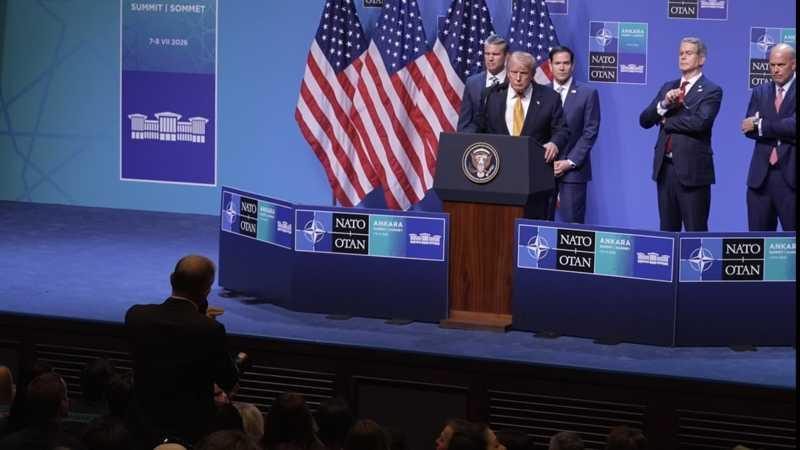
Inside NATOs extraordinary 48 hours that revealed Trumps grip on global diplomacySteve Sedgwick goes behind the scenes of NATOs dramatic 48 hours, where Trumps changing tone reshaped diplomacy and left allies guessing. #News #NATO #Trump #US
mastodon bot · 3 months ago