 Thursday, May 21Thursday, May 21
Russian President Vladimir Putin is traveling to Beijing on May 18, 2026, accompanied by a delegation of ministers and CEOs, with a key objective of reviving the stalled Power of Siberia 2 pipeline project—a critical energy initiative between Russia and China. The visit follows a high-stakes summit between Chinese leader Xi Jinping and former U.S. President Donald Trump, who left China just four days prior. Xi and Putin exchanged congratulatory letters ahead of the meeting, emphasizing the deepening of bilateral cooperation as the two countries mark the 30th anniversary of their strategic partnership. Chinese state media framed Beijing as a focal point of global diplomacy, underscoring the growing alignment between Russia and China amid Western concerns, particularly in the context of Moscow’s war in Ukraine .
The recent Trump-Xi summit in Beijing has sparked geopolitical ripple effects, including trade concessions from China, which agreed to increase purchases of U.S. agricultural products such as beef and poultry. The apparent rapprochement between Trump and Xi has also fueled anxiety in Japan and Taiwan, with concerns over potential shifts in U.S. policy toward China and its implications for regional security. A senior Taiwanese diplomat indicated openness to a direct call between Trump and Taiwanese leadership, suggesting Taipei’s efforts to navigate the evolving U.S.-China dynamic .
The China-U.S.-Russia triangle remains a central focus of global geopolitics, with analysts noting that both Moscow and Beijing seek to reshape the international order, though the ideological conflict is less pronounced than during the Cold War. The Pelosi-Taiwan visit in 2022 served as a flashpoint, temporarily shifting global attention from Ukraine to Taiwan and highlighting the fragility of U.S.-China relations. While some observers initially framed Pelosi’s trip as a U.S. strategic victory, long-term assessments suggest a more complex realignment, with China and Russia deepening ties in response to Western pressure .
Meanwhile, Russian opposition figure Vladimir Kara-Murza has described Putin as a "weak, paranoid old man" whose rule is nearing its end, though the Kremlin’s grip on power remains a subject of debate .

Taiwan Takes the Stage at Prague Fringes 25th Anniversary Three Taiwanese theatre companies are bringing dementia, Lady Macbeth, and poetic confusion to one of Pragues most beloved festivals. Taiwan is making its Prague Fringe debut this May, with a dedicated showcase called Taiwan Week running from May 25 to 30 at Divadlo Inspirace in the city centre. The initiative is the first official collaboration between Taiwans Ministry of Culture — represented locally by the Taipei Economic and Cultural Office — and the Prague Fringe Festival, now celebrating its 25th anniversary. This years festival brings together 60 companies from 17 countries across seven venues in historic Prague. Taiwans contribution: nine performances from three companies, plus a side of Taiwanese tea and traditional snacks for good measure. Whats on stage The three productions are as different from each other as youd expect from a country that clearly isnt playing it safe: Dancing with Dementia (Bandone Productions) is a solo show by Hsuan Szu-Min, drawn from her own experience of caring for a mother living with dementia and depression. Minimal staging, expressive movement, and a lot of emotional weight. The Rodin Project: Lady Macbeth (Shinehouse Theatre) mashes up Rodins Gates of Hell with Shakespeares most ruthless female character — performed by three... The post Taiwan Takes the Stage at Prague Fringes 25th Anniversary appeared first on Prague Morning.
prague morning · 2 days ago
Putin Headed to Beijing With Entourage of Ministers and CEOs The president intends to make a renewed push to convince Chinese leader Xi Jinping to finalize the stalled Power of Siberia 2 pipeline project.
themoscowtimes · 2 days ago
Gasgoo Weekly | Trump completes visit to China; Luxshare Precision plans to acquire 59.5 stake in BWI
gdeltproject.org · 2 days ago

US college student set to make history at Olympics for trades competition in China She said shes looking forward to testing her skills against the worlds best
independent · 2 days ago
Opinion: The future of the China-US-Russia triangle after Pelosis visit to Taiwan Since February 24, 2022, the international communitys focus was concentrated entirely on the war in Ukraine and the growing Russia – West confrontation. It seemed that nothing could change the situation until the end of hostilities in Ukraine. However, on August 2 and 3, almost everyones attention shifted from Ukraine to Taiwan. As the Speaker of the US House of Representatives, Nancy Pelosi, stated her intention to visit Taiwan, up to half a million people were watching the trajectory of her plane on air flight tracking sites. The negative reaction of China, including the warning of President Xi during his conversation with President Biden that those who played with fire would be perished by it, created hype around this visit. Many were discussing the possibility of Chinese military jets closing the airspace over Taiwan and preventing Pelosis plane from landing in Taiwan, while some enthusiasts were even contemplating the possibility of a US-China direct military clash. As Pelosi landed in Taiwan and met with the Taiwanese President, the global social media was full of amateur assessments about the strategic victory of the US and the confirmation of the US global hegemony. However, as the dust settles down, and information noise and manipulation eventually decreases, a more serious assessment is needed to understand the real consequences of this visit.
commonspace · 2 days ago
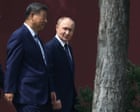
Xi prepares to welcome Putin to China four days after hosting Trump Chinese state media say Beijing emerging as focal point of global diplomacy with Russian leader arriving on TuesdayXi Jinping and Vladimir Putin exchanged congratulatory letters on Sunday ahead of the Russian presidents visit to Beijing this week, four days after Donald Trump left China after a high-stakes summit.Xi said bilateral cooperation between Russia and China had continuously deepened and solidified, Chinese state media reported, with this year marking the 30th anniversary of the two countries strategic partnership. Continue reading...
theguardian · 2 days ago
Xi Jinping prepares to welcome Vladimir Putin to China, four days after hosting Donald Trump Chinas deep relationship with Russia remains a continuing cause for concern in the west, particularly since Moscow launched its invasion of UkraineXi Jinping and Vladimir Putin exchanged congratulatory letters on Sunday ahead of the Russian presidents visit to Beijing this week, four days since Donald Trump left China after a high-stakes summit.Xi, Chinas leader, said bilateral cooperation between Russia and China had continuously deepened and solidified, with this year marking the 30th anniversary of the two countries strategic partnership, according to Chinese state media. Continue reading...
theguardian · 2 days ago
Trumps China Opening and Japans Taiwan Anxiety – The Diplomat The apparent closeness between U.S. President Donald Trump and Chinese President Xi Jinping at their recent Beijing summit…
europesays.com · 2 days ago
China agrees to boost trade for US beef and poultry following Trump-Xi summit — Naharnet China has agreed to ramp up trade for U.S. agricultural products such as beef and poultry, buying at…
europesays.com · 2 days ago
Harri Tiido: Former U.S. ambassador reflects on autocracy and democracy In this installment of Harri Tiidos background series, Russia, China, and the West are examined through the lens of Michael McFaul. Both Russia and China seek to reshape the global order — much like the Soviet Union during the Cold War — but the ideological conflict today is less intense than it was 40 years ago, Tiido notes.
news.err · 3 days ago
Taiwan Open To Trump–Lai Call After Xi Summit Remarks A senior Taiwanese diplomat said on Monday that Taiwan would welcome a direct phone call between U.S. President…
europesays.com · 3 days ago
Putins rule is nearing its end, Kara-Murza says in Vilnius Kremlin leader Vladimir Putin appears as a weak, paranoid old man whose rule is nearing its end, Russian opposition figure Vladimir Kara-Murza told BNS in an interview.
lrt · 3 days ago