
European leaders scramble to redefine sovereignty as geopolitical fractures deepen
European leaders face mounting pressure to redefine sovereignty as geopolitical fractures deepen
European Union leaders are under intensifying scrutiny to address existential threats to the bloc’s strategic autonomy, as warnings from officials, policymakers, and critics converge on three critical fronts: digital dependence, military vulnerability, and geopolitical expansion. The debate, unfolding at high-level meetings and in sharp public critiques, underscores a growing consensus that Europe’s global standing hinges on its ability to act decisively—or risk irrelevance.
Lithuanian Foreign Minister Gabrielius Landsbergis, speaking at the informal Gymnich meeting of EU foreign ministers this week, demanded a "clear definition" of which threats to Europe qualify as existential, framing the discussion as a prerequisite for unified action. "We cannot afford to debate endlessly while adversaries exploit our divisions," Landsbergis said, according to a readout from the Lithuanian Ministry of Foreign Affairs . His remarks reflect broader anxieties over Europe’s capacity to counter hybrid warfare, energy coercion, and technological dominance from the U.S. and China.
That technological dependence is now described as a psychological threat to EU values. Paul Timmers, former European Commission director for digital and cybersecurity, warned in an interview that reliance on American or Chinese tech infrastructure risks "eroding the EU’s moral and political agency." Timmers, now a professor at KU Leuven and the European University in Cyprus, argued that the bloc’s failure to develop sovereign alternatives—particularly in cloud computing and AI—leaves it vulnerable to "subtle but corrosive" foreign influence . His concerns echo calls in Germany’s *Frankfurter Allgemeine Zeitung* for "digital sovereignty," with analysts warning that Europe’s current trajectory risks turning it into a "protectorate of Silicon Valley" .
The debate over Europe’s geopolitical role has also turned inward. George Simion, president of Romania’s far-right Alliance for the Union of Romanians (AUR), accused EU leaders of "strategic naivety" that has left the bloc dangerously dependent on external powers. "Europe will lose its status as a global power if it does not protect its borders and reassert control over its supply chains," Simion said, citing energy dependence on Russia and manufacturing reliance on China as evidence of policy failures . While his rhetoric aligns with nationalist critiques across the continent, his focus on strategic autonomy mirrors mainstream concerns voiced by centrist leaders.
On the defensive front, U.S. Secretary of Defense Pete Hegseth delivered a blunt rebuke to European allies at the Shangri-La Dialogue in Singapore, accusing them of "moralizing" while failing to meet NATO defense spending targets. "When our interests diverge, we adapt with pragmatism—not drama," Hegseth said, according to *Digi24*. His remarks, which followed similar criticisms from Washington earlier this year, underscore the transatlantic rift over burden-sharing and Europe’s reluctance to confront threats from Russia and China without U.S. leadership .
Amid the warnings, some leaders are pushing for expansion as a geopolitical tool. Séamus Boland, president of the European Economic and Social Committee (EESC), framed EU enlargement as an "imperative" to counterbalance rising authoritarianism. "A stronger, larger Europe is the only way to ensure security and prosperity in an era of great-power competition," Boland said in a statement, urging accelerated accession talks with Ukraine, Moldova, and the Western Balkans . His call reflects a growing recognition that the bloc’s influence depends on its ability to integrate—and stabilize—its immediate neighborhood.
The urgency of these debates will come to a head at the June European Council summit, where leaders are expected to finalize a new Strategic Compass for defense and approve a Digital Decade 2030 roadmap. Yet skepticism persists. A *Der Standard* analysis this week highlighted Europe’s "latent potential" but cautioned that bureaucratic inertia and member-state divisions risk undermining even well-intentioned reforms . The question now is whether the bloc’s leaders can translate rhetoric into action—or whether the warnings of 2026 will become the crises of 2030.
- der standard
- adevarul
- digi24
- faz
Articles

Zehn Gründe, an Europa und seine Zukunft zu glauben Europa gilt vielen als träge, bürokratisch und wirtschaftlich abgehängt. Doch hinter den Krisendiagnosen entsteht ein anderes Bild. Es gibt durchaus viel Zukunftspotenzial
der standard · 8 days ago

George Simion: Europa își pierde statutul de putere globală dacă nu își protejează granițele Președintele AUR, George Simion, acuză că deciziile liderilor europeni din ultimele decenii au dus la dependențe strategice periculoase de marii actori globali.
adevarul · 8 days ago
Budrys at the Gymnich meeting: we must clearly define which threats to Europe are existential
gdeltproject.org · 8 days ago
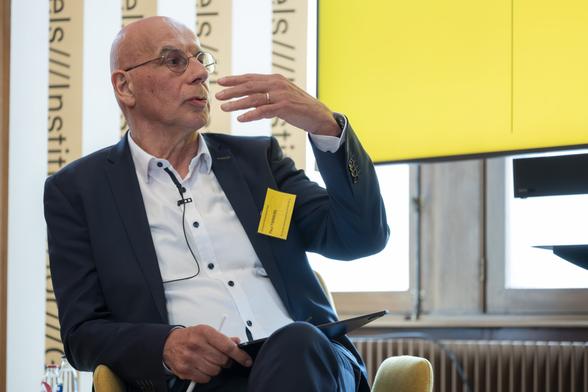
Interview: Dependence on US or Chinese tech risks psychological erosion of EU values, ex-commission official warns.EUobserver sat down for an interview with Paul Timmers, who served as director for digital and cybersecurity in the European Commission, and is now a geopolitics and technology professor at KU Leuven in Belgium and the European University in Cyprus. #DigitalSovereignty #Cybersecurity #Tech #EU
mastodon bot · 8 days ago

Séamus Boland , președintele CESE : Extinderea UE este un imperativ geopolitic pentru o Europă mai puternică , mai sigură și mai prosperă
gdelt bot · 8 days ago

Digitale Souveränität: Cloud ohne Amerikaner Die Risiken der Abhängigkeit von amerikanischer Software sind bekannt. Wer sich heute nicht resilient aufstellt, darf sich morgen nicht beschweren.
faz · 8 days ago
Pete Hegseth, avertisment pentru Europa: „Când interesele noastre diverg, ne adaptăm cu pragmatism, fără dramă şi fără a face morală Secretarul american al Apărării, Pete Hegseth, a criticat aspru aliații europeni la o importantă conferință de securitate din Singapore, reproşându-le că au ignorat „prea mult timp apelurile de a-şi întări apărarea şi cerându-le să se abţină de la „a face morală. În același timp, el a avertizat asupra unei potențiale dominații chineze în Indo-Pacific, scrie focus.de.
digi24 · 8 days ago