
IMO repatriates 11,000 stranded seafarers in global crew change breakthrough
Story Timeline
3 months · 2 summary articles
IMO repatriates 11,000 stranded seafarers in global crew change breakthrough
Social media overtakes TV as top news source for under-35s
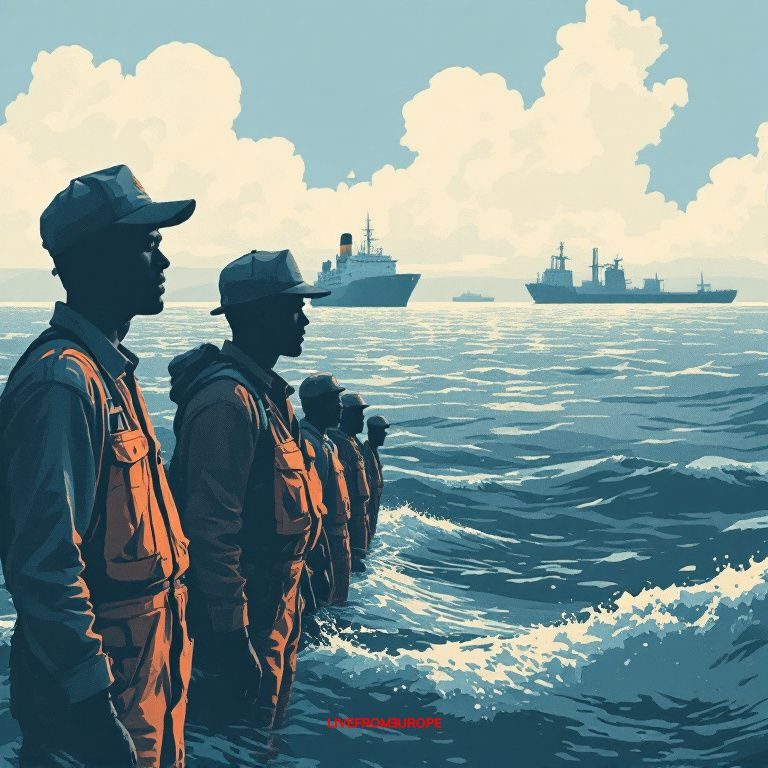
The International Maritime Organization (IMO) announced today it will repatriate 11,000 seafarers stranded at sea, marking a critical intervention in the ongoing global crew change crisis. The decision, confirmed by the IMO on 23 June 2026, follows mounting pressure from unions and industry groups over unsafe working conditions and prolonged contracts that have left thousands of mariners isolated beyond their contractual limits. “This is a humanitarian imperative,” said IMO Secretary-General Arsenio Dominguez in a statement released this morning. “No seafarer should be forced to remain at sea indefinitely due to logistical or bureaucratic barriers.” The operation will prioritize vessels flagged under IMO member states and is expected to begin within 48 hours, with support from national maritime authorities and private shipping companies.
The crisis has intensified amid rising geopolitical tensions and disrupted air and land transport routes, which have complicated crew rotations. According to the International Transport Workers’ Federation (ITF), over 400,000 seafarers have been affected since 2024, with many working up to 18 months without shore leave. “This is not just a labor issue—it’s a safety issue,” said ITF General Secretary Stephen Cotton. “Fatigue leads to accidents, and accidents cost lives.” The IMO’s plan includes the deployment of commercial flights, military-assisted transport, and temporary quarantine facilities where required, ensuring compliance with both health and labor regulations.
In parallel, the maritime sector is also grappling with environmental pressures. On the same day, Austrian researchers reported partial success in using elm trees to filter microplastic pollution from river systems, a project launched in 2024 to address the Danube’s contamination levels. While the study—published by ORF on 23 June 2026—shows promise, experts caution that scalability remains a challenge. “Elms can absorb certain pollutants, but they are not a silver bullet,” said Dr. Eva Meier of the University of Vienna. “We need integrated solutions combining policy, technology, and nature-based approaches.”
Meanwhile, consumer goods giants are turning to strategic partnerships to revive stagnant sales. Bath & Body Works and Ulta Beauty announced a joint retail collaboration on 23 June 2026, aiming to expand market reach through Ulta’s 1,300-store network and digital platform. The deal includes co-branded product lines and in-store experiences, with a pilot launch scheduled for Q4 2026. “This partnership leverages Ulta’s beauty authority and our heritage in self-care,” said Bath & Body Works CEO Gina Boswell. Analysts view the alliance as a response to shifting consumer preferences toward experiential retail.
Elsewhere, wellness technology continues to evolve. The Nuropod, a wearable device that stimulates the vagus nerve to reduce stress, officially launched today in Hungary after clinical trials showed a 30% improvement in focus among users. Developed by Budapest-based Parasym, the device retails for €299 and is available online and in select pharmacies. “We’re not just selling a gadget—we’re offering a pathway to sustained performance,” said Parasym CEO Dr. László Kádár. The company plans to expand into German and Austrian markets by September 2026.
Finally, La Roche-Posay unveiled a new skincare protocol targeting hyperpigmentation, positioning it as a “complete solution” for prevention and treatment. The regimen, highlighted in Greek media on 23 June 2026, combines sun protection, exfoliation, and antioxidant serums, with results visible within four weeks. Dermatologists have welcomed the approach, though they emphasize the need for personalized adaptation. “No single product works for everyone,” noted Athens-based dermatologist Dr. Sofia Papadopoulou. “Consistency and professional guidance remain key.”
Follow us for live European news
- 1
- 1
- 1
- 1
- 1
1 further source not geolocated
Articles

Bath & Body Works partners with Ulta Beauty as it looks to boost sales reut.rs/4f2DLFp
bluesky bot · 3 months ago

Κηλίδες: Βρήκαμε το τέλειο combo για την πρόληψη και την αντιμετώπισή τους Το απόλυτο δερματολογικό πρωτόκολλο από τη La Roche-Posay που χαρίζει ορατά αποτελέσματα.
protothema · 3 months ago

Stresszes? Ez a fülhallgató-szerű eszköz egy gombnyomásra megnyugtja Már kapható a Nuropod, amely az ígéret szerint egy fontos ideget stimulálva segíti az embert a stressz kezelésében, így a jobb teljesítmény elérésében is.
hvg.hu · 3 months ago
IMO will 11.000 Seeleute in Sicherheit bringen
orf.at · 3 months ago

Nawrocki wspomniał o SAFE. Tusk skomentował ją w czterech słowach - Dzisiaj przemysł zbrojeniowy będzie się rozwijał m.in. za sprawą kredytu, który trafił do Polski z Unii Europejskiej, ale wierzę też, że większość parlamentarna przyjmie moje rozwiązania, które zamknięte są w ustawie PSL, a więc "polski SAFE 0 proc." - powiedział Karol Nawrocki podczas Poland Future Summit.
gazeta.pl · 3 months ago
Teilerfolg für Ulmen gegen „Spiegel
orf.at · 3 months ago
❗️Help GeoPwatch grow! If you have a Telegram Premium subscription, please support our project by clicking this link and selecting "Boost": Its not a donation, and it costs you absolutely nothing, but it allows our channel to unlock new features and improve the quality of our content. Its a small gesture for you that carries enormous value for us—your support truly means the world. Thank you for helping us reach new heights! @GeoPWatch
telegram bot · 3 months ago
Quick 2 min survey If you wanna help me out (fully anonymous): Topic: Taking back control of our digital legacy
telegram bot · 3 months ago