
EU launches toughest China trade policy in a decade, Beijing threatens retaliation
Brussels launches toughest China trade policy in a decade as Beijing threatens retaliation
The European Commission has adopted a sweeping new trade strategy targeting China, marking the EU’s most aggressive shift in economic policy toward Beijing in years. The move, unveiled at a rare Beijing-focused leadership debate on Friday, comes as the bloc seeks to counter what officials describe as a "new China shock" to European industries, according to people briefed on the discussions .
Trade Commissioner Maroš Šefčovič outlined plans to develop a new instrument compelling companies in critical sectors—likely including semiconductors, green tech, and advanced manufacturing—to diversify supply chains and reduce dependence on Chinese imports. The proposal also signals a push for stricter enforcement of existing trade defenses, such as anti-subsidy tariffs, and the creation of emergency mechanisms to shield strategic industries from economic coercion . The Commission’s internal assessment, published Friday, declared the current state of EU-China economic relations "unsustainable," citing Beijing’s industrial overcapacity, state subsidies, and weaponization of trade dependencies .
Beijing has responded with threats of its own. China’s Ministry of Commerce warned it would launch trade investigations into the EU if Brussels proceeds with plans to curb imports of subsidized Chinese goods, including potential probes into European agricultural subsidies, automotive exports, and renewable energy policies . The escalation follows months of EU probes into Chinese electric vehicles, wind turbines, and medical devices, which Beijing has dismissed as protectionist.
Germany’s shift has been pivotal in breaking EU resistance to tougher measures. Berlin, long China’s most influential advocate within the bloc, has signaled openness to stronger trade defenses, with a government official telling *Politico* that "the status quo is no longer tenable" . However, divisions persist: while Commission President Ursula von der Leyen pushes for a unified hardline stance, countries like Hungary and Greece—along with German Economy Minister Robert Habeck—continue to prioritize economic ties with Beijing, fearing retaliation could disrupt supply chains and investment .
The policy overhaul reflects broader EU concerns about China’s technological ambitions. A parallel Commission initiative, revealed this week, aims to reduce reliance on foreign—particularly U.S.—tech in critical infrastructure, citing risks of "weaponized interdependence" in transatlantic relations . Meanwhile, the EU is establishing an emergency control mechanism for semiconductor supply chains, a direct response to fears that chips could become a tool of economic coercion amid U.S.-China tensions .
The Commission’s strategy now faces a critical test: translating political consensus into concrete tools before the next EU-China summit, expected in late 2026. With Beijing already mobilizing its diplomatic and economic leverage, the coming months will determine whether the EU can enforce its new red lines without triggering a full-blown trade war.
EU launches toughest China trade policy in a decade, Beijing threatens retaliation
- sueddeutsche
- digi24
- politico.eu
- south china morning post
- eunews.it
- news.err
- die presse
Articles

Germany has signaled its willingness for the EU to take firmer action to stop a surge in Chinese goods, buoying a new push by the European Commission to strengthen the blocs trade defenses.
bluesky bot · 9 days ago

Confruntare economică tot mai probabilă: planul Ursulei Von der Leyen pentru China stârnește diviziuni în UE Președinta Comisiei Europene, Ursula von der Leyen, va solicita înalților funcționari să susțină o acțiune fermă împotriva importurilor chineze subvenționate, pregătind terenul pentru o confruntare cu țările UE care doresc în continuare să-și protejeze relațiile cu Beijingul, arată, într-o analiză, Politico.
digi24 · 9 days ago
Berlin gives the OK for tougher trade action on China Berlin is open to discussing stronger trade defense measures, German government official tells POLITICO.
politico.eu · 9 days ago
![⚡The #EU 🇪🇺 is establishing an emergency control mechanism for microchip supply chains. The initiative responds to tensions between the #US 🇺🇸 and #China 🇨🇳 and concerns that semiconductors could serve as a tool for economic coercion. [TASS]Follow for more information](https://files.mastodon.social/media_attachments/files/116/658/851/285/094/372/original/aa2cffca2c4dea22.png)
⚡The #EU 🇪🇺 is establishing an emergency control mechanism for microchip supply chains. The initiative responds to tensions between the #US 🇺🇸 and #China 🇨🇳 and concerns that semiconductors could serve as a tool for economic coercion. [TASS]Follow for more information
mastodon bot · 9 days ago
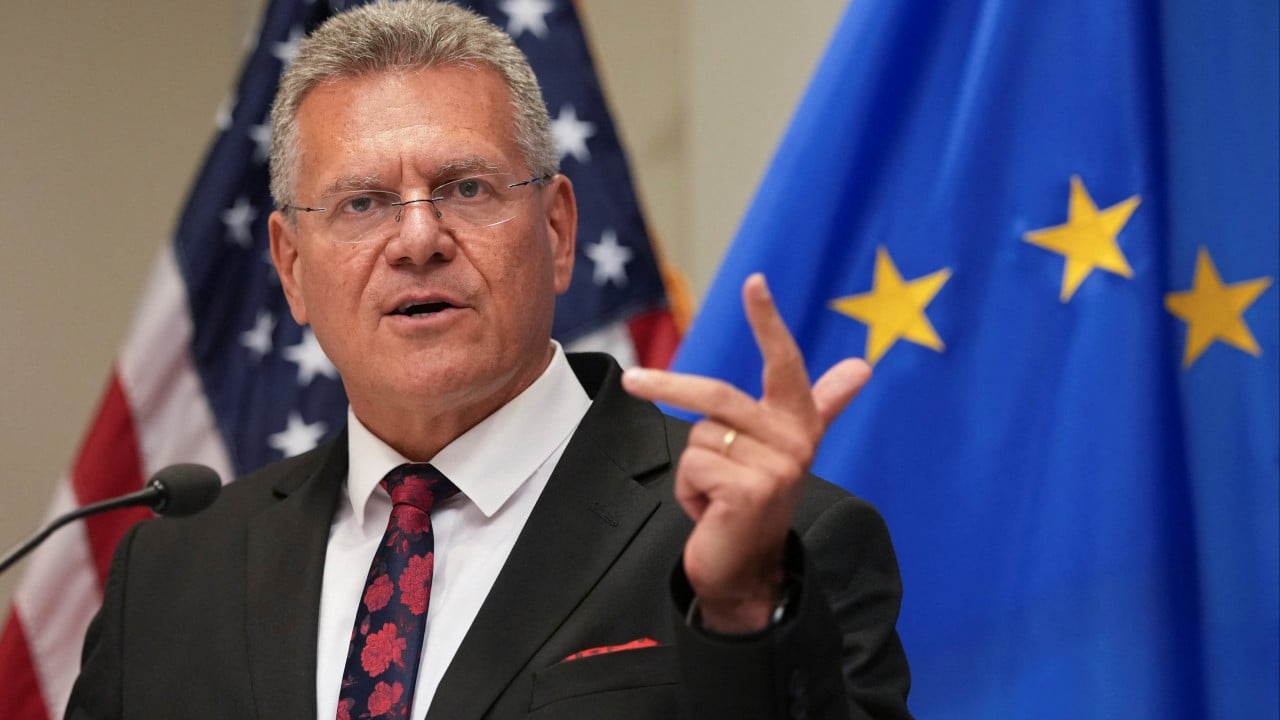
Brussels fires starting gun on tougher China trade policy, as Beijing vows retaliation The European Commission agreed on a tough new approach to trade relations with China, at a rare Beijing-focused debate among Brussels leadership on Friday. In a presentation, trade chief Maros Sefcovic laid out why the bloc needed to take stronger steps to defend itself from what is described as a new China shock to its industries, according to people briefed on the event. This may require developing a new instrument to compel companies in critical sectors to expand both the number and the...
south china morning post · 9 days ago

European Commission vows tougher action on trade with China reut.rs/3PTivJn
bluesky bot · 9 days ago

China Threatens to Launch Trade Probes Against the European Union Beijing threatened to launch trade probes against the European Union if the 27-member bloc pushes ahead with a proposal to curb imports of heavily subsidized foreign products.
wsj · 9 days ago
EU Commission: the current state of economic relations with China is unsustainable Meeting of the College of Commissioners on the state of relations with Beijing: "As economic and security interests become ever more intertwined, both dimensions will require a more robust and coherent response."
eunews.it · 9 days ago

The European Union wants to move away from foreign technology over concerns that overreliance has become a risk in shaky trade ties with Washington.
bluesky bot · 9 days ago
Chinas langer Marsch zur technologischen Dominanz [premium] China verfolgt schon lange eine erfolgreiche Strategie, die auf die technologische Vorherrschaft im 21. Jahrhundert abzielt.
die presse · 9 days ago
Handelspolitik: Die EU wappnet sich gegen China – und Deutschland zögert Einigkeit sieht anders aus: Während Wirtschaftsministerin Reiche sich um Annäherung bemüht, weitet die Europäische Union ihre Schutzinstrumente gegen Pekings aggressive Industriepolitik aus.
sueddeutsche · 9 days ago
Harri Tiido: On Chinas moral realism This time, the background discussion focuses on China. If we set aside Beijings claims that it does not seek to become a hegemon, the impression remains that Chinas goal is nonetheless to take a leading role through control of international norms and algorithms, writes Harri Tiido.
news.err · 9 days ago