
Macron stages final Bastille Day parade in Paris with European leaders backing Ukraine
Story Timeline
1 day · 2 summary articles
Macron stages final Bastille Day parade in Paris with European leaders backing Ukraine
Macron hosts leaders from over 35 countries in Paris to boost Ukraines air defense production
Continuation
French President Emmanuel Macron presided over his final Bastille Day military parade on Tuesday, July 14, 2026, in Paris, showcasing European unity and military strength in support of Ukraine. The event, marking Macron's tenth and final parade as president, gathered around 30 world leaders, including Ukrainian President Volodymyr Zelenskyy, and featured over 6,600 troops, 98 aircraft, 31 helicopters, and 315 vehicles.
The parade, themed "The Strategic Awakening of Europe," aimed to demonstrate France's rearmament and Europe's strategic autonomy. Ukrainian troops marched down the Champs-Elysees, and aircraft from various European countries participated in a flypast. The event was seen as a show of unity and determination to support Ukraine against Russia.
Macron emphasized the importance of peace, freedom, and the rule of law in a speech to the armed forces ahead of the parade. "The message we send to the world is this: yes, peace is our goal. Yes, we cherish freedom and the rule of law. And yes, we stand ready to fight to defend them. Always, and at the cost of blood, if necessary," he said.
The parade included troops from the so-called Coalition of the Willing, mainly European nations supporting Kyiv against Moscow. Symbolically, 25 Ukrainian soldiers followed the troops of coalition members. The event also marked the 10-year anniversary of a devastating truck attack in Nice in 2016, with around 7,000 police officers deployed to secure the celebrations.
The parade was the largest ever, with a record number of military personnel and equipment. The Élysée Palace called the two-hour display "strategic signaling." Aircraft flew with mock munitions under their wings, and helicopters passed above tanks to mimic a modern battlefield, both parade firsts.
The flypast unfolded in seven sequences, with 84 French aircraft and 11 foreign ones. The first sequence was devoted to the ability to enter a conflict first and run a full air campaign, featuring Rafales, Mirage 2000D and 2000-5 jets, and A330 MRTT tankers, joined by eight aircraft from European partners, including F-35s, Gripens, Eurofighters, F-16s, and a Tornado.
The parade was held a day after Macron hosted a summit of Ukraine's allies, some four-and-a-half years into the full-scale Russian invasion of its smaller neighbor. Other European leaders watching the parade included German Chancellor Friedrich Merz and British Prime Minister Keir Starmer.
France has long pushed for the European Union to be more independent of the United States in its defense and security strategy. The parade aimed to illustrate "France's rearmament, France's strategic autonomy, and Europe's strategic awakening," said a French presidential official.
Deputy Defense Minister Alice Rufo told French radio that the marching troops showed "a Europe united and determined to support Ukraine in the face of Russia; a Europe confident in itself."
At the summit on the eve of the parade, ten countries – Denmark, France, Germany, Italy, Netherlands, Norway, Spain, Sweden, Ukraine, and the United Kingdom – announced they would work together to develop anti-ballistic missile systems to protect Europe.
The Kremlin condemned the gathering of the so-called Coalition of the Willing, calling it a "coalition of warmongers" driven by the delusion that it's possible to inflict a strategic defeat on Russia.
Follow us for live European news
- 3
- 2
- 2
- 1
- 1
- 1
- 1
- 1
- 1
- 1
5 further sources not geolocated
Articles

Bitter Emmanuel Macron is reluctant to hand over power and hates it when anyone mentions he only has months left as president Emmanuel Macron is reluctant to hand over power, a source has claimed, as the French president celebrates his last Bastille Day before relinquishing his role as leader.
dailymail · about 2 hours ago

Zelenskyy: participation of Ukrainian military in Bastille Day parade is recognition of strength of AFU
gdeltproject.org · about 2 hours ago
France flaunts firepower, unity with allies in military parade
gdeltproject.org · about 2 hours ago
Irish troops take part in huge Bastille Day parade as Macron showcases Europes awakening – The Irish Times
gdeltproject.org · about 2 hours ago
Macron Themes National Day Parade on European Strategic Awakening
gdeltproject.org · about 2 hours ago
A call for freedom and independence: Baltic Way memorial unveiled in Paris A commemorative plaque for the Baltic Way was unveiled in the center of Paris on Monday by the citys mayor and the prime ministers of Latvia and Estonia.
news.err · about 2 hours ago
Lithuanian festival in Chicago draws over 7,000 people including former president Chicago hosted the largest Lithuanian folk dance festival in several decades, with more than 2,000 dancers and over 5,000 spectators attending the celebration of Lithuanian culture on July 10–12.
lrt · about 2 hours ago

Europe, Flexing Muscle in Ukraine, Is Still on Sidelines in Iran In a show of collective strength, President Emmanuel Macron of France hosted European allies at the annual Bastille Day parade in Paris. Yet Europe is still a hostage to Americas foreign policy.
new york times · about 2 hours ago
Acht Nederlandse militairen lopen met Oekraïnecoalitie mee in Franse parade Honderden militairen van bondgenoten van Oekraïne deden dinsdag mee aan de militaire parade op de Franse nationale feestdag in Parijs. Ook acht Nederlandse militairen marcheerden over de Champs-Élysées.
nu.nl · about 2 hours ago
Venue controversée de Le Pen, cérémonie avec Macron, minute de silence avant France-Espagne : 10 ans après, Nice se souvient de lattentat du 14 juillet 2016 La ville méditerranéenne a commencé à honorer les 86 morts et plus de 400 blessés touchés par lattaque terroriste à la voiture-bélier, voilà dix ans.
liberation · about 2 hours ago
14 Juillet : un défilé très international et lillustration du «réarmement» de la France Près de 6 700 troupes à pied, 98 avions, 31 hélicoptères et 315 véhicules : jamais autant de militaires nauront été alignés sur les Champs-Elysées. La France a voulu envoyer un message : «ses armées sont puissantes et prêtes au combat.»
liberation · about 2 hours ago
Premierul Bolojan, la Ziua Națională a Franței: „Influenţa franceză se vede şi astăzi în cultura noastră, în educaţie şi în instituţii Premierul interimar Ilie Bolojan a declarat, marţi, la recepţia organizată cu prilejul Zilei Naţionale a Republicii Franceze, de la Ambasada Franţei la Bucureşti, că Franţa este unul dintre principalii investitori în România, cu investiţii de peste 12 miliarde de euro şi peste 11.000 de companii fra
adevarul · about 2 hours ago
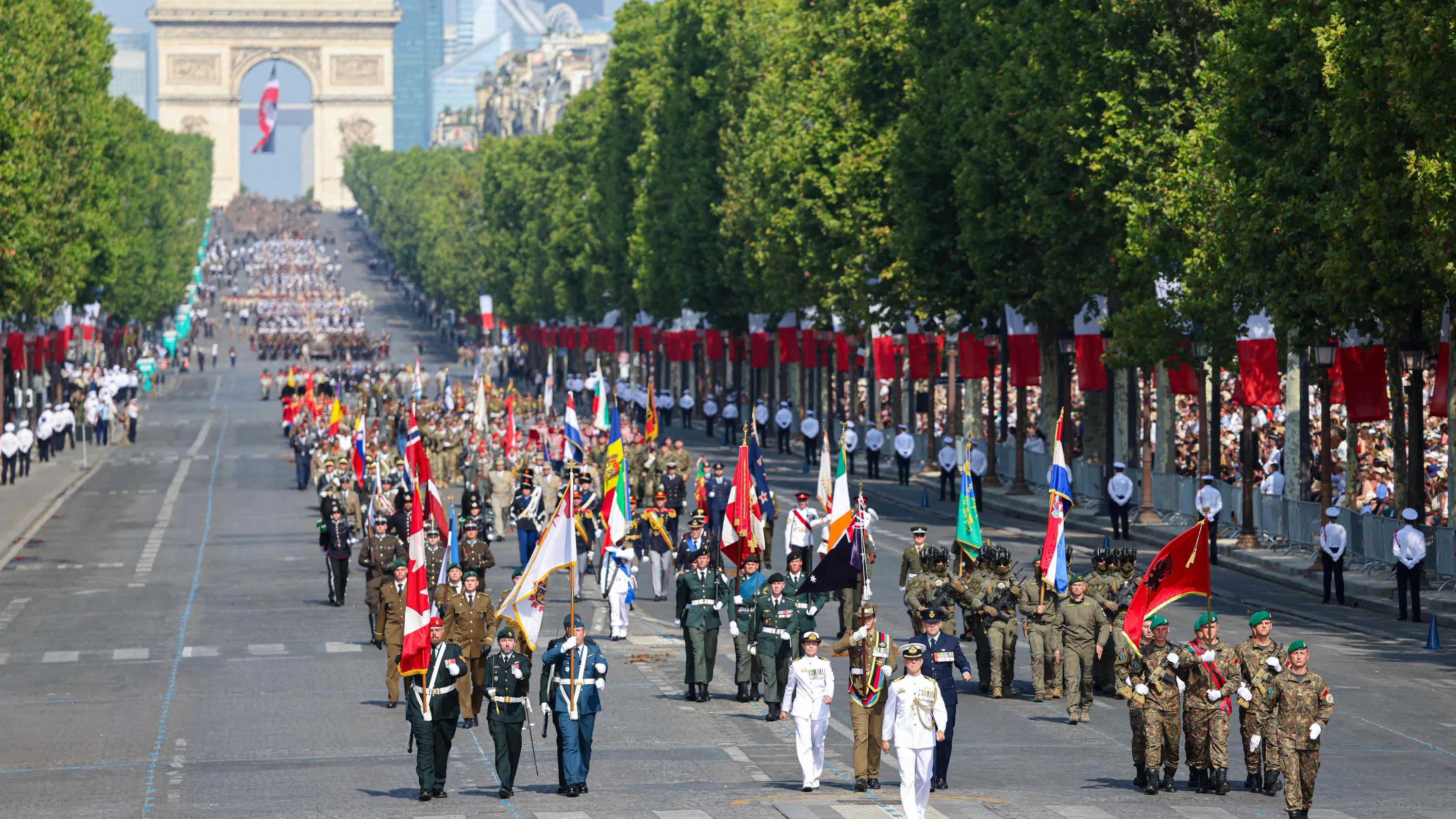
Nationalfeiertag in Paris: Ukraine-Verbündete marschieren bei Parade Rund 500 Soldaten der „Koalition der Willigen zur Unterstützung der Ukraine haben am Dienstag bei der Militärparade zum französischen Nationalfeiertag auf den Champs-Élysées teilgenommen.
faz · about 2 hours ago

On Bastille Day, Macron Offers Spectacle of European Military Might Troops from across Europe marched in Frances annual military parade as the continent prepares for a world without the U.S. security umbrella.
wsj · about 2 hours ago
French city of Nice marks 10th anniversary of terrorist attack France marks the 10-year anniversary of the 2016 Nice Bastille Day truck attack. The attacker, Mohamed Lahouaiej Bouhlel, drove his truck into a crowd along the promenade des Anglais" who had gathered to watch fireworks - killing 86 people. While Bouhlel was killed by police on the same night, eight people are accused of helping him with the attack. Their trial will begin on Monday in a special terrorism court in Paris. Catherine Viette takes a look back at the events of that night.
france24 · about 2 hours ago
Macron reviews troops for the last time at Frances annual military parade French president Emmanuel Macron presided over his last Bastille day military parade as president. This edition showcased over 6,000 troops, including 500 from the coalition of the willing. Frances rearmament and Europes strategic autonomy on full display. The event aims to show the US president and Russias Vladimir Putin that Europe is united and stands ready to defend itself. For more, FRANCE 24 spoke to Paul Smith, head of Modern Languages, university of Nottingham.
france24 · about 2 hours ago
France marks 10 years since Nice terror attack This Tuesday marks a decade since the Nice terror attack. A 31-year-old man ploughed a truck into crowds leaving a Bastile Day fireworks display in the southern French city. 86 people were killed and more than 400 wounded. The attacker was shot dead by police and the Islamic State group later claimed responsibility for the carnage. More information with FRANCE 24 journalist Mark Owen.
france24 · about 2 hours ago
Live: France marks tenth anniversary of deadly Nice terror attack President Emmanuel Macron holds a national tribute in Nice on Tuesday for the victims of a deadly jihadist attack 10 years ago in the southern French city. Later Tuesday, the French football team will observe a minute of silence ahead of their World Cup semi-final in a commemoration to the 86 victims of the attack. Follow FRANCE 24s live coverage of the event.
france24 · about 2 hours ago
Bastille Day parade in Paris displays European support for Ukraine
gdeltproject.org · about 2 hours ago
France holds largest military parade ever in large show of unity for Ukraine Every year, France holds a military parade to celebrate its national holiday and the anniversary of the storming of the Bastille fortress during the French revolution. But this years July 14th parade was the largest ever – President Emmanuel Macron had rallied European allies behind Ukraine for his last Bastille day parade in a large show of unity. Story by Caroline Baum.
france24 · about 2 hours ago
Spectacular drones and fireworks illuminate Eiffel Tower ahead of Bastille Day Paris staged an early Eiffel Tower fireworks and drone show, reserving Bastille Day to commemorate the 2016 Nice attack and its 86 victims.
euronews · about 2 hours ago
Zelenskyy joins Macron and European leaders in Paris for Bastille Day Volodymyr Zelenskyy joins Emmanuel Macron and European leaders at a Ukraine-focused Bastille Day parade in Paris showcasing military strength.
euronews · about 2 hours ago
Ninth Bouquet Kyiv Stage Festival to be held on August 13–16 #UkraineNinth Bouquet Kyiv Stage Festi...
mastodon bot · about 2 hours ago

Prime Minister Rumen Radev announced today that Bulgaria doesnt belong in the Coalition of the Willing, as his countrys guards marched alongside other European armed forces during Bastille Day celebrations hosted by French President Emmanuel Macron.
bluesky_Politico Europe · about 2 hours ago
Cyprus showcases defence ties with France at Bastille Day parade Cyprus reaffirmed its close defence partnership with France on Tuesday as National Guard personnel marched in the Bastille Day military parade in Paris. National Guard Chief Lieutenant General Emmanouel Theodorou attended the celebrations at the invitation of chief of the armed forces of France Lieutenant General Fabien Mandon, joining official events marking Frances national day. […]
cyprus mail · about 2 hours ago
Francija državni praznik proslavila z največjo vojaško parado doslej Ob francoskem državnem prazniku je na Elizejskih poljanah v Parizu potekala tradicionalna vojaška parada, ki jo je na častni tribuni ob predsedniku Emmanuelu Macronu in voditeljih 24 evropskih držav spremljal tudi ukrajinski predsednik Volodimir Zelenski.
rtv slovenia · about 2 hours ago
Συγκίνηση: Δείτε τον ελληνικό στρατό να παρελαύνει μπροστά από την Αψίδα του Θριάμβου για πρώτη φορά από το 1919, δείτε βίντεο και φωτογραφίες Ελληνικά Rafale πέταξαν σε σχηματισμό στον ουρανό του Παρισιού στα πλαίσια της εκδήλωσης - Ελληνικά στρατεύματα στο Παρίσι, 107 χρόνια μετά το τέλος του Α Παγκοσμίου Πολέμου το 1919
protothema · about 2 hours ago

Marie-Pierre Rey : "Poutine renoue avec le rêve impérial et limaginaire stratégique de Catherine II"
lexpress · about 2 hours ago
Französischer Nationalfeiertag: Ukraine im Fokus von Macrons letzter Parade in Paris Frankreichs Präsident lädt zur größten Militärparade seiner Amtszeit. Kanzler Merz und weitere Gäste geben mit ihrer Teilnahme ein Zeichen der Unterstützung für die Ukraine ab.
handelsblatt · about 2 hours ago
Französischer Nationalfeiertag: Größte Militärparade unter Macron - Ukraine im Fokus Frankreichs Präsident Macron lädt zur umfangreichsten Militärparade seiner Amtszeit. Kanzler Merz und weitere Gäste geben mit ihrer Teilnahme ein Zeichen der Unterstützung für die Ukraine ab.
handelsblatt · about 2 hours ago