
Putin escalates espionage to bypass sanctions as Kremlin targets Western tech
Russian intelligence operatives are intensifying efforts to acquire Western technology, as U.S. and European officials report a surge in espionage activity driven by sanctions. Multiple agencies confirm that Moscow’s spies now prioritize procuring advanced semiconductors, AI tools, and military-grade components—critical for sustaining Russia’s war machine in Ukraine—through front companies, smuggling networks, and cyber intrusions . The push reflects the Kremlin’s growing desperation to bypass export controls, with officials warning that Russian operatives are exploiting loopholes in third-party countries like China, Turkey, and the UAE.
The espionage campaign coincides with escalating pressure from the Kremlin on Armenia, where President Vladimir Putin has issued an ultimatum: abandon EU integration or face expulsion from the Moscow-led Eurasian Economic Union. Putin’s spokesman declared the two paths "impossible to reconcile," while the bloc’s leadership has demanded a referendum on Armenia’s alignment by year’s end . The threat follows Yerevan’s recent overtures to Brussels, including a pending EU membership application, and underscores the Kremlin’s willingness to weaponize economic and political ties to retain influence in its near abroad.
Meanwhile, the Kremlin is advancing a $26 billion state-funded research program aimed at extending human lifespan through gene therapy—a project widely seen as tailored to Putin’s personal longevity. Italian media reports that the initiative, dubbed "Project Immortality," involves collaborations with rogue scientists and black-market procurement of Western biotech, despite sanctions . Analysts note the program’s dual-use potential, with applications ranging from military bioenhancement to elite life extension.
In Ukraine, former UK Prime Minister Gordon Brown has renewed calls for a special tribunal to prosecute Putin and his inner circle for war crimes, arguing that existing legal frameworks are insufficient to hold the Kremlin accountable. Brown’s proposal, outlined in *The Guardian*, advocates for a hybrid court modeled on the Nuremberg trials, with jurisdiction over the crime of aggression . The plan gains traction as Kyiv documents over 120,000 alleged war crimes since 2022, though Moscow dismisses the effort as "politicized."
Separately, revelations about Putin’s secretive family continue to erode his anti-Western rhetoric. Investigative reports detail how the Kremlin leader has quietly enrolled his children in elite Western schools, employing European tutors and securing residency in EU countries—despite his public condemnations of "decadent" European values . The hypocrisy underscores the regime’s reliance on Western infrastructure even as it wages war against it.
The Kremlin’s recent visit to Kazakhstan yielded little beyond symbolic gestures, according to analyst Paul Goble, who told *Kyiv Post* that Astana resisted Moscow’s demands on trade routes and migrant labor. Goble interpreted Putin’s extended focus on Armenia during the trip as a sign of panic over Yerevan’s westward drift, particularly ahead of Armenia’s June 7 parliamentary elections . The episode highlights the erosion of Russia’s regional dominance, even as it doubles down on coercion.
Putin escalates espionage to bypass sanctions as Kremlin targets Western tech
- france24
- digi24
- adevarul
- corriere
Articles

Putins cabal must be brought to trial for crimes in Ukraine. With this plan, the world can do that | Gordon Brown
gdeltproject.org · 8 days ago
Russias spies seek Western technology as sanctions bite
gdeltproject.org · 8 days ago
Russian spies are aggressively seeking Western technology as sanctions bite, officials say
gdeltproject.org · 8 days ago
Putins warning to Armenia: Russia or the European Union Armenia is under pressure from Russia. President Nikol Pashinyan has been openly pursuing a strategy of "diversification" - forging ties with both Russia and the West. But his aspirations for the country to join the EU are unacceptable to President Vladimir Putin, and The Eurasian Economic Union, led by Moscow, has threatened to suspend Armenia. The group has called on Yerevan to hold a popular referendum to choose between it and the EU, with Putin saying it was "impossible to reconcile the two". Details by Eliza Herbert.
france24 · 8 days ago
Russia, il piano di Putin leterno: una terapia genica di Stato per non invecchiare Mosca ha investito 26 miliardi di dollari per questa ricerca. Con cui il presidente vuole allungare – anche – la propria vita. E dunque il suo regno. Mentre in Ucraina ha già fatto morire con la guerra 500mila suoi cittadini
corriere · 8 days ago
Russian spies aggressively seeking Western technology as sanctions bite: Officials
gdeltproject.org · 8 days ago
Russias spies seek Western technology as sanctions bite
gdeltproject.org · 8 days ago
Russian spies are aggressively seeking Western technology as sanctions bite, officials say
gdeltproject.org · 8 days ago
Consilierul spiritual al lui Donald Trump: „Vladimir Putin este o persoană cu care nu se pot face afaceri Rezistența Ucrainei în fața agresiunii ruse și încălcările sistematice ale acordurilor de încetare a focului de către Rusia, prin atacurile pe care le lansează, fac ca pentru conservatorii americani să fie „evident că este dificil să se poată negocia pe fond cu Moscova, potrivit lui Mark Burns, consilierul spiritual al președintelui american Donald Trump, relatează Kyiv Post.
digi24 · 8 days ago
Dezvăluiri despre familia secretă a liderului de la Kremlin. Cine sunt profesorii occidentali angajați pentru copiii lui Putin În timp ce atacă constant Occidentul și vorbește despre „decadența valorilor europene, liderul de la Kremlin, Vladimir Putin, pare să aibă alte standarde atunci când vine vorba despre propriii copii.
adevarul · 8 days ago
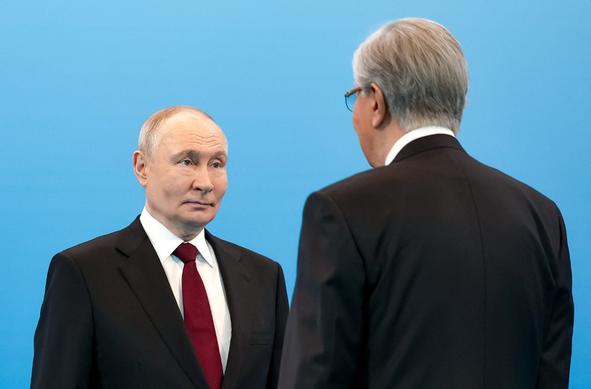
KYIV POST: Putin Leaves Kazakhstan With Empty Rhetoric and Panic Over Armenia, Goble Says In an interview with Kyiv Post, Paul Goble said Putins Kazakhstan visit produced symbolic language but few substantive gains, as Astana resisted Moscows pressure on trade routes and migrant labor. Goble said Putins lengthy focus on Armenia revealed Kremlin panic over Yerevans westward shift, ahead of the June 7 election. #World #Europe
mastodon bot · 8 days ago