Loading…
 Saturday, September 26Saturday, September 26
3 months · 2 summary articles
Chinas World Cup failure exposes collapse of Xis decade-long football revolution
Turkey crashes out of World Cup after 1-0 loss to Paraguay
China’s football ambitions lie in tatters as Xi Jinping’s decade-long drive to turn the world’s most populous nation into a global powerhouse on the pitch collapses under the weight of political interference, financial missteps and systemic failure. On 25 June 2026, as the 2026 FIFA World Cup unfolds across North America, the Chinese national team remains absent for the fourth consecutive edition, a humiliation that underscores how Beijing’s top-down sporting revolution has stalled.
The collapse is documented in two major analyses published the same day. Liberation’s investigation and Repubblica’s Italian-language report both trace the failure to President Xi Jinping’s 2015 declaration that China would qualify for and host the World Cup by 2030. State media framed football as a “civilisational project,” funneling billions into academies, foreign stars and a revamped Super League that briefly lured Brazilians like Hulk and Oscar. Yet the results have been catastrophic: China’s men’s team has not won a competitive match since February 2024 and sits 84th in FIFA rankings, below nations like Jamaica and Vietnam.
Analysts cite three interlocking causes. First, the politicisation of the sport: local cadres treated football as a propaganda tool, pressuring coaches to field unqualified players to meet quotas rather than merit. Second, endemic corruption: the 2023 “Football Reform” purge saw 50 officials and executives sanctioned, including the former head of the Chinese Football Association, Chen Xuyuan, jailed for bribery. Third, the post-2020 economic slowdown forced abrupt budget cuts, leaving academies without pitches and top prospects without stipends.
The failure mirrors similar setbacks elsewhere. In Turkey, where President Recep Tayyip Erdoğan had promised a “new era” for the national team, the squad crashed out of the 2026 World Cup after losing all three group matches, prompting Le Monde to headline the “huge disillusionment” among a public long fed on nationalist sporting narratives . Meanwhile, in Hungary, a football chronicler confessed to Nepszava that despite FIFA’s corruption scandals and the tournament’s carbon footprint, the spectacle’s emotional pull remains irresistible .
With China’s next World Cup qualifying campaign beginning in September 2027, the question is whether Beijing will double down on centralised control or finally accept that elite football cannot be decreed into existence. For now, the empty seats in stadiums across China speak louder than any five-year plan.
Follow us for live European news

I Mondiali senza la Cina Il Paese che voleva dominare il calcio è ancora fuori dalla Coppa del Mondo. Tra investimenti falliti, scandali e crisi economica, il progetto di Xi Jinping si è arenato
corriere · 3 months ago

Regarder la Coupe du monde, cet indomptable plaisir coupable Malgré Donald Trump, la Fifa corrompue ou la catastrophe écologique que représentent les déplacements des 48 équipes présentes, ce chroniqueur hongrois qui suit lédition 2026 ne peut vaincre son addiction au plus grand tournoi de la planète, avoue-t-il dans le journal Nepszava.
courrier international · 3 months ago
Football : pourquoi la Chine, si ambitieuse, est-elle si nulle ? Malgré les grands projets du président Xi Jinping, le deuxième pays le plus peuplé au monde ne parvient pas à percer en foot. La politisation du sport a eu des effets contreproductifs et le volontarisme des autorités sest essoufflé.
liberation · 3 months ago
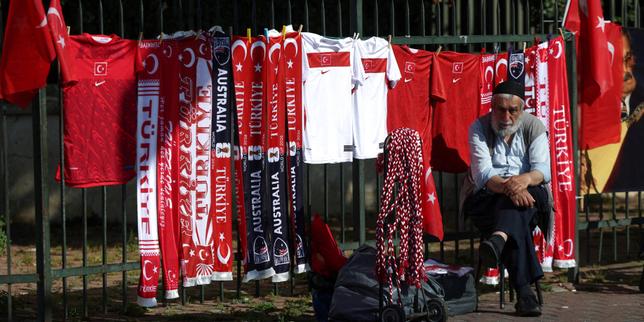
En Turquie, lénorme désillusion face au parcours catastrophique de léquipe nationale au Mondial Les autorités affichaient de grandes ambitions pour léquipe nationale et en avaient fait un outil de propagande. La réalité du terrain les a rattrapées.
le monde · 3 months ago
Yleisurheilu | Olympiavoittaja Alex Schwazer kärysi dopingista kolmatta kertaa Italialaiskävelijää uhkaa elinikäinen kilpailukielto.
helsingin sanomat · 3 months ago
Fem VM-spelare räcker inte: Jag vill bli störst Medan världens bästa landslag slåss om VM-guldet pågår ett annat spel bakom kulisserna. SvD har följt Blash Hosseini – fotbollsagenten från en stökig Stockholmsförort som säljer spelare för hundratals miljoner och vill bli störst i världen.
svenska dagbladet · 3 months ago
O Amílcar vai à bola A ideia de que o futebol embrutece o povo assenta na contestável premissa de que o povo seria revolucionário se não fosse estúpido, e é o futebol que o mantém estúpido. Opinião de Luísa Semedo
publico · 3 months ago