 Wednesday, June 10Wednesday, June 10
A high-ranking Russian general overseeing the country’s heavy ammunition supplies for the war in Ukraine was killed on Tuesday in a car bomb attack outside Moscow, multiple independent outlets reported on Wednesday. The explosion, which occurred at approximately 5:30 a.m. local time in the town of Balashikha, some 20 kilometres east of the Russian capital, targeted a BMW sedan carrying the officer, according to Kyiv Post .
Unnamed Russian military sources cited by Hungarian outlet 444.hu identified the victim as Major General Damir Davydov, a senior figure within the Russian Ministry of Defence responsible for the missile and artillery wing . Davydov’s portfolio included the procurement and distribution of heavy munitions to frontline units, a role that made him a critical link in Moscow’s war effort. The blast, which also killed the driver, occurred in a residential district originally built for military personnel, the Kyiv Independent noted .
Russian state media have not confirmed Davydov’s death, but international outlets including The Independent and Belgian newspaper De Morgen reported the incident within hours of the explosion . The attack follows a pattern of targeted assassinations against Russian military logistics officers, which Ukrainian and Western intelligence sources have linked to covert operations aimed at disrupting Moscow’s war machine.
The timing of the blast—just days after European Union foreign ministers discussed a proposed travel ban for Russian military personnel entering EU territory—has fuelled speculation about possible Ukrainian involvement or tacit Western approval of such operations . Polish outlet Gazeta Wyborcza reported that the EU is considering the measure within ten days, citing nearly 15,000 Russian casualties in Ukraine since late May .
Analysts caution that definitive attribution remains difficult in the fog of war, but the incident underscores the growing vulnerability of Russia’s military command structure. Davydov’s death, if confirmed, would mark the highest-profile casualty in a string of attacks on Russian officers since the invasion of Ukraine began in February 2022. The Kremlin has yet to issue an official statement on the blast, which occurred as President Vladimir Putin reiterated nuclear threats against perceived Western aggression.

Felrobbantottak egy orosz tábornokot Moszkva közelében Orosz független források szerint az áldozat Damir Davidov lehetett, aki a rakéta- és tüzérségi lőszerek ellátásáért felelt.
444.hu · about 3 hours ago
Greece Remembers the Cold-Blooded Nazi Massacre at Distomo The massacre at Distomo remains to this day one of the most heinous crimes the Nazis committed against innocent women and children
greek reporter · about 3 hours ago

russian military war criminal killed in car bombing outside Moscow, media reportsThis mass murderer was head of russian aviation in Syria and killed countless innocent Syrians over decades of brutal crimes against the people of Syria.The incident took place in the Aviatorov district is a residential neighborhood originally built for military personnel and their families. According to Astra, apartments there are distributed through russias military terrorist and war criminals. #eu #news
mastodon bot · about 3 hours ago
Russia loses 1,190 soldiers over past day Ukraines General Staff has updated data on Russian losses: Russia lost 1,190 soldiers killed and wounded over the past day.
ukrpravda · about 3 hours ago
Cine este generalul rus de rang înalt ucis într-un atentat cu mașină-capcană lângă Moscova Un ofițer militar de rang înalt din Ministerul rus al Apărării, responsabil de aprovizionarea cu muniție grea pentru armata rusă, a fost ucis în explozia produsă marți dimineață cu o mașină-capcană, la periferia Moscovei, relatează Kyiv Post. Explozia a avut loc marți, 9 iunie, în jurul orei 5:30 dimineața, ora locală, în orașul Balașiha, la …
hotnews.ro · about 3 hours ago
Autobombe detoniert nahe Moskau: Ist das Opfer ein russischer General? Unweit der russischen Hauptstadt Moskau ist ein Mann in einem fahrenden BMW getötet worden.
die presse · about 3 hours ago
Ukraine-Russia war latest: Moscow car bomb kills Putins general overseeing ammunition supplies Russian general Davydov was handling the defence ministrys missile and artillery wing
independent · about 3 hours ago
Live - Autobom ontploft in Moskou, slachtoffer is vermoedelijk opnieuw Russische generaal • EU wil inreisverbod voor Russische militairen in Oekraïne
de morgen · about 3 hours ago
Krieg in der Ukraine: Autobombe bei Moskau soll russischen General getötet haben Ein Mann ist in der Nähe von Moskau durch eine Autobombe getötet worden. Berichten zufolge war er ein hoher russischer Militärangehöriger.
die zeit · about 3 hours ago
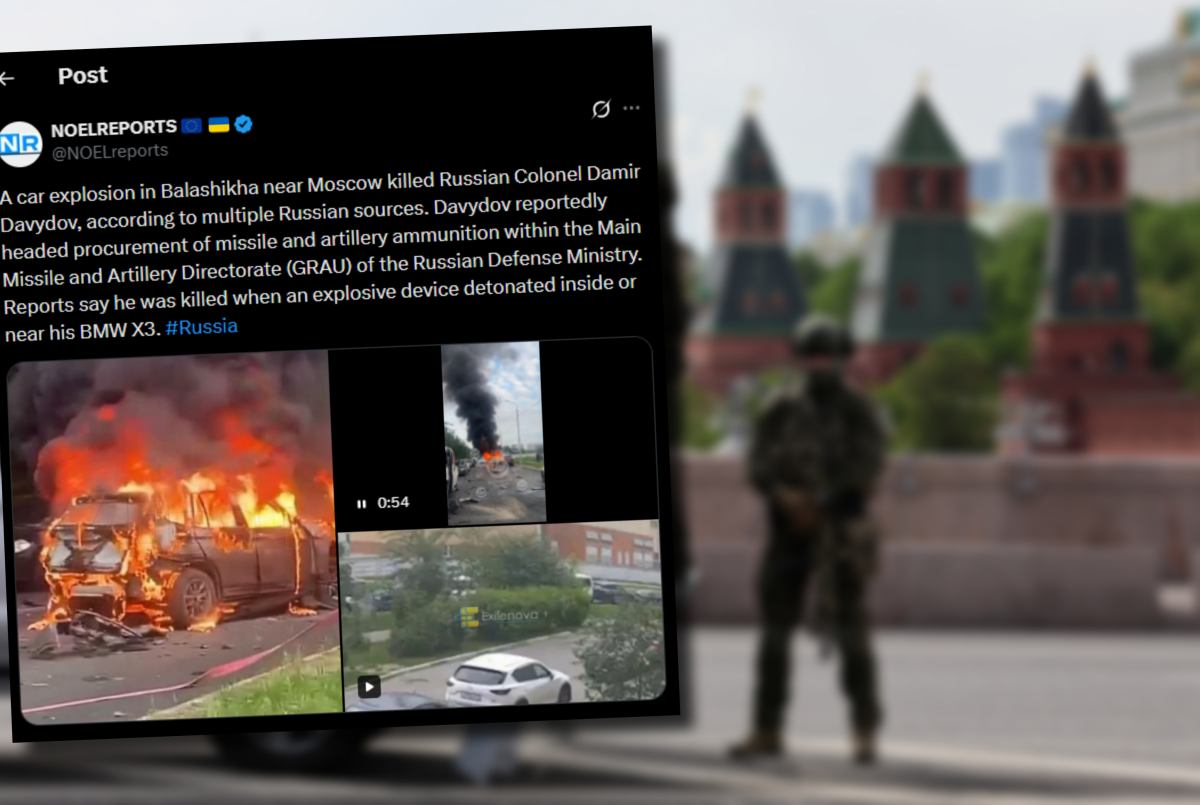
Zamach bombowy pod Moskwą. Media: Zginął oficer odpowiedzialny za amunicję w rosyjskim MON W wyniku eksplozji śmierć poniósł kierowca samochodu, pod którym podłożono ładunek wybuchowy. Tożsamość ofiary nie została oficjalnie podana, jednak media donoszą, że był to wysoki rangą wojskowy z Ministerstwa Obrony Federacji Rosyjskiej.
gazeta.pl · about 3 hours ago