Loading…
 Saturday, September 26Saturday, September 26
3 months · 2 summary articles
Japan crush Tunisia 4-0 in milestone 1,000th World Cup match
Japans World Cup fans clean stadiums: women demand same effort at home
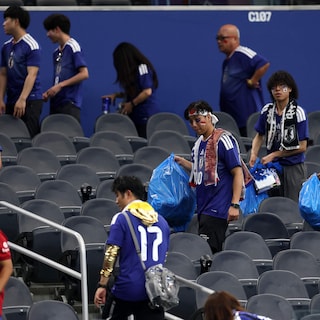
Japan’s World Cup supporters are being praised worldwide for cleaning stadiums after matches—only to face a sharp backlash at home, where many women say the same men do little to help with household chores.
Images and videos from the 2026 FIFA World Cup in Japan have gone viral, showing fans in blue and white jerseys sweeping aisles, collecting cups, and stacking trash bags after their team’s matches. The scenes have been hailed as a display of national discipline and respect, with international media calling it “a lesson in civic pride” . Yet within Japan, the contrast has sparked frustration. “They clean the stadium but leave the mess at home,” wrote one commentator in *De Morgen*, echoing a wave of social media posts under hashtags like #CleanAtTheStadiumNotAtHome .
The debate intensified after Dutch outlet *NU.nl* highlighted the scarcity of women in football’s medical ranks, noting that Curaçao’s Suzanne Huurman is the only female team doctor at the tournament. “I stood on the pitch in men’s kit,” she told the site, underscoring broader gender gaps in the sport .
The cleaning spectacle first drew attention during Japan’s opening match against the Netherlands, when fans stayed to tidy the 72,000-seat stadium in Yokohama. French newspaper *Courrier International* framed the act as a cultural paradox: “A politeness that the world admires, yet one that clashes with daily realities” . Austrian broadcaster ORF similarly contrasted the stadium’s spotless aisles with the “dishes still in the sink at home” .
The contradiction has become a lightning rod for discussions on gender roles in Japan, where women perform 2.5 times more unpaid care work than men, according to government data. Activists point out that while the World Cup spotlight highlights Japan’s public order, it also exposes private inequalities. “Cleaning a stadium is commendable,” said gender studies professor Aiko Tanaka at the University of Tokyo. “But it’s not a substitute for sharing responsibility at home.”
Meanwhile, the Dutch Football Association auctioned players’ match-worn shirts from the Japan game, raising €59,069 for the Princess Máxima Fund, a childhood cancer charity . The funds will support treatment and research, a reminder that even amid cultural debates, the tournament’s humanitarian legacy continues to grow.
Follow us for live European news

Volejbalistky podlehly v Lize národů Japonsku 0:3. O první výhru zabojují proti Dominikánské republice České volejbalistky na turnaji Ligy národů na Filipínách neuspěly ani ve třetím zápase proti týmu z neužší světové špičky. Dosud neporaženému Japonsku, které loni skončilo čtvrté na mistrovství světa, podlehly 0:3. První sadu prohrály jednoznačně 15:25, ale pak držely krok a podlehly až v koncovkách 23:25 a 25:27.
irozhlas.cz · 3 months ago
Japanse vrouwen verontwaardigd: voetbalfans ruimen tribunes wél netjes op, maar thuis niet
de morgen · 3 months ago
Gedragen shirts van Oranje-spelers voor 59.069 euro geveild De veiling van gedragen shirts van de spelers van het Nederlands elftal tijdens het eerste WK-duel met Japan heeft 59.069 euro opgeleverd. Het overgrote deel van de opbrengst gaat naar het Prinses Máxima Fonds.
rtl nieuws · 3 months ago
Veiling gedragen Oranje-shirts levert ruim 59.000 euro op, Van Dijk-shirt meest gewild De veiling van gedragen shirts van de spelers van het Nederlands elftal tijdens het eerste WK-duel met Japan heeft 59.069 euro opgeleverd. Het overgrote deel van de opbrengst gaat naar het Prinses Máxima Fonds.
rtl nieuws · 3 months ago
Auf der Suche nach Stadionruhe: Ein Raum im Nirgendwo Die Fifa wirbt mit neu geschaffenen Sensory-Rooms in den Stadien. Gute Idee. Leider weiß in Guadalajara niemand, wo diese eigentlich zu finden sind. mehr...
taz.de · 3 months ago
CM 2026. Deputaţii norvegieni i-au imitat pe suporterii echipei naţionale chiar în timpul şedinţei parlamentare Parlamentul Norvegiei s-a transformat joi într-o tribună de stadion, pentru câtrva minute. Deputaţii acestei ţări scandinave au preluat coregrafia suporterilor echipei naţionale, imitând vâslaşii vikingi pe băncile adunării lor, relatează LEquipe, citat de News.ro.
digi24 · 3 months ago

Faites-le plutôt à la maison : au Japon, le ménage des supporteurs agace En ramassant les déchets dans les tribunes après les matchs de leur équipe, ces supporteurs japonais attirent lattention du monde entier grâce à leur politesse et leur respect, décrits comme typiques de la culture nationale. Une attitude qui na parfois rien à voir avec celle quils ont à leur domicile, sagacent médias et internautes.
courrier international · 3 months ago
NU+ | Huurman is enige vrouwelijke teamarts op WK: Damestoilet zit vaak dicht Van de 48 deelnemende landen aan het WK voetbal heeft Curaçao als enige een vrouwelijke teamarts. Suzanne Huurman vindt haar unieke positie bijzonder, maar ziet liever meer vrouwen op het WK. "Ik stond in een mannentenue op het veld."
nu.nl · 3 months ago
Fußball-WM: Japans Fans putzen Stadion - Frauen kontern Japans Fans sammeln nach dem WM-Spiel den Müll im Stadion ein und ernten dafür weltweit Lob. In der Heimat aber wächst der Widerspruch: Viele Frauen fordern mehr Einsatz im Haushalt.
tagesspiegel · 3 months ago
WM: Japans männliche Fans putzen im Stadion statt zu Hause
orf.at · 3 months ago