Loading…
 Saturday, August 29Saturday, August 29
2 months · 3 summary articles
Volkswagens CEO pushes job cuts and plant closures despite resistance from Lower Saxony and IG Metall
Volkswagen unveils sweeping plan to cut up to 100,000 jobs and close four German plants
Volkswagen proposes up to 100,000 job cuts and closes four German factories
Volkswagen on Friday confirmed plans to eliminate up to 100,000 jobs worldwide and close four German factories as part of the most sweeping restructuring in the company’s history. The cuts would affect nearly one in six of the 657,000 positions currently held across the Volkswagen Group, according to multiple German and international outlets including *Manager Magazin* and the *Financial Times* . The proposed closures target plants in Emden, Hannover, Zwickau and Audi’s Neckarsulm facility, a move that would reshape Germany’s industrial map and send shockwaves through Europe’s automotive sector.
The plan, which the supervisory board is scheduled to review on 9 July, reflects Volkswagen’s urgent response to collapsing sales in its two largest markets. Once the company’s biggest revenue source, China has become a battleground with aggressive Chinese automakers undercutting prices on electric vehicles, while demand in the United States has also softened . “The entire group must change fundamentally,” Volkswagen chief executive Oliver Blume told reporters in Berlin, adding that the proposals were “not a drill” but a last-resort effort to secure the company’s future .
Trade unions and regional leaders reacted with alarm. IG Metall, Germany’s largest metalworkers’ union, vowed to fight the proposals, calling them a “frontal assault” on Volkswagen employees . Emden’s mayor Tim Kruithoff described the potential closure of the local plant as a “severe breach of trust” that could trigger a regional economic catastrophe . Analysts warn the move could accelerate the decline of Germany’s auto industry, already struggling with high energy costs and lagging EV adoption .
Volkswagen’s supervisory board is expected to vote on the restructuring plan next month, but the political fallout is already intensifying. European policymakers are under pressure to respond to the crisis by imposing trade barriers on Chinese EVs, a step that could reshape global supply chains . For a company that has long symbolised German industrial might, the proposed cuts mark a historic inflection point—one that could redefine not just Volkswagen, but the continent’s automotive future.
Follow us for live European news
4 further sources not geolocated

Volkswagen weighs cutting up to 100,000 jobs and closing four German plants, sources say
gdeltproject.org · 2 months ago
Volkswagens mass lay-offs are a call to action for a sleepy EU Carmakers move will ratchet up the pressure on European policymakers to slap restrictions and trade barriers on China
financial times · 2 months ago
VW may close four factories to adapt to the future, report saysWith falling sales in the US and especially China, VW Group wants to restructure. #News #Germany #Europe #VolkswagenGroup
mastodon bot · 2 months ago

PS defende aposta na educação contra a pobreza nas regiões O Presidente do PS/Açores afirmou que "não bastam bons discursos que reconhecem a autonomia" das regiões
observador · 2 months ago

Volkswagen planea suprimir hasta 100.000 puestos de trabajo en todo el mundo El gigante automotriz alemán estudia cerrar cuatro fábricas en Alemania dentro de su proceso de reestructuración, según la prensa del país
la vanguardia · 2 months ago
Stellenabbau bei Volkswagen: Es geht um mehr als um die Zukunft von VW 100.000 von 657.000 Stellen im Konzern sollen wegfallen. Den Werken in Emden, Hannover, Zwickau und dem Audi-Werk in Neckarsulm droht das Aus. inzwischen wackelt viel mehr als nur Deutschlands Autoindustrie.
tagesspiegel · 2 months ago
Technologiekonzern: Bosch-Chef Stefan Hartung geht vorzeitig Konjunkturflaute, Stellenabbau, rote Zahlen: Bei Bosch drückt es gerade an allen Ecken und Enden. Mitten in der Krise verlässt nun Chef Stefan Hartung überraschend den Konzern. Wer folgt ihm nach?
handelsblatt · 2 months ago
Kommentar: Wer nur Kosten senkt, gewinnt noch keinen Kunden zurück Die Debatte über einen schärferen Jobabbau greift zu kurz. Konzernchef Blume braucht die Unterstützung aller Machtzentren im Konzern – und am Ende eine zentrale Entscheidung.
handelsblatt · 2 months ago
Stellenstreichung bei VW: Bis zu 100.000 Jobs sollen wegfallen Volkswagen will einem Medienbericht zufolge bis zu 100.000 Stellen streichen. In Deutschland sollen vier Werke geschlossen werden. mehr...
taz.de · 2 months ago
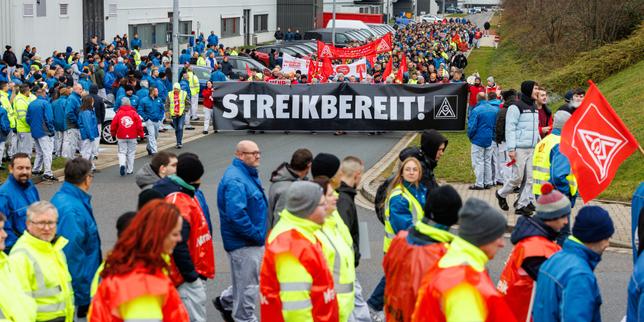
Bestürzung nach Bericht über Volkswagen Europas größter Autohersteller Volkswagen (VW) steht laut einem Bericht des „Manager Magazins vor einem weiteren großen Stellenabbau. In den nächsten Jahren sollen im Konzern weltweit bis zu 100.000 der aktuell rund 657.000 Arbeitsplätze wegfallen, so das Blatt am Freitag unter Berufung auf Insider. Auch Schließungen von Werken seien möglich. Gewerkschaften und Politik sind alarmiert. Die Pläne seien ein „Frontalangriff auf die VW-Beschäftigten.
orf.at · 2 months ago
Autoindustrie: Die letzte Chance für VW und Mercedes Wieder kündigen zwei deutsche Autohersteller Sparpläne an. Die Arbeitnehmer sollten jetzt nicht blockieren. Sonst könnte es bald zu spät sein.
sueddeutsche · 2 months ago
Autozulieferer: Mitten in der schweren Krise: Bosch-Chef geht überraschend Der Abschied kommt sehr kurzfristig: Stefan Hartung gibt bereits Anfang kommender Woche seinen Chefposten bei dem weltweit größten Autozulieferer ab. „Auf eigenen Wunsch, heißt es. Die Hintergründe sind unklar.
sueddeutsche · 2 months ago
Volkswagen reportedly plans to cut 100,000 jobs Volkswagen reportedly wants to cut 100,000 jobs, about 15 of its workforce, and close German plants. It would be the biggest overhaul in the carmakers history, and the unions are vowing to fight. Europes car industry is shrinking, and its biggest name is leading the retreat. Volkswagen reportedly plans to cut around 100,000 jobs at […] This story continues at The Next Web
the next web · 2 months ago

VW prepara corte de 100 mil empregos e fecho de fábricas Volkswagen enfrenta uma enorme pressão da indústria automóvel chinesa
observador · 2 months ago
Περικοπές ως και 100.000 θέσεων εργασίας και κλείσιμο εργοστασίων επεξεργάζονται στη Volkswagen
protothema · 2 months ago
Volkswagen pourrait supprimer 100 000 emplois dans le monde Le géant automobile allemand, qui emploie 657 000 salariés, est confronté à une chute de ses ventes en Chine, autrefois son premier marché, et alors que les exportateurs chinois lui imposent une redoutable concurrence, notamment sur lélectrique.
le monde · 2 months ago
Emdens Oberbürgermeister über drohende Schließung von VW-Werk: „Ein schwerer Vertrauensbruch gegenüber den Beschäftigten Das VW-Werk in Emden soll geschlossen werden. Es ist von überragender Bedeutung für die Region, Oberbürgermeister Tim Kruithoff fürchtet den GAU für ganz Ostfriesland. Was ihn jetzt umtreibt.
tagesspiegel · 2 months ago
Pred 50 rokmi nevedeli čítať, dnes sú vzorom. Ako Portugalsko vyriešilo problém, s ktorým Slovensko prehráva „Ak deti nepodchytíme včas, v budúcnosti budeme platiť oveľa viac za vysokú nezamestnanosť, predčasné ukončovanie školskej dochádzky, sociálne dávky či kriminalitu mládeže," hovorí bývalý portugalský minister školstva João Costa.
aktuality.sk · 2 months ago
Bericht: Volkswagen will bis zu 100.000 Stellen abbauen Nach dem angekündigten Sparprogramm könnte Volkswagen noch deutlich mehr Stellen streichen.
die presse · 2 months ago
Was müssen wir in Zukunft überhaupt noch wissen, Felix Ohswald? [premium] Der GoStudent-Gründer rechnet mit einem veralteten Schulsystem ab. Welche Fähigkeiten junge Menschen brauchen, um für künftige Herausforderungen gewappnet zu sein, was für ihn einen gebildeten Menschen ausmacht – und was er aus unternehmerischen Fehlern selbst gelernt hat.
die presse · 2 months ago
Bosch-Chef Stefan Hartung geht vorzeitig Stefan Hartung verlässt den deutschen Konzern bereits Ende Juni.
die presse · 2 months ago
Stellenabbau bei Volkswagen : Der Tabubruch Volkswagen will noch mehr sparen als bekannt, 100.000 Jobs könnten wegfallen. Kritiker fürchten jetzt, der Vorstand könnte das mit einem Trick durchsetzen.
die zeit · 2 months ago

Which Volkswagen factories in Germany could be shut down? reut.rs/4gHo1d9
bluesky bot · 2 months ago
„Der gesamte Konzern muss sich tiefgreifend verändern: Vier deutsche VW-Standorte geraten besonders unter Druck Konzernchef Blume plant einen noch radikaleren Jobabbau als bislang bekannt, 100.000 Stellen sollen wegfallen. Die Arbeitnehmer sind alarmiert.
tagesspiegel · 2 months ago
Autoindustrie: Mercedes verschärft Sparkurs: Mehr arbeiten für das gleiche Geld Der Stuttgarter Autohersteller stellt die 35-Stunden-Woche infrage und stimmt die Belegschaft auf Einschnitte ein. Der Vorstand schreibt, die Situation in Deutschland sei „dramatisch.
sueddeutsche · 2 months ago