 Thursday, May 28Thursday, May 28
NASA and Amazon-backed Blue Origin secure key roles in lunar and satellite ventures as Starlink expands its orbital dominance
NASA has awarded Jeff Bezos’ Blue Origin the first of three uncrewed lunar missions this year, marking a decisive step toward constructing a $20 billion moon base by 2028. The agency confirmed on Tuesday that Blue Origin will lead the initial landing, outpacing Elon Musk’s SpaceX, as part of a broader push to establish permanent lunar infrastructure before the decade’s end . The announcement, made by NASA Administrator Jared Isaacman in Washington, D.C., aligns with the agency’s accelerated timeline, which includes launching foundational missions before the end of 2026 .
Meanwhile, Amazon’s satellite ambitions gain momentum as the company edges closer to joining Europe’s mobile satellite spectrum plan alongside SpaceX’s Starlink. Reuters reports that regulators may allow both firms to buy into the EU’s proposed spectrum allocation, a move that could reshape the continent’s connectivity landscape . Amazon’s terrestrial expansion also advances, with plans to build a new data center in Maintal, Germany—a first for the company in the country—signaling its growing investment in cloud infrastructure .
Starlink’s influence extends beyond Earth’s atmosphere, with Starcloud—a startup developing orbital data centers—ordering SpaceX’s laser terminals to integrate Starlink’s network into its own infrastructure. The deal deepens the collaboration between the two firms, as Starcloud relies on SpaceX for future spacecraft launches . SpaceX’s military footprint also expands, with the U.S. Space Force awarding the company a $2.29 billion contract to build a military space data network, underscoring Starlink’s dual-use capabilities .
The competition for orbital dominance intensifies as Open Cosmos, a UK-based satellite provider, races to deploy its ConnectedCosmos broadband constellation by 2028. The project aims to reduce Europe’s reliance on undersea cables, positioning the continent as a contender in the global satellite internet race . Meanwhile, SpaceX’s financial leverage grows, with the Pentagon agreeing to a fivefold increase in Starlink service fees for military operations over Iran, highlighting the system’s critical role in modern warfare .
As NASA and private firms accelerate their space ambitions, the next 18 months will test whether Blue Origin’s lunar contracts, Amazon’s satellite spectrum bids, and Starlink’s expanding network can reshape global connectivity—and who will control it.
NASA awards Blue Origin first lunar mission as Starlink and Amazon expand orbital dominance

Open Cosmos CEO on what it takes to bring IoT to space Open Cosmos, based in the United Kingdom, is facing a 2028 deadline to field an ambitious broadband constellation for Europe. That system, ConnectedCosmos, aims to reduce reliance on undersea cables […] The post Open Cosmos CEO on what it takes to bring IoT to space appeared first on SpaceNews.
spacenews · 2 days ago
NASA își intensifică eforturile pentru construirea unei baze pe Lună și stabilește un calendar ambițios: primele misiuni, anul acesta Primele misiuni pentru construirea unei baze pe Lună vor fi lansate înainte de sfârșitul acestui an, a anunțat, marți, conducerea NASA.
digi24 · 2 days ago
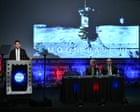
Nasa selects Jeff Bezoss Blue Origin for first of three uncrewed lunar missions Three lunar landings are planned for this year in preparation for the construction of a $20bn moon baseSign up for the Breaking News US newsletter emailNasa announced on Tuesday ambitious plans for three uncrewed lunar missions this year to kickstart construction of a $20bn moon base, and said it had chosen the Amazon founder Jeff Bezoss Blue Origin, ahead of Elon Musks SpaceX, to conduct the first.The revelation by Nasas administrator, Jared Isaacman, at a press conference in Washington DC marked the first detailed public explanation of how and when the moon base will be built. Continue reading...
theguardian · 2 days ago
JUST IN - U.S. Space Force awards SpaceX $2.29 billion contract for military space data network. Read here: @disclosetv
telegram bot · 2 days ago

Pläne vorgestellt: Amazon will Rechenzentrum in Maintal bauen Premiere in Maintal: Erstmals in Deutschland hat Amazon Pläne für den Bau eines neuen Rechenzentrums bei einem „Infomarkt vorgestellt und für sein Projekt bei den Bürgern geworben.
faz · 2 days ago
DARPA pregăteşte pentru lansare un robot destinat reparării sateliţilor pe orbită Agenţia americană din domeniul apărării DARPA pregăteşte lansarea în această vară a programului Robotic Servicing of Geosynchronous Satellite (RSGS) de alimentare, reparaţii şi întreţinere a sateliţilor pe orbită, conform unui anunţ făcut de grupul de cercetare şi dezvoltare al armatei americane, transmite marţi Space.com.
digi24 · 2 days ago
NOW - NASA reveals a phased timeline for colonizing the Moon with settler outposts and awards Jeff Bezos Blue Origin lunar lander contracts to establish the lunar base. @disclosetv
telegram bot · 2 days ago
Rechenzentren: Amazon will in Maintal bauen Premiere in Maintal: Erstmals in Deutschland hat Amazon Pläne für den Bau eines neuen Rechenzentrums bei einem „Infomarkt vorgestellt und für sein Projekt bei den Bürgern geworben.
faz · 2 days ago

Exclusive: Starlink and Amazon may be able to buy into EU mobile satellite spectrum plan reut.rs/4dGL7yV
bluesky bot · 2 days ago
Starcloud orders Starlink lasers for orbital data center network Starcloud has ordered optical terminals from SpaceX to use Starlink as a global data-relay network for its future orbital data centers, deepening ties with the company it is counting on to launch full-size spacecraft. The post Starcloud orders Starlink lasers for orbital data center network appeared first on SpaceNews.
spacenews · 2 days ago
Voyager wins DARPA contract for solid rocket propellant technology The $16.5 million award is for thrust-control technology designed to make solid propulsion systems more adaptable across different missions and weapons programs The post Voyager wins DARPA contract for solid rocket propellant technology appeared first on SpaceNews.
spacenews · 2 days ago
SpaceX a cerut Pentagonului o sumă de cinci ori mai mare pentru serviciile Starlink în timpul războiului cu Iranul. De ce au cedat SUA SpaceX a transmis Pentagonului că plătește prea puțin pentru conexiunile prin Starlink care ghidează dronele kamikaze americane deasupra Iranului, cerând un preț de cinci ori mai mare, creștere pe care Departamentul Apărării a fost în cele din urmă de acord să o plătească, potrivit Reuters.
digi24 · 2 days ago