Loading…
 Tuesday, September 1Tuesday, September 1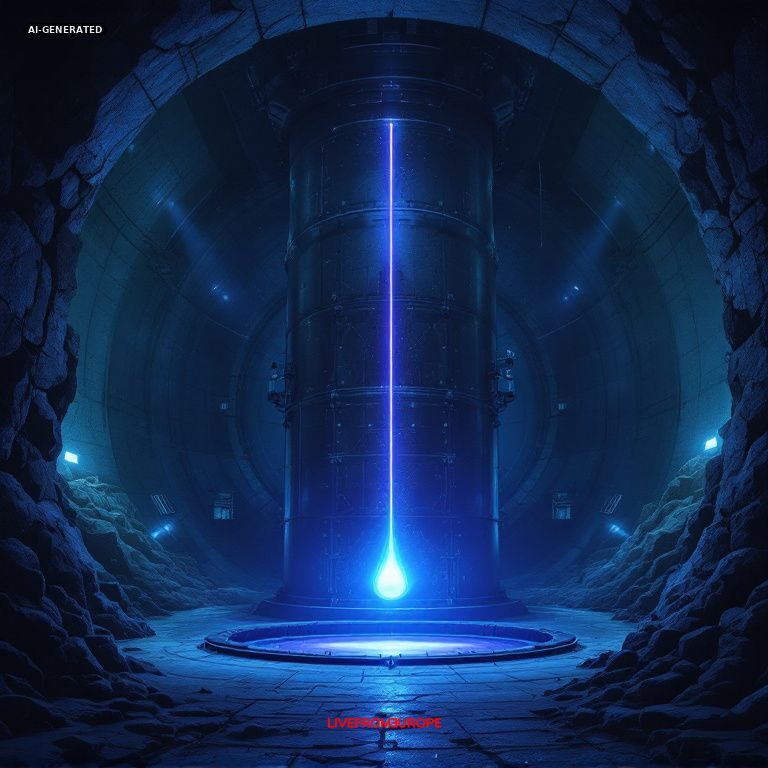
Scientists announced a potential breakthrough in the search for dark matter on Tuesday, describing an interaction observed at the Sanford Underground Research Facility in South Dakota that may involve a hypothesized particle called a WIMP, or weakly interacting massive particle.
The observation occurred during the LUX-ZEPLIN experiment, which uses 10 tons of liquid xenon inside a cylindrical detector to catch rare interactions between dark matter and ordinary matter. Researchers documented a particle collision with a xenon atom’s nucleus, producing a faint flash of ultraviolet light and a nuclear recoil, according to a study submitted to the journal *Physical Review Letters*. The announcement was made at a scientific conference in Japan.
Particle physicist Sam Eriksen of the University of Bristol, lead author of the study, said the observation “could be the first hint of a dark matter observation.” Dark matter, which does not emit or reflect light, is thought to make up about 85% of the universe’s matter, with ordinary matter accounting for the remaining 15%. Its existence is inferred from gravitational effects at galactic scales.
The LZ experiment is managed by the U.S. Department of Energy’s Lawrence Berkeley National Laboratory and is optimized to detect WIMPs, one of the leading candidates for dark matter particles. Scientists are searching for dark matter scattering off xenon atoms, with the properties of resulting light flashes revealing the interacting particle’s type.
In a separate discovery, researchers in Saudi Arabia analyzing DNA from naturally mummified cheetahs found in caves near Arar revealed that at least two cheetah subspecies once roamed the Arabian Peninsula. The findings, published in January in *Communications Earth & Environment*, showed that two of the oldest specimens were genetically closer to the Northwest African cheetah (*Acinonyx jubatus hecki*) rather than the previously assumed Asiatic cheetah (*Acinonyx jubatus venaticus*).
Ahmed Al Boug, lead author and deputy CEO of Saudi Arabia’s National Center for Wildlife, called the discovery “highly surprising,” noting it was the first documented case of natural mummification in cheetahs and the first physical evidence of multiple cheetah subspecies in the region. The cave environment’s hyper-arid conditions contributed to the mummification of seven cheetahs, alongside skeletal remains of 54 additional cats.
Meanwhile, genetic analysis of Scythian elites, including the famed “Golden Man” burial in Kazakhstan, showed that upper-class status was inherited and shared among relatives, according to research published Friday in *Science Advances*. The study confirmed the Golden Man, buried around 400–300 BC, was likely genetically male and belonged to the Saka, a southern Scythian group. Scientists used DNA markers and statistical methods to fill gaps in damaged genetic data.
Follow us for live European news
2 further sources not geolocated

Scientists make potential breakthrough in search for dark matter
news.yahoo.com · about 2 hours ago

Ancient DNA reveals clues about mysterious Golden Man and rise of the Scythian elites
news.yahoo.com · about 2 hours ago

Wimp particle offers clue to identity of dark matter Collision detected in underground lab may help to solve the biggest mystery in physics
financial times · about 2 hours ago

Scientists make potential breakthrough in search for dark matter reut.rs/4zOzPS5
bluesky_Reuters · about 2 hours ago

Resuelto el misterio del cadáver móvil de la tumba antivampiros de Polonia Los investigadores encontraron evidencias de prácticas antidemoníacas, como una hoz en el cuello y un candado en el dedo del pie
la vanguardia · about 2 hours ago

Scientists extracted DNA from mummified cheetah remains and made a surprising discovery
news.yahoo.com · about 2 hours ago