Loading…
 Sunday, August 23Sunday, August 23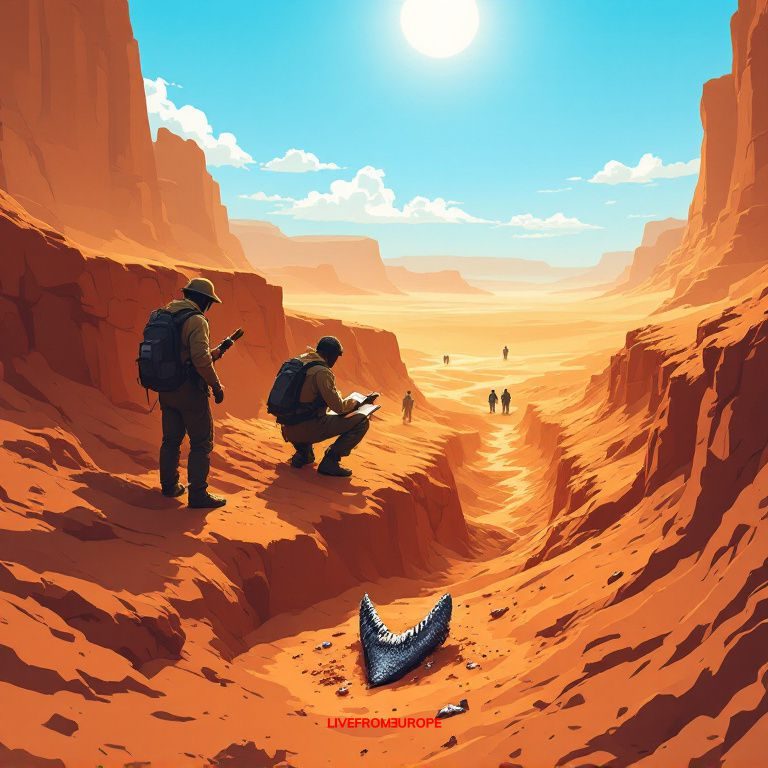
Paleontologists have uncovered fossilized shark teeth in Egypt’s Abu-Tartur Plateau, revealing that at least seven shark species once thrived in the waters covering northern Africa during the Cretaceous period, according to a study published in *Cretaceous Research*. The team, led by Tarek Yassin of the University of Cairo, identified two species previously unknown in Egypt, suggesting a nutrient-rich marine ecosystem supported by upwelling currents that fueled high productivity .
The fossils were found in the Duwi Formation, a layer of sediment that once formed the seabed of a shallow sea spanning parts of North Africa. During the Cretaceous, roughly 145 to 66 million years ago, higher sea levels submerged vast land areas, including regions now part of the Egyptian desert. The presence of phosphate deposits in the area further indicates a historically fertile marine environment, the researchers noted.
In a separate discovery, archaeologists in Peru unearthed human remains at the Huaca Pucllana site in Lima, believed to be part of a ritual burial linked to the pre-Columbian Lima culture, which flourished between the 1st and 7th centuries. The skeleton, found in a pit, was positioned on its left side with its head oriented toward a pyramid and the Pacific Ocean, according to Gladys Paz, the excavation leader. Paz stated the remains could help reconstruct the culture’s ceremonial practices, which predated the Inca Empire by approximately 700 years .
Meanwhile, a long-standing debate over the location of Vilcabamba, the last Inca capital, resurfaced after reports highlighted conflicting claims by explorers. In 1911, American professor Hiram Bingham III announced the discovery of Machu Picchu, asserting it was the lost city. However, in 1964, explorer Gene Savoy argued that the true Vilcabamba—meaning “sacred plain” in Quechua—lay 60 kilometers northwest at Espiritu Pampa, a ruin site above an Amazon tributary. Savoy’s claim was investigated by a BBC team within weeks of his announcement, as the site was believed to have housed Inca resistance efforts against Spanish conquistadors before its abandonment in 1572 .
In Egypt, another archaeological find has puzzled researchers: a 2,000-year-old tomb near Luxor contained a mummified dog placed directly on the legs of a man and woman buried together. The unusual arrangement has raised questions about ancient Egyptian beliefs regarding the afterlife and human-animal relationships .
Follow us for live European news
2 further sources not geolocated

„Nu ne venea să ne credem ochilor: Povestea „adevăratului Indiana Jones, care a descoperit legendarul oraș pierdut al incașilor În 1911, un profesor din SUA a anunțat descoperirea ruinelor de la Machu Picchu, spunând că acestea erau rămășițele vechii fortărețe din Munții Anzi a ultimului rege incaș. Însă, 53 de ani mai târziu, un alt explorator american, poreclit „adevăratul Indiana Jones, a demonstrat că orașul pierdut al incașilor, despre care se spunea că ar ascunde comori fabuloase și care rămâne în continuare acoperit, în mare parte, de junglă, se afla în altă zonă izolată din Peru, relatează BBC.
digi24 · about 5 hours ago
Ein mumifizierter Hund in altägyptischen Grab lässt Archäologen rätseln Forschende stoßen in einem mehr 2000 Jahre alten Grab bei Luxor erstmals auf einen Vierbeiner, der über Mann und Frau lag und diese augenscheinlich in den Tod begleitete
der standard · about 5 hours ago
Can Cyprus sunken treasure ever be found? More than 150 years after she disappeared beneath the waves, the Napried holds a mythological status in the world of underwater archaeology. The ship was carrying thousands of ancient artefacts excavated in Cyprus by Luigi Palma di Cesnola, the American consul whose plunder of antiquities from the island helped disperse a substantial part of Cyprus […]
cyprus mail · about 8 hours ago
Un „cimitir de rechini preistorici, descoperit în deșertul Egiptului. Șapte specii au fost identificate Paleontologii au descoperit în deșertul Egiptului dinți fosilizați care arată că cel puțin șapte specii de rechini au populat apele ce acopereau nordul Africii în urmă cu zeci de milioane de ani. Noile fosile, găsite pe Platoul Abu-Tartur, oferă indicii despre un ecosistem marin extrem de bogat din Cretacic, iar două dintre speciile identificate nu mai fuseseră descoperite până acum în Egipt.
digi24 · about 11 hours ago
Arheologi v Peruju odkrili ostanke okostja človeka, ki je bil verjetno obredno žrtvovan Arheologi so izkopali ostanke okostja odraslega človeka, za katerega menijo, da je bil pokopan kot daritev v bližini vznožja starodavne piramide iz sušene opeke Huaca Pucllana na območju perujske prestolnice Lime.
rtv slovenia · about 13 hours ago