 Tuesday, July 14Tuesday, July 14
5 days · 2 summary articles
Bayeux Tapestry arrives in London for historic British Museum display
Bayeux Tapestry arrives in London for first time in nearly a millennium
The Bayeux Tapestry, the 11th-century embroidered masterpiece chronicling the Norman Conquest of England, arrived in London overnight in a secretive operation that capped nearly a decade of meticulous planning. Transported under maximum security from its home in Normandy, the 70-metre-long artefact reached the British Museum just before 3am on Friday, marking its first departure from French soil in more than 900 years.
British Museum director Nicholas Cullinan called the arrival “a unique moment, the result of immense effort.” Speaking to AFP , he said: “Watching the tapestry arrive at the museum is a moment I will never forget.” The French ambassador to the UK, Hélène Duchene, described it as “very moving,” telling RTVSLO that witnessing its arrival on these shores after a millennium was “particularly poignant.”
The tapestry will go on public display at the British Museum from 10 September 2026 to 11 July 2027, a loan hailed by French President Emmanuel Macron as “a tangible expression of longstanding friendship” between the two nations. UK Culture Secretary Lisa Nandy said it was “a historic moment and a significant act of friendship,” adding that the exhibition offered “a once-in-a-lifetime opportunity to learn about this pivotal period in our national story and our shared heritage.”
Transporting the fragile artefact required extraordinary precautions. The tapestry was folded accordion-style inside a climate-controlled aluminium crate, itself mounted on a shock-absorbing cradle, then loaded onto a truck that crossed the Channel via the Eurotunnel’s vehicle shuttle. Kent and Metropolitan police forces provided a heavy escort from Folkestone to London, where the lorry arrived through empty streets just after 3am. The entire operation was coordinated over 12 months, with two full-scale test runs using a full-scale reproduction to assess risks.
Restorers had moved the tapestry from its museum in north-western Normandy to a secret location last September, amid concerns that its weakened condition—30 tears and nearly 10,000 holes—could make it vulnerable to damage during transit. A 2021 conservation study had warned that any journey exceeding two hours posed serious risks. To mitigate this, the British government secured an £800 million insurance policy—approximately €920 million—covering the loan. Peter Ricketts, a transport coordinator, told RTVSLO that the unprecedented coverage reflected “how seriously we take ensuring it returns in good condition.”
Demand for tickets has already shattered records. Within hours of going on sale, 100,000 advance tickets were sold for the first four months alone, with up to 80,000 people simultaneously queued online. The exhibition has generated an estimated £2.5 million in revenue—€2.93 million—making it the British Museum’s best-selling show in its history.
The tapestry’s journey mirrors the very event it depicts: William, Duke of Normandy, crossed the Channel in 1066 to claim the English throne after the Battle of Hastings. Nearly a millennium later, its return to Britain underscores both the enduring historical ties between France and the UK and the modern challenges of preserving and sharing cultural heritage. As Macron wrote in *The Times*, the loan is “a sign of our shared desire to see France and the United Kingdom build their future together.”
Follow us for live European news
3 further sources not geolocated

Tajna operacija zaključena: 70-metrska tapiserija iz Bayeuxa je prispela v London Znamenito tapiserijo iz Bayeuxa iz 11. stoletja, ki bo od septembra za enajst mesecev na ogled v Britanskem muzeju, so danes v zgodnjih jutranjih urah pripeljali v London. Kot kaže, bo to najbolj prodajana razstava v zgodovini muzeja.
rtv slovenia · 4 days ago

Bayeux Tapestry Arrives in U.K. After Maximum-Security Operation The 11th-century tapestry will go on display at the British Museum in September. Tickets for the exhibition have already been selling rapidly.
new york times · 4 days ago

🏴 🇫🇷 The medieval Bayeux Tapestry arrived in London in the early hours of Friday after a hugely complicated journey to leave France for the first time in more than 900 years for an exhibition in the British capital. ➡️ u.afp.com/SKRw
bluesky_AFP English · 4 days ago
🏴🇫🇷 Woman on decade-long mission to recreate Bayeux Tapestry In eastern England, Mia Hansson has spent the last decade recreating one of historys most famous embroidered artworks. But Hansson says she started the project for the craftsmanship, not the history.
bluesky_AFP English · 4 days ago

Bayeux tapestry arrives on British shores for once-in-a-lifetime exhibition
bluesky_The Guardian · 4 days ago
The Bayeux Tapestrys risky journey across the Channel Nearly 1,000 years after chronicling the Norman conquest of England, the Bayeux Tapestry is making history once again. The fragile 11th-century embroidery has arrived in London on an unprecedented loan to the British Museum, prompting delight and concern in equal measure. Celebrated as one of Europes greatest medieval treasures, its journey has reignited debates over heritage, diplomacy and the risks of moving delicate cultural artefacts.
france24 · 4 days ago
The Bayeux Tapestrys extraordinary journey back to Britain After nearly 1,000 years, the Bayeux Tapestry has returned to the UK for a year-long exhibition at the British Museum. Its highly secretive and carefully controlled journey involved police escorts, a specially designed case and strict conditions to protect the fragile medieval masterpiece, in a move seen as a symbol of Franco-British ties.
france24 · 4 days ago
Medieval masterpiece Bayeux Tapestry arrives in London The Bayeux Tapestry has arrived in London for the first time in more than 900 years after a highly secure and complex journey from France to the British Museum, as FRANCE 24s Rochelle Ferguson-Bouyahi explains. The 11th-century masterpiece depicting the Battle of Hastings will be displayed from September 2026 to July 2027, in a historic loan hailed as a symbol of Franco-British ties.
france24 · 4 days ago
Vespa incontra lAmerigo Vespucci a New York. Nasce un esemplare unico Due simboli del Made in Italy si sono incontrati per la prima volta oltreoceano. A New York, dove lAmerigo Vespucci è ormeggiata per partecipare ai festeggiamenti di Sail4th250, dedicati ai 250 anni degli Stati Uniti, è stato svelato un esemplare unico di Vespa ispirato alla nave scuola della Marina Militare Italiana. La speciale Vespa rende […] Larticolo Vespa incontra lAmerigo Vespucci a New York. Nasce un esemplare unico proviene da Il Fatto Quotidiano.
il fatto quotidiano · 4 days ago
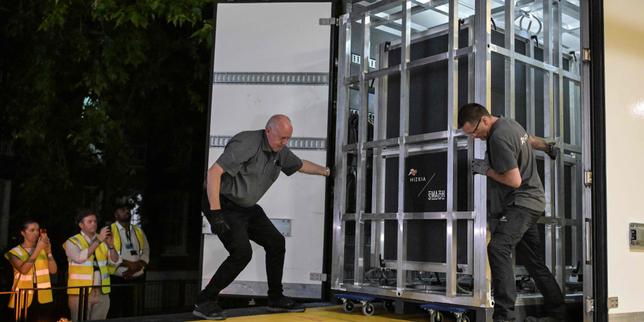
La tapisserie de Bayeux est arrivée au British Museum, à Londres, pour un prêt historique « Cest un moment unique, fruit dun travail acharné, dune planification minutieuse », sest réjoui le directeur du British Museum, Nicholas Cullinan. La tapisserie sera exposée dans ce musée à partir du 10 septembre et jusquau 11 juillet 2027.
le monde · 4 days ago
:format(jpg)/f.elconfidencial.com%2Foriginal%2F96a%2F7db%2F4ec%2F96a7db4ec863a04f318742c374e66d77.jpg)
Viaja a la Edad Media sin salir de Asturias: más de 80 puestos, exhibiciones de cetrería y carreras de cintas a caballo este fin de semana Uno de los momentos más esperados será la gran cena medieval, cuyo menú incluirá paté, croquetas, buñuelos de merluza, trenca en salsa con patatas y crema de limón, en un fin de semana repleto de actividades inspiradas en la Edad Media
el confidencial · 4 days ago
France: la célèbre tapisserie de Bayeux est arrivée au British Museum de Londres Arrivée dans la nuit du jeudi 9 au vendredi 10 juillet dans la capitale britannique, lœuvre, qui décrit la conquête de lAngleterre par Guillaume le Conquérant en 1066, est prêtée au Royaume-Uni par la France pour une durée dun an. Pour le musée londonien, son exposition sannonce dores et déjà comme lévènement de tous les superlatifs.
rfi.fr · 4 days ago
World-famous tapestry arrives in London overnight The Bayeux Tapestry arrived in London on Friday, leaving France for the first time in over 900 years. The approximately 70-meter-long tapestry depicts the Norman conquest of England and the Battle of Hastings in 1066. Transported under high security with a police escort, it arrived at the British Museum in a specially built metal box, […]
cphpost · 4 days ago