
Jellyfish clog cooling system forcing shutdown of two reactors at Frances Gravelines nuclear plant
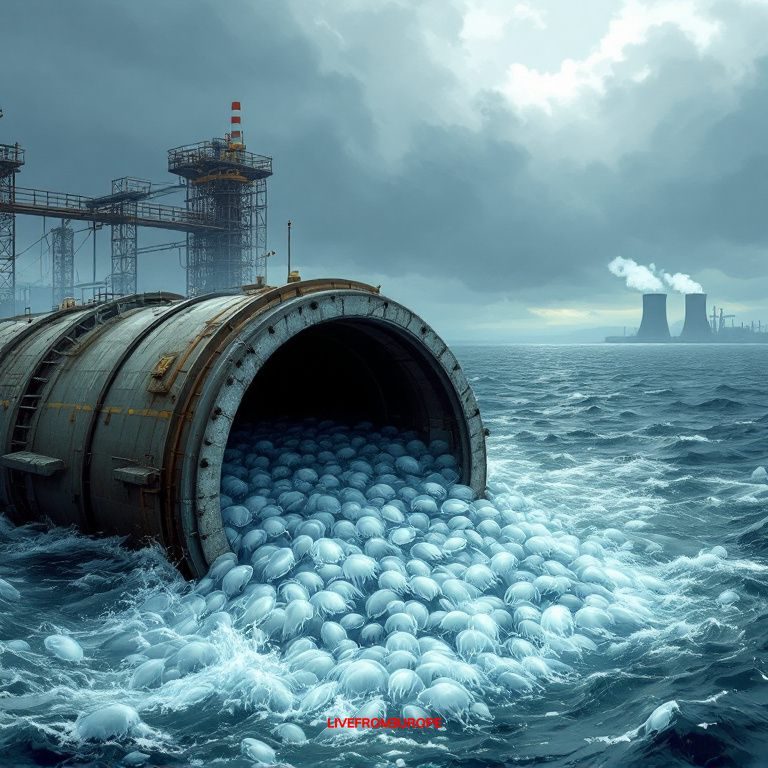
Two reactor units at France’s Gravelines nuclear power plant were shut down on Wednesday and Thursday after more than 200 metric tons of jellyfish clogged the facility’s seawater filtration systems, operator Électricité de France said.
A company spokeswoman told the Deutsche Presse-Agentur that the jellyfish appeared near the plant’s pump station filters overnight. Two of the six reactor blocks were fully powered down as a precaution “to ensure that this situation has no impact whatsoever on the safety of our facilities.” Two additional units were operating at reduced capacity, while the remaining two were already offline—one due to a technical issue and another for maintenance, according to EDF .
As of Thursday, none of the plant’s six reactors were running at full capacity. Unit 6 was taken offline early Thursday, followed by Unit 3 later in the day, EDF confirmed on its website. Units 1 and 2 were operating at reduced power, while Unit 4 remained shut after an earlier jellyfish-related stoppage on Aug. 10, and Unit 5 was down for scheduled maintenance .
The plant, located on France’s northern coast between Calais and Dunkerque, has faced repeated jellyfish disruptions this month and in August 2025. EDF said it has installed monitoring and detection systems to identify jellyfish swarms early, with support from the organization France Pêche Durable. Seven boats are operating around the clock near the plant to capture jellyfish and release them farther offshore .
The spokeswoman said the cause of the jellyfish surge remains unclear, though EDF is working with partners to better understand the phenomenon. She emphasized that the incident poses no risk to the power grid .
Gravelines, one of France’s largest nuclear stations, uses seawater from a canal connected to the North Sea for cooling. Jellyfish activity typically increases in warmer months due to higher plankton levels, experts noted . Similar jellyfish-related shutdowns have occurred at other plants, including Scotland’s Torness in 2011 and Sweden’s Oskarshamn in 2013 .
Follow us for live European news
- 2
- 1
- 1
- 1
- 1
Articles

Des réacteurs nucléaires de nouveau mis à larrêt à cause "darrivées massives de méduses" À Gravelines, un nouvel afflux massif de méduses perturbe le fonctionnement de la centrale nucléaire, où aucun des six réacteurs ne tourne normalement jeudi. ...
la libre · about 1 hour ago

Meerestiere: 200 Tonnen Quallen legen Atomreaktoren in Frankreich lahm Die französische AKW-Anlage Gravelines ist mit sechs Reaktoren die größte des Landes. Zum zweiten Mal in diesem Monat stören Tierchen den Betrieb. Was tut der Betreiber dagegen?
handelsblatt · about 1 hour ago
Reactoare ale celei mai mari centrale nuclearo-electrice din Franța au fost închise din cauza invaziei meduzelor Reactoare ale centralei nuclearo-electrice Gravelines, cea mai mare din Franţa, au fost închise din nou din cauza unui aflux de meduze, informează dpa. Gravelines, una din cele aproape 20 de centrale nuclearo-electrice ale Franţei, este situată pe coasta de nord, aproximativ la jumătatea distanţei dintre Calais şi Dunkerque.
digi24 · about 1 hour ago
Jellyfish force partial shutdown of French nuclear plant It is the second consecutive year that jellyfish has forced the closure of the Gravelines power station in northern France.
bbc · about 1 hour ago
Im größten AKW Frankreichs: 200 Tonnen Quallen legen Reaktoren in Gravelines lahm Schon zum zweiten Mal in diesem Monat stören die Tiere den Betrieb. Reaktorblöcke werden abgeschaltet oder müssen ihre Leistung drosseln. Der Betreiber sieht sich zu kreativen Maßnahmen gezwungen.
tagesspiegel · about 2 hours ago
Ecologically catastrophic | Libération - France
eurotopics.net · about 2 hours ago