Loading…
 Saturday, September 26Saturday, September 26
3 months · 3 summary articles
Rescue teams withdraw as Venezuela quake toll rises with thousands missing
Death toll rises as rescue teams race against time in Venezuela earthquakes
Boy rescued alive three days after Venezuela earthquakes as death toll rises
The death toll from Venezuela’s twin earthquakes has risen to at least 1,450, with rescue teams racing against time as hopes of finding survivors fade five days after the disaster. National Assembly President Jorge Rodriguez confirmed the updated figure on Sunday, while more than 3,150 people remain injured and 12,721 have been displaced. International aid teams, including those from the European Union, Turkey, and Lithuania, have joined local efforts, but frustration is growing over the government’s response and the lack of coordination.
Aerial footage reveals entire neighborhoods in Caracas and La Guaira reduced to rubble, with 189 buildings completely collapsed. Rescue workers, aided by search dogs and advanced technology, have pulled 33 survivors from the debris over the weekend, including a father and son found alive four days after the quakes. Yet the critical 72-hour window for live rescues has passed, and a new 4.6-magnitude aftershock rattled the capital early Monday, further destabilizing already precarious structures.
Among the most poignant stories is that of Dayana Patiño, an 18-day-old baby, and his mother, rescued from the ruins of a collapsed high-rise in La Guaira. Patiño, trapped with her newborn son, credited the infant with giving her the strength to survive. Their rescue has become a symbol of hope amid the devastation, though the broader humanitarian crisis deepens. Over 50,000 people are still missing, according to local reports, and the death toll is expected to climb as recovery operations continue.
Criticism of the government’s handling of the crisis is intensifying. An editorial in *El Nacional* lamented the absence of the military in relief efforts, while international observers note bureaucratic chaos and a lack of unified command slowing aid delivery. Engineers have urged audits of state housing, citing poor construction standards as a factor in the collapse of buildings. Meanwhile, China pledged $14.7 million in aid and satellite support, and the U.S. doubled its assistance to $300 million, targeting healthcare, food, and shelter.
As the focus shifts from rescue to recovery, experts warn the disaster will exacerbate Venezuela’s existing economic and displacement crises. The International Rescue Committee’s Elinor Raikes described the quakes as a collision of natural disaster and systemic vulnerabilities, with recovery likely to span months rather than weeks. For now, the world watches as Venezuela confronts the grim aftermath of a catastrophe that has left thousands grieving and millions in need.
Follow us for live European news
6 further sources not geolocated

Mother pulled from rubble of earthquake in Venezuela with newborn son says he motivated her to stay alive Dayana Patino was trapped under the rubble with her 18-day old son after the quake in Caracas
independent · 3 months ago

Lithuania sends aid teams to earthquake-hit Venezuela Lithuania dispatched rescue and medical teams to earthquake-hit Venezuela on Sunday after the government approved an aid mission.
lrt · 3 months ago
Sentinel-1 shows ground displacement after Venezuela earthquakes Image: The map is an interferogram derived from the comparison of Sentinel-1 data on two dates: on the 18 June before the earthquakes and on 25 June a day after.
esa · 3 months ago

Cabinet of the Blacklisted: Sanctioned Loyalists Take Charge of Venezuelas Quake Relief www.occrp.org/en/news/cabi...
bluesky_OCCRP · 3 months ago

Engineers urge Venezuela to audit state housing after deadly quake reut.rs/4xPv1L7
bluesky_Reuters · 3 months ago
BREAKING: Strong earthquake aftershock felt in Venezuela capital Caracas, days after devastating earthquakes READ: @insiderpaper
telegram_Insider Paper · 3 months ago
Caos nei soccorsi in Venezuela, burocrazia e mancanza di una regia comune rallentano le operazioni: Impossibile comunicare, non abbiamo neanche gli interpreti Nessuna tregua. Scosse, giorno e notte. La terra tremava anche stamattina, a Caracas e a Guanare, alle 7.01 ora locale. Resta elevato (84) il rischio di unaltra forte scossa. Tensioni e incertezze salgono insieme alla cifra dei dispersi, ora a quota 50mila, secondo il portale Venezuelareporta.org, mentre la conta ufficiale dei morti è ferma a […] Larticolo Caos nei soccorsi in Venezuela, burocrazia e mancanza di una regia comune rallentano le operazioni: Impossibile comunicare, non abbiamo neanche gli interpreti proviene da Il Fatto Quotidiano.
il fatto quotidiano · 3 months ago
La cagnolina Tsunami è il simbolo del terremoto in Venezuela: con il suo fiuto ha aiutato a individuare quasi 100 persone sotto le macerie Nel Venezuela ferito dal terremoto, dove le squadre di soccorso continuano a scavare tra cumuli di cemento e acciaio nella speranza di trovare superstiti, cè uneroina che non indossa una divisa. Ha il manto bianco e nero, un occhio azzurro e uno marrone e risponde al nome di Tsunami. È una border collie addestrata per […] Larticolo La cagnolina Tsunami è il simbolo del terremoto in Venezuela: con il suo fiuto ha aiutato a individuare quasi 100 persone sotto le macerie proviene da Il Fatto Quotidiano.
il fatto quotidiano · 3 months ago
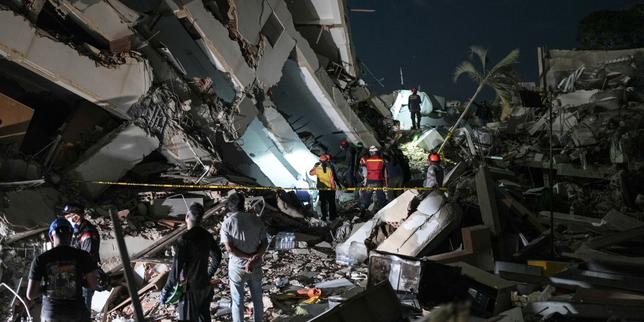
Venezuela : forte secousse ressentie à Caracas et La Guaira, cinq jours après le double séisme meurtrier Le double séisme survenu mercredi a fait au moins 1 450 morts et des dizaines de milliers de disparus, selon le dernier bilan. Le pays oscille entre farouche volonté de sauver des vies supplémentaires et exaspération à légard dautorités jugées défaillantes.
le monde · 3 months ago
Berlin / Brandenburg: Venezuela: Totenzahl steigt nach Erdbeben auf mehr als 1.400 Venezuela: Totenzahl steigt nach Erdbeben auf mehr als 1.400
tagesspiegel · 3 months ago
Venezuela: Wettlauf gegen die Zeit – Hoffnung auf Überlebende schwindet Nach den schweren Erdbeben bleibt die humanitäre Lage in Venezuela prekär. Nachbeben erschweren die Suche. Aus der EU sind bereits Einsatzkräfte vor Ort.
handelsblatt · 3 months ago
Türkiyes rescue teams begin operations in Venezuela Teams from Türkiyes Disaster and Emergency Management Authority and the Turkish Armed Forces have commenced search operations in Venezuela following twin earthquakes that killed more than 1,400 people, focusing their efforts on a collapsed 14-story building in La Guaira where survivors are believed to remain trapped under the rubble.
yenisafak · 3 months ago
Venezuela quake death toll climbs to 1,450: Top official National Assembly President Jorge Rodriguez announced on Sunday that the death toll from two powerful earthquakes that struck Venezuela has climbed to 1,450, with more than 3,150 people injured and 12,721 displaced as international rescue teams join ongoing search operations across the devastated regions.
yenisafak · 3 months ago
China pledges $14.7M aid, satellite support for Venezuela quake Foreign Ministry spokesperson Guo Jiakun said Beijing will deliver emergency supplies worth 100 million yuan to Caracas in the coming days, adding that the assistance will support both immediate relief operations and longer-term reconstruction efforts in the earthquake-hit South American nation.
yenisafak · 3 months ago
Venezuela : Caracas et La Guaira de nouveau touchés par une forte secousse sismique Cinq jours après le double séisme qui a fait près de 1 500 morts, la capitale du pays est de nouveau frappée par un tremblement de terre.
liberation · 3 months ago
Debate: After the earthquake: who is helping the Venezuelans? Two devastating earthquakes struck Venezuela last week, claiming more than 1,400 lives and leaving tens of thousands injured, missing or homeless. Entire blocks of buildings collapsed. Rescue teams from within the country and abroad continue the search for survivors. Commentators see more in play here than a spontaneous readiness to help.
eurotopics.net · 3 months ago
FirstFT: AI fuels record number of power sector deals Also in todays newsletter: Venezuelas government faces backlash over earthquake response; and how top executives stay fit
financial times · 3 months ago
Venezuela earthquake rescues: Five heart-warming moments Amid the death and destruction, a few fleeting moments have brought rare relief to Venezuelans.
aljazeera · 3 months ago
Aerial images reveal scale of destruction after Venezuela earthquakes Four days after twin quakes hit Venezuela, rescues continue at Los Cocos beach, with 1,500 dead, 189 buildings down and a father and son pulled alive.
euronews · 3 months ago

🇻🇪 Hopes are fading of finding survivors more than four days after powerful twin earthquakes struck Venezuela, as residents grow increasingly frustrated with the governments response to the disaster that has killed at least 1,450 people and left tens of thousands unaccounted for. ➡️ u.afp.com/SKUo
bluesky_AFP English · 3 months ago
⚡️Video of the earthquake in Venezuela Absolutely devastating… 💧 Rainbet.com the #1 Non-KYC Crypto Casino & Sportsbook @rainbetcom +18
telegram_War Monitors · 3 months ago
Google earthquake alerts warned 11.4M before Venezuelas quakes Venezuela has no national earthquake warning system. Yet moments before two huge quakes hit on Wednesday, millions of phones lit up. Google earthquake alerts reached 11.4 million people, the company says, buying some of them up to two minutes to act. The warnings came from Googles Earthquake Alerts system, which turns ordinary Android phones into […] This story continues at The Next Web
the next web · 3 months ago

De nouvelles secousses au Venezuela après le double séisme de mercredi Une forte secousse a de nouveau touché Caracas et La Guaira lundi matin peu après 07h00 locales (11H00 GMT), ont ressenti des journalistes de lAFP, près de cinq jours après le double séisme dont le bilan provisoire avoisine déja les 1.500 morts. ...
la libre · 3 months ago
Cutremure în Venezuela: Bilanţul deceselor urcă la 1.450. 189 de clădiri s-au prăbuşit complet Echipele de salvare, însoţite de câini de urmă, au căutat duminică ultimii supravieţuitori ai celor două cutremure puternice care au lovit săptămâna trecută Venezuela. Bilanţul a urcat la 1.450 de morţi şi 189 de clădiri complet prăbuşite, transmite AFP, preluat de Agerpres.
digi24 · 3 months ago
Un nou cutremur puternic a zguduit Venezuela, la cinci zile după seismul devastator care a ucis aproape 1.500 de oameni Un cutremur cu magnitudinea 4,6 a zguduit din nou oraşele Caracas şi La Guaira, luni, în jurul orei locale 07:00 (11:00 GMT), potrivit Institutului de Prospectare Geologică al Statelor Unite (USGS), la aproape cinci zile după dublul seism care a ucis deja aproape 1.500 de persoane.
digi24 · 3 months ago
Mirakelräddning i Venezuela: Man hittad vid liv Chanserna att hitta överlevande efter skalven i Venezuela minskar minut för minut. Men mirakel sker – på måndagen räddades en 21-åring från rasmassor i La Guaira.Samtidigt skakades den redan hårt drabbade kustregionen av ett kraftigt efterskalv.
svenska dagbladet · 3 months ago

Bebis räddades ur rasmassorna: Kände om han andades Småbarnsmamman Dayana Patino och hennes 18 dagar gamla son Juan David hittades vid liv i rasmassorna i La Guaira. Hennes berättelse sprider hopp i Venezuela där räddningsinsatsen nu är inne på fjärde dygnet.
dagens nyheter · 3 months ago
Venezuela earthquakes: International rescue teams join the search for survivors as death toll surpasses 1,400 Continue reading Venezuela earthquakes: International rescue teams join the search for survivors as death toll surpasses 1,400 at The European Sting - Critical News & Insights on European Politics, Economy, Foreign Affairs, Business & Technology - europeansting.com.
european sting · 3 months ago
New aftershocks rattle Venezuelas quake zone as death toll nears 1,500 A new earthquake shook Venezuelas devastated coast on June 29, five days after twin quakes flattened entire neighbourhoods, as the death toll climbed to at least 1,450 and the window for finding survivors alive in the rubble effectively closed.
intellinews · 3 months ago
Neymar a donat o avere pentru victimele cutremurelor din Venezuela. Nici familia Messi nu a rămas indiferentă în fața tragediei Dezastrul natural din Venezuela a avut consecințe tragice și pentru lumea fotbalului.
adevarul · 3 months ago