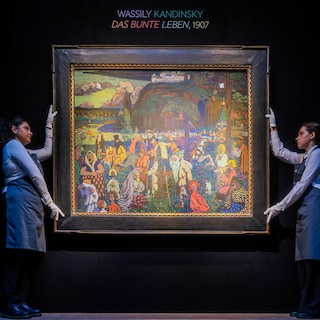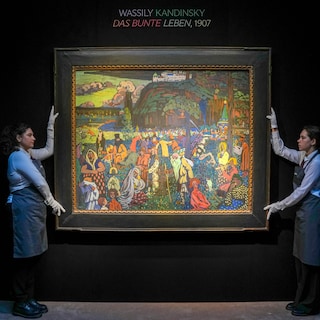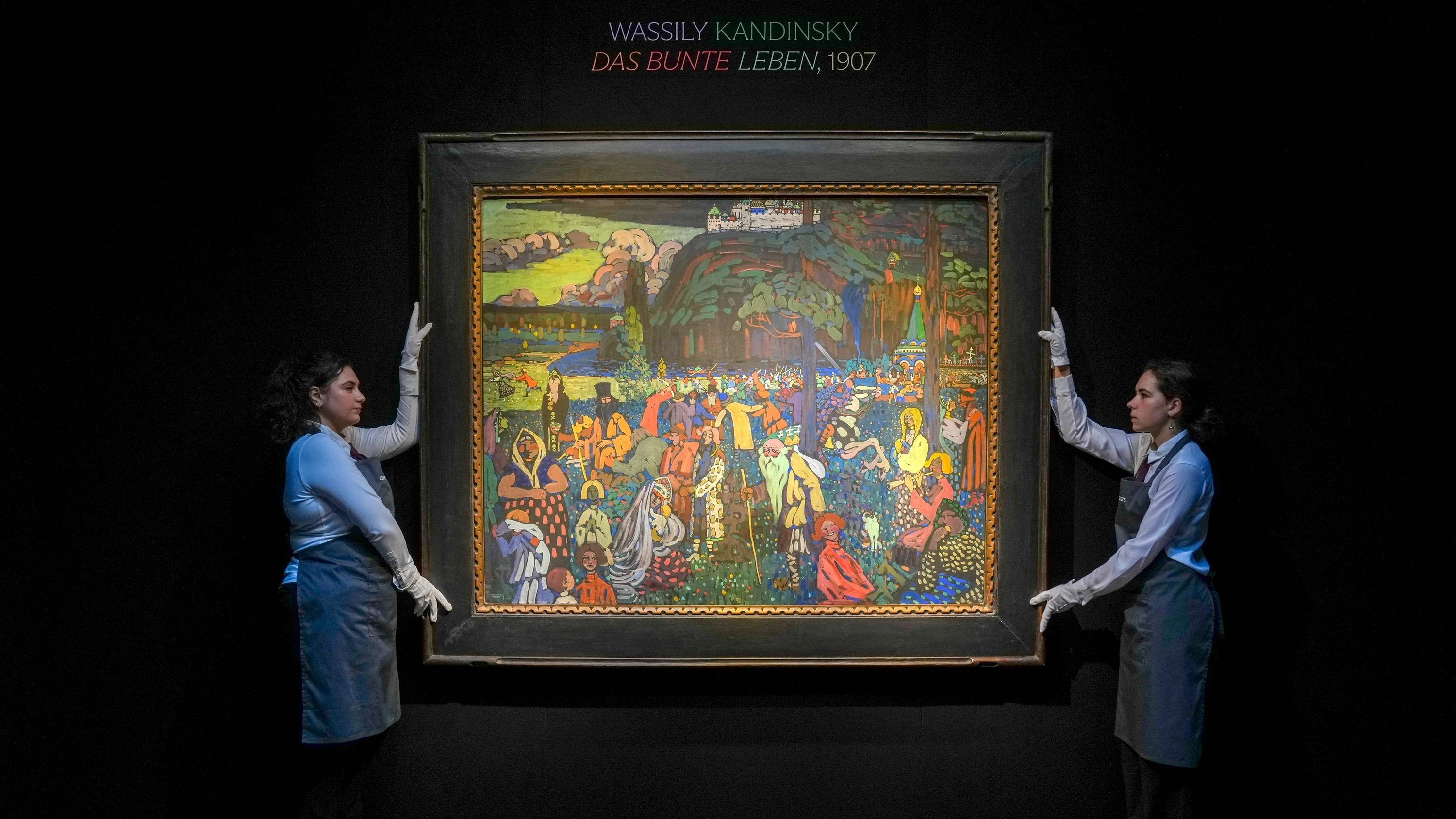
Wassily Kandinsky’s *Das bunte Leben* sold for £27 million (about €32 million) at Christie’s London on Wednesday evening, following its restitution to the heirs of the Jewish collector family Lewenstein.
The 1907 painting, a key work in Kandinsky’s oeuvre, was classified as Nazi-looted art in 2023 and returned to the descendants of Emanuel Albert Lewenstein and Hedwig Lewenstein-Weyermann. The couple had acquired the piece in 1927, and after Emanuel’s death, Hedwig loaned it to Amsterdam’s Stedelijk Museum. In October 1940, during the Nazi occupation of the Netherlands, the work was auctioned without the family’s consent, according to the heirs’ legal argument. Provenance research later supported their claim, leading to its restitution.
Christie’s specialist Keith Gill described the painting as “a groundbreaking work that encapsulates the development of the artist’s formal language and foreshadows the extraordinary evolution of his style in the years that followed,” noting its deep ties to Russian cultural traditions. The tempera piece, featuring Old Russian motifs and fairy-tale figures, was painted in Paris under the influence of Fauvism, Symbolism, and Art Nouveau, and was exhibited at the 1907 Paris Autumn Salon.
The painting passed through several hands after the 1940 sale, including collector Salomon B. Slijper, whose family sold it in 1972 to Bayerische Landesbank. The bank loaned it to Munich’s Lenbachhaus in 1973, where it remained for decades before the restitution process began. The heirs’ legal battle centered on the 1940 auction, which they argued was conducted under duress as the family fled the Nazis to the U.S. in 1938. Germany’s Advisory Commission on Nazi-looted art ultimately ruled in their favor.