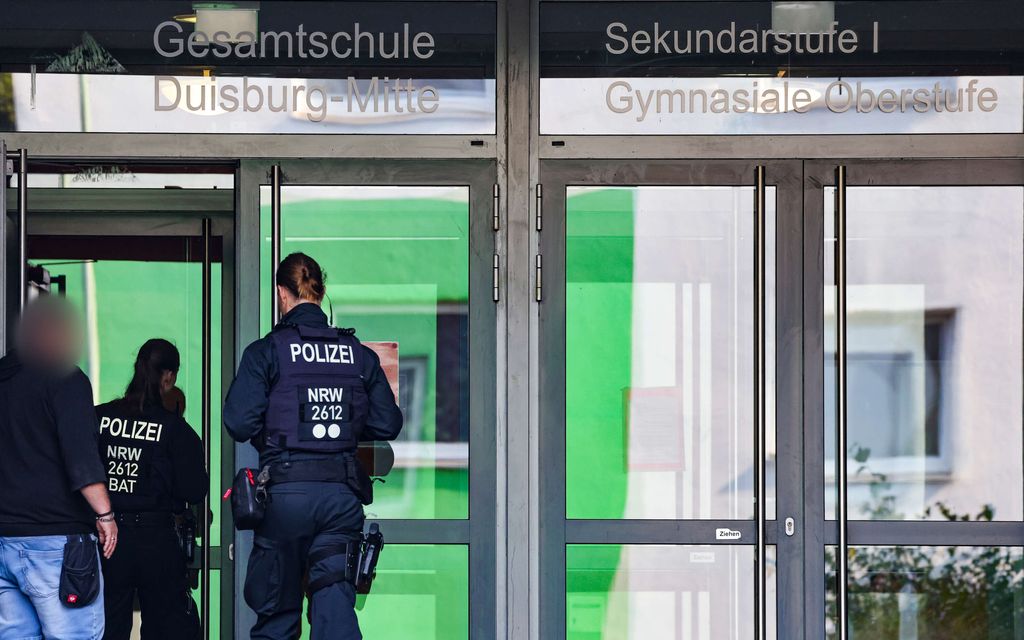

Hundreds of schools in Germany and Denmark received emailed bomb threats on Monday that police say are hoaxes.
About 450 schools across Germany received the messages, according to Freiburg police [1]. Targets included institutions in Berlin, Hamburg and Lower Saxony. Schools in Thuringia were among those hit, along with institutions in North Rhine-Westphalia and Bavaria. Saxony and Mecklenburg-Western Pomerania also reported threats [2]. In Denmark, several schools nationwide received identical emails. The German messages demanded the resignation of Chancellor Friedrich Merz's government. They also called for the introduction of sharia law and ended with the phrase "Allahu Akbar!" [2]. Danish emails carried the subject line "death awaits you". They claimed a plastic bag containing explosives made of ammonium nitrate and nitromethane had been left in the building with a remote detonator [3]. The messages were mostly identical to one another, according to police in Rhineland-Palatinate [2].
Police in both countries said they found no evidence of real danger. Berlin police stated there was no indication that the targeted schools faced any concrete threat [1]. In Thuringia, officials told schools to maintain normal teaching schedules [4]. Danish police said they saw no need to evacuate schools or take special security measures [5]. Copenhagen police chief Simon Hansen said many recipients received the same email [4].
The threats fit a broader pattern of false bomb threats across Europe since mid-October [5]. Schools in Italy, Spain and Northern Ireland have received similar messages [1]. Airlines, airports and media outlets have also been targeted [5]. Supermarkets and blood donation centers were hit as well [4]. Last week, more than 10 Spanish schools were evacuated after receiving threats [4]. European intelligence agencies are investigating whether Russia was involved in sending the threats, according to the Financial Times [5]. Some European officials suspect Moscow aims to disrupt daily life in countries supporting Ukraine [4]. Some countries have also suspected Iran's involvement [1]. Russia has denied the accusations [4].
A German Interior Ministry spokesman said the incidents fit a broader picture of recent bomb threats in Europe that have all proven false [1]. Thuringia Interior Minister Georg Maier said the initiative had the character of an attack from outside [2]. He said this was sufficient to trigger fears and destabilize the country [2].