Loading…
 Thursday, August 6Thursday, August 6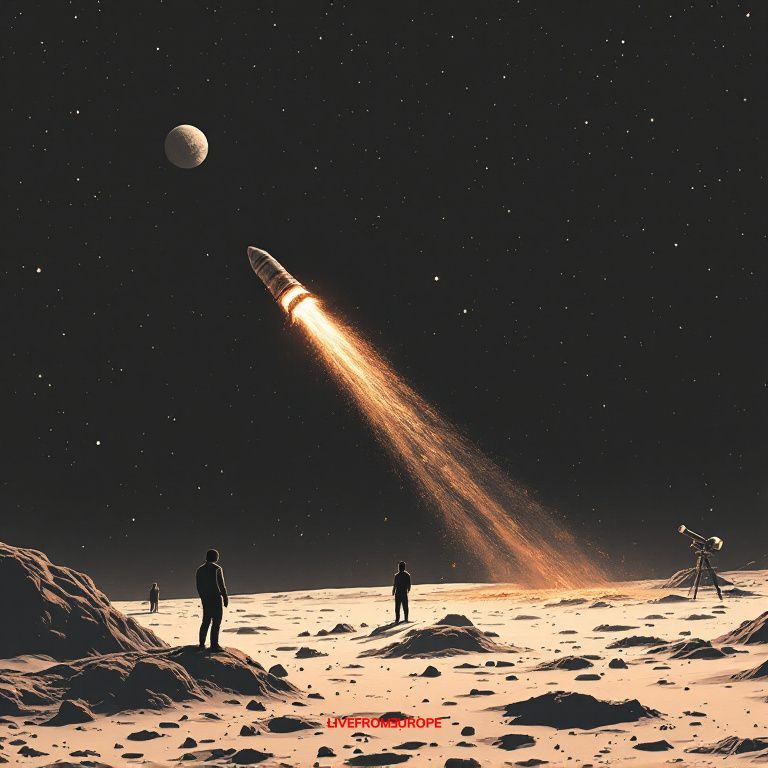
1 day · 2 summary articles
SpaceX rocket debris crashes into moon, creating plume detected by European telescope
SpaceX rocket stage to crash into Moon on Wednesday, creating new lunar crater
A four-tonne piece of a SpaceX Falcon 9 rocket crashed into the moon early Wednesday, creating a debris plume detected by the European Southern Observatory’s Very Large Telescope in Chile.
The impact occurred around 06:35 GMT near the moon’s Einstein Crater, according to Carl Schmidt, a research assistant professor of astronomy at Boston University who led the observations. The telescope recorded spectral lines of sodium and lithium gas in the plume, which lasted 5-10 minutes, said Dr. Bárbara Ferreira, ESO’s media manager. Ferreira noted the sodium likely originated from lunar soil, while the lithium may have come from the rocket itself .
The rocket’s upper stage had been adrift in space since January 2025, when a Falcon 9 launched two commercial lunar landers. Julianna Scheiman, SpaceX’s director of NASA Science and Dragon Programs, previously said the stage deviated from its calculated path due to a mix of solar activity and gravitational forces, sending it toward the moon unintentionally .
NASA and South Korea’s space agency had announced plans to capture images of the impact site using their lunar orbiters, but confirmation of those images was still pending as of Wednesday. The U.S. agency aims to establish a sustained human presence on the moon, making data on space debris collisions valuable for future missions .
The plume stretched several tens of kilometers, with Schmidt describing it as the most visible aspect of the collision. Benjamin Fernando, a postdoctoral fellow at Los Alamos National Laboratory, confirmed the detection using the telescope’s Ultraviolet and Visual Echelle Spectrograph, which identified the rocket’s chemical signature dispersed across the lunar surface .
The European Space Agency estimates over 46,000 pieces of space debris, totaling roughly 17,000 tonnes, currently orbit Earth. While meteorites frequently strike the moon, collisions with rocket parts or other artificial debris remain rare .
Follow us for live European news
3 further sources not geolocated

SpaceX‑Raketenteil schlägt auf dem Mond ein – Teleskop liefert erste Daten Ein SpaceX‑Raketenteil ist ungeplant auf dem Mond eingeschlagen. Das hat die Europäische Südsternwarte bestätigt. Die oberste Raketenstufe war nach dem Start zweier Mondlander vor eineinhalb Jahren vom Kurs abgekommen.
welt.de · about 3 hours ago

SpaceX maandus Kuule – mitte päris plaanipäraselt ja see oli korralik katastroof Pärast ligi kaks aastat kestnud kontrollimatut eksirännakut Maa ja Kuu vahelises ruumis lõppes ühe SpaceX-i Falcon 9 kanderaketijäänuse teekond 5. augustil plahvatusliku finaaliga. Ligi neljatonnine raketiosa paiskus vastu Kuu pinda kiirusega umbes 8700 km/h, mille tulemusel tekkis meie taevase kaaslase pinnasesse uus, kuni 40-meetrise läbimõõduga kraater.
postimees · about 3 hours ago
Vom Kurs abgekommen: Vier Tonnen Schrott von SpaceX-Rakete schlagen auf dem Mond ein Eine ungeplante, aber jetzt erwartete Bruchlandung: Anfang 2025 hatte die Falcon 9 Material ins All befördert. Forscher bestätigen, dass jetzt Teile der Rakete auf dem Erdtrabanten niedergegangen sind.
tagesspiegel · about 3 hours ago
Ce au descoperit cercetătorii după ce fragmentul din racheta SpaceX s-a prăbușit pe Lună. Norul uriaș detectat de un telescop din Chile Un nor de praf întins pe zeci de kilometri s-a ridicat deasupra suprafeței Lunii după impactul cu o parte a unei rachete SpaceX. Fenomenul, vizibil doar câteva minute, le-a oferit astronomilor indicii despre compoziția norului și urmele lăsate de coliziune.
digi24 · about 3 hours ago
Ce au văzut oamenii de știință când racheta SpaceX a lovit Luna cu o viteză de 8.700 km/h Telescopul din Chile al Observatorului European a surprins dovezi ale impactului provocat de o bucată uriașă dintr-o rachetă SpaceX care s-a prăbușit pe Lună în timp ce se deplasa cu o viteză de 8.690 km/h, relatează The Guardian. Gaze de sodiu și litiu s-au format într-un uriaș nor de praf lunar ridicat după impact, potrivit imaginilor …
hotnews.ro · about 4 hours ago
Artemis III Orion Modules Joined: Europes Engine Must Now Insert Crew Into Orbit
gdeltproject.org · about 5 hours ago
Wissenschaftler bestätigen: SpaceX-Raketenteil auf Mond eingeschlagen Die Europäische Südsternwarte in Chile entdeckt entsprechende „Spektrallinien. Die Bilder des Einschlags sollen zu Forschungszwecken dienen.
die presse · about 5 hours ago
ESO bestätigt: SpaceX-Raketenteil auf Mond eingeschlagen
orf.at · about 5 hours ago
Foguetão da SpaceX colidiu com a Lua, mas NASA descarta risco para a Terra Num vídeo publicado na rede social X, a NASA explica que a colisão ocorreu devido a uma combinação de actividade solar e das forças gravitacionais que alteraram a trajectória do objecto.
publico · about 5 hours ago

A SpaceX rocket collided with the moon. Heres what to know
news.yahoo.com · about 5 hours ago

Un resto del cohete de SpaceX se estrella contra la Luna y levanta una nube de polvo El fragmento, del tamaño de un autobús escolar, lleva flotando en el espacio desde el año pasado
la vanguardia · about 6 hours ago

Crash dune fusée SpaceX sur la Lune, Fifa, Nigeria, DZ Mafia, Bangladesh : les informations de la nuit Les principales actualités de ces dernières heures vues par la presse internationale.
courrier international · about 6 hours ago
Welp, Nobody Saw SpaceXs Falcon 9 Rocket Crash Into the Moon Although no one captured a direct image of the impact, scientists have detected signals confirming the rocket hit the lunar surface. Orbiters could provide the first images of the crash site in the coming days.
wired.com · about 7 hours ago
Defunct SpaceX rocket crashes into the moon, kicks up dust A SpaceX rocket piece floating in space since last year smashed into the moon at high speed early Wednesday morning, joining the ranks of meteoroids, wayward spacecraft and…
japantoday · about 8 hours ago
SpaceX: Schrottteil von SpaceX-Rakete auf Mond eingeschlagen Die Falcon 9 hatte vergangenes Jahr zwei Mondlandegeräte ins All befördert. Nun wurde bestätigt, dass ein vier Tonnen schweres Teil der Rakete auf dem Mond aufschlug.
die zeit · about 9 hours ago
Stray piece of SpaceX rocket crashes on moon Where were our interceptors?
financial times · about 9 hours ago
New Glenn explosion linked to rocket engine valve Blue Origin has traced the explosion of its New Glenn rocket during a static-fire test in May to a valve in the rockets BE-4 engine. The post New Glenn explosion linked to rocket engine valve appeared first on SpaceNews.
spacenews · about 9 hours ago

Blue Origin zeroes in on rocket engine issue as source of New Glenn explosion reut.rs/459RlSE
bluesky_Reuters · about 9 hours ago