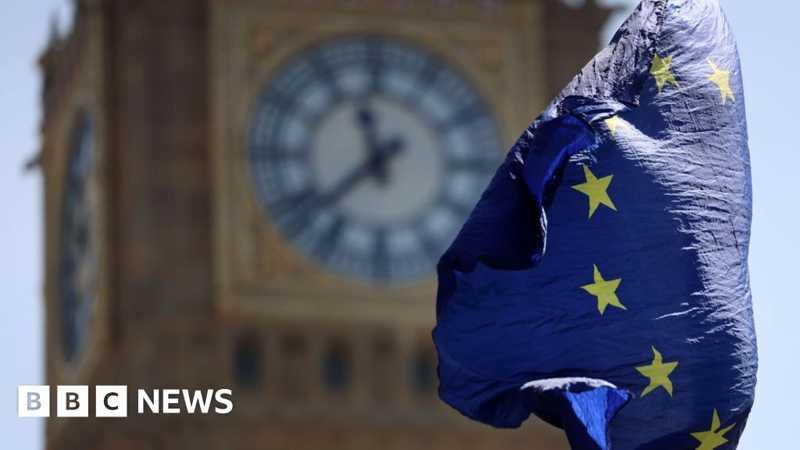
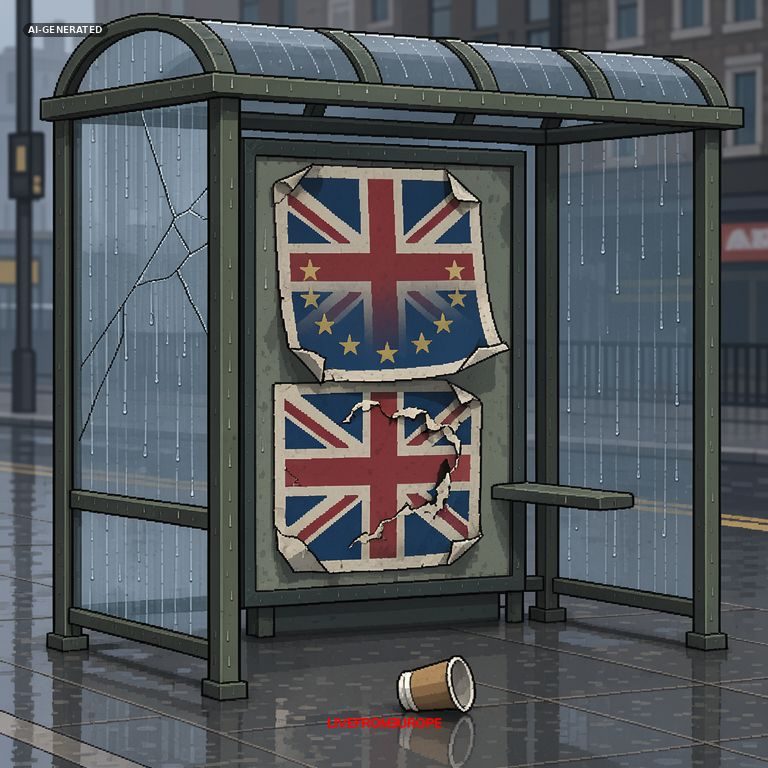
Brexit's most prominent campaigners have relaunched their fight against EU membership as a majority of Britons now call Brexit a mistake and Britain's government reopens the question of rejoining.
On Wednesday, Nigel Farage of Reform UK and Arron Banks launched Keep Britain Out, a reformation of their Leave.EU campaign, to seek the official pro-Brexit designation should another referendum be held Politico. A rival group, Stay Out, a reformation of Vote Leave led by Michael Gove, launched last week and is seeking the same designation The Guardian. Farage described Keep Britain Out as "an insurance vehicle" that would be needed if Labour or Labour and the Liberal Democrats form a majority after the next general election Politico. Farage and Banks also signed a pledge committing to oppose rejoining the EU while supporting North Sea oil drilling, the fishing sector and free trade deals Politico.
The campaigns arrive as public opinion has shifted. Ten years after the 2016 vote, 57 percent of Britons say Brexit was a "bad decision" or an "error," according to Christian Lequesne, a professor of political science at Sciences Po Paris, writing in Ouest-France Ouest-France. Lequesne attributes the view to the fact that the economic miracle promised by Brexit's supporters never happened.
Prime Minister Andy Burnham has reopened the debate. He called for rejoining the EU on November 16, and at a November 20 summit in Brussels with EU leaders the two sides agreed to a youth mobility scheme for 100,000 people annually and made progress on food trade and linking emissions trading schemes Vijesti. Talks on tuition fees for EU students at British universities from 2030 and tariffs on Chinese electric cars remain unresolved, and Burnham has insisted EU students will not pay the same fees as UK students Politico. He told the BBC it would be "unthinkable" for the UK to rejoin without a referendum, and said former prime ministers who urged him not to reopen the debate are "stuck in the past" BBC.
Conservative leader Kemi Badenoch is keeping her distance. The Financial Times reports she is aware the EU debate could stir painful memories within her party and alienate the voters it needs to return to power Financial Times. She told the BBC that Burnham has "oversold" the reset deal and is "trying to take Britain back to 2015" BBC.
The reset deal itself was published on Thursday. Two treaties covering food trade and emissions trading carry a 10-year termination clause requiring a departing party to pay to rebuild border checks infrastructure; Badenoch and Farage have both suggested they would refuse to pay BBC. An internal analysis forecasts a 16 percent boost to agricultural exports from scrapping checks and red tape BBC. The treaty text specifies that the UK will observe and shape, but not vote on, relevant EU rules, and accompanying legislation grants ministers so-called Henry VIII powers to align UK and EU laws BBC.
Pol Taylor, a senior fellow at the European Policy Centre in Brussels, wrote in the Guardian that Burnham is right to reopen the question of Britain's long-term relations with the EU, but unlikely to succeed in returning the country to the bloc Vijesti. The EU, he wrote, is always in the stronger negotiating position: a candidate country must accept the entire body of EU law, including free movement of people, and pay into the joint budget. France, which since Charles de Gaulle has viewed Britain as a country whose policy is aligned with American interests, would be less than enthusiastic about a return, Taylor added. He also noted a domestic calculation behind Burnham's move: it helps Labour win back voters lost to the Greens and Liberal Democrats in this year's local elections and mobilize pro-European young voters. Badenoch's claim that Burnham was forced to accept an unfair deal, under which Britain pays too much and gets too little, foreshadows fierce political battles over money, Taylor wrote. Farage, who built his career on equating EU membership with uncontrolled immigration, warned that political elites were betraying the democratically expressed will of British citizens in 2016 Vijesti.