maldita
The TikTok search engine: unfiltered access to child sexual abuse material
{{x.sep}}{{x.txt}} {{x.sep}}{{x.txt}}
{{t.menu}}
ES|ENES|EN
{{t.apoyarCorto}}{{t.apoyarLargo}}
{{g.n}}[EN PENDIENTE]{{g.tema}}{{g.fechaTxt}}{{t.politicas}}[EN PENDIENTE]{{p.antes}}{{p.tramo}}{{p.despues}}{{t.editorial}}{{t.politicas}}[EN PENDIENTE]{{p.antes}}{{p.tramo}}{{p.despues}}
{{x.txt}}
{{t.avisoContenido}}
{{t.politicas}}
{{tp.marcaProvTxt}}{{tp.marcaTradTxt}}[EN PENDIENTE][TRAMO DESTACADO PENDIENTE]{{tp.antes}}{{tp.tramo}}{{tp.despues}}
[FECHA PROVISIONAL]{{firmaFecha}} · {{firmaLectura}}
El propio buscador de TikTok funciona como acceso al material de abuso sexual infantil. A diferencia de otras redes sociales, como Instagram o Facebook, permite realizar búsquedas con términos explícitos y ampliamente conocidos en los entornos donde se comparte y comercializa este material. En Maldita.es lo hemos puesto a prueba y comprobado que ciertas búsquedas devuelven resultados que permiten localizar contenidos y cuentas vinculadas al abuso sexual infantil.TikTok's own search function acts as a gateway to child sexual abuse material. Unlike other social media platforms, such as Instagram or Facebook, it allows users to carry out searches using explicit terms that are widely recognised in the circles where such material is shared and traded. At Maldita.es, we have put this to the test and found that certain searches return results that enable users to locate content and accounts linked to child sexual abuse.
Edad del menor + "sexy"Age of the child + 'sexy'
Empezamos por una búsqueda sencilla y evidente: "niño/a" junto con la edad del menor que buscamos y "sexy". El buscador de TikTok arroja resultados independientemente de la edad que asociemos a esta palabra.We started with a simple and obvious search: 'boy/girl' together with the age of the child we are looking for and 'sexy'. The TikTok search engine returns results regardless of the age we associate with this word.
TikTok propone vídeos en los que aparecen menores sexualizadas con la búsqueda de "6 años sexy".TikTok suggests videos featuring sexualized minors when users search for "sexy 6-year-old".
Cuando hacemos esa misma búsqueda en una plataforma de Meta, en este caso Instagram, arroja un resultado completamente diferente:When we carry out that very same search on a Meta platform – in this case, Instagram – it returns a completely different result:
Comparación de cómo Instagram alerta de que "El abuso sexual infantil es ilegal" tras buscar "8 años sexy" mientras TikTok sugiere vídeos de menores sexualizadas.A comparison of how Instagram warns that "Child sexual abuse is illegal" after searching for "sexy 8-year-old", while TikTok suggests videos of sexualized minors.
La diferencia entre ambas plataformas sugiere que no es imposible moderar según qué búsquedas, sino que se debe a la elección de cada plataforma de qué modera y qué no.The difference between the two platforms suggests that it is not impossible to moderate certain searches, but rather that it comes down to each platform's choice of what to moderate and what not to.
La 'Cheese Pizza', el emoticono 🍕 y los 'pizza sellers''Cheese Pizza', the 🍕 emoji and 'pizza sellers'
Como ya contamos en nuestra anterior investigación, CP son las siglas de Child Pornography (en español, pornografía infantil) y, para intentar saltarse los sistemas de moderación de las plataformas, los pederastas hacen variaciones de las mismas. La más recurrente y la más conocida es 'Cheese Pizza', con su abreviatura de uso "pizza" a secas, junto con el uso del emoji de la pizza.As we explained in our previous investigation, 'CP' stands for 'Child Pornography' and, in an attempt to get around the platforms' moderation systems, predators come up with variations on this term. The most common and well-known is 'Cheese Pizza', often abbreviated to simply 'pizza', along with the use of the pizza emoji.
Lo lógico sería pensar que un código tan evidente estaría moderado en el buscador de TikTok. Mientras que "CP" sí despliega una advertencia en TikTok que alerta de que el término "puede estar relacionado con contenido de menores de carácter sexual", no reacciona igual a búsquedas por 🍕 o 'pizza sellers' (vendedores de pizza en inglés), a diferencia de las plataformas de Meta, que sí tienen moderados esas búsquedas o no devuelven resultados. Más grave aún es que, desde un perfil con el algoritmo entrenado para encontrar material de abuso infantil, los resultados de las búsquedas en TikTok te ofrecen las cuentas de los vendedores de material de abuso, que sólo tienen que ponerse de nombre de usuario 'pizza sellers' para aparecer en esa búsqueda junto con fotos de niñas en el perfil.One would naturally expect such an obvious code to be moderated by TikTok's search engine. Although 'CP' does trigger a warning on TikTok stating that the term 'may be related to sexual content involving minors', the platform does not react in the same way to searches for 🍕 or 'pizza sellers' – unlike Meta's platforms, which do moderate such searches or do not return any results. More concerningly, when searching from a profile with an algorithm trained to find child abuse material, TikTok's search results show accounts run by sellers of such material; they simply need to use 'pizza sellers' as their username to appear in that search alongside photos of young girls on their profile.
Captura de cómo Instagram impide la búsqueda de canales de "venta de pizza" por una posible relación con el abuso sexual infantil mientras TikTok sugiere un listado de usuarios potencialmente pederastas.Screenshot showing how Instagram blocks searches for "pizza sales" channels due to a possible link to child sexual abuse, while TikTok suggests a list of users who may be predators.
Las búsquedas más complejas, utilizando la palabra 'pizza' y el emoticono de la cámara de vídeo, cuando las haces utilizando un perfil con un algoritmo de TikTok entrenado para encontrar material pederasta, también devuelven los resultados que el pederasta buscaría. De nuevo, ante esta búsqueda, las plataformas de Meta no arrojan resultados.More complex searches – combining the word 'pizza' and the video camera emoji – when conducted through a profile with a TikTok algorithm trained to detect child sexual abuse material, also return the results that a predator would look for. Once again, Meta's platforms do not return any results for this search.
TikTok solo nos recomienda vídeos de menores sexualizadas tras introducir "pizza" en su buscador.TikTok already recommends videos of sexualized minors after typing "pizza" into its search bar.
VGK: abuso sexual infantil a niños de origen asiáticoVGK: child sexual abuse of children of Asian origin
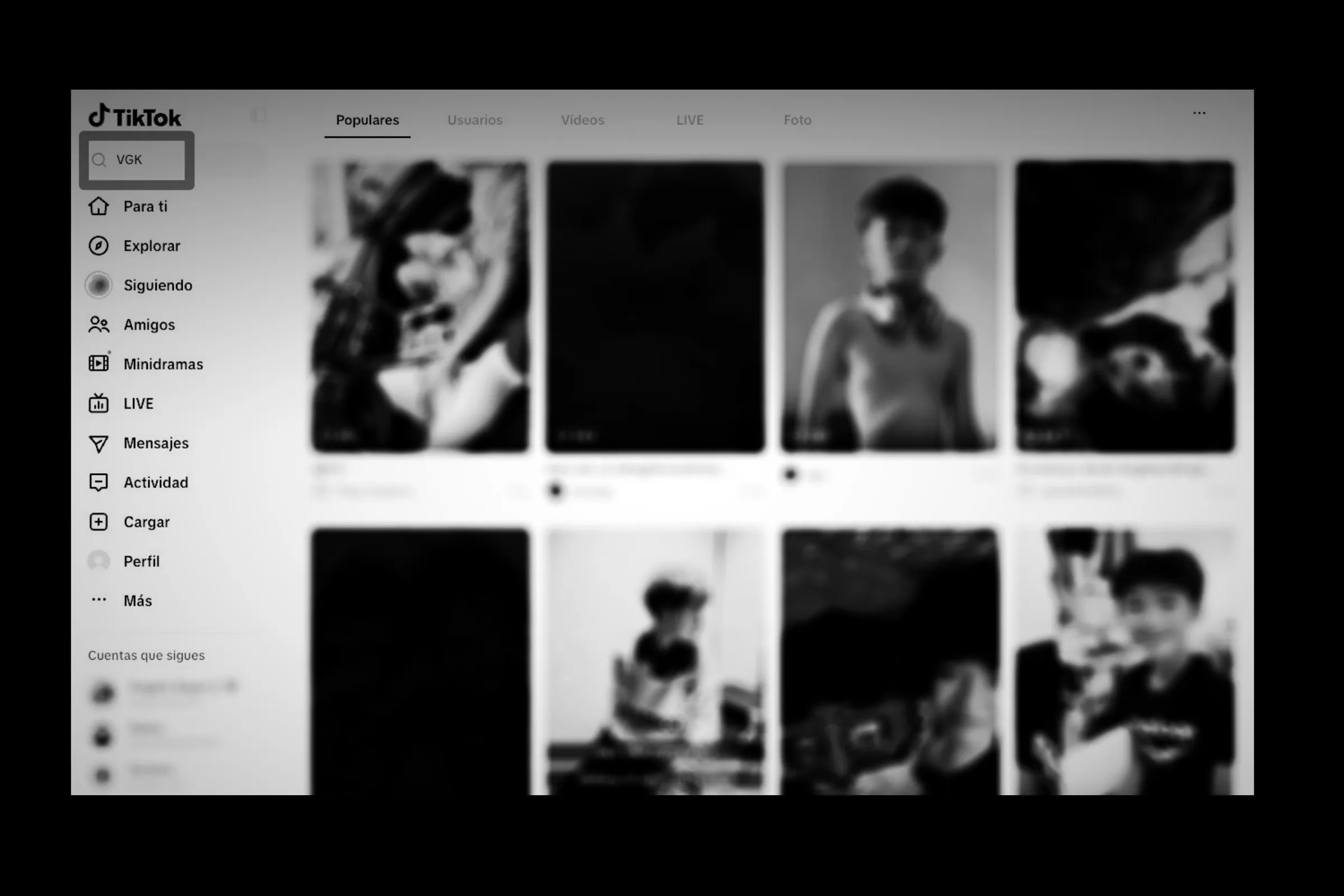
El término VGK, siglas de 'Video Gay Kids', lleva años vinculado a redes de compraventa de material de abuso sexual infantil, especialmente de niños varones, desde que en 2017 la policía indonesia desarticuló una red internacional que utilizaba esta denominación para comercializar imágenes y vídeos de abusos sexuales contra menores.The term VGK, which stands for Video Gay Kids, has for years been linked to networks trading child sexual abuse material, particularly involving young boys, ever since the Indonesian police dismantled an international network in 2017 that used this name to exchange images and videos of sexual abuse against minors.
A pesar de ser un término conocido, el buscador de TikTok arroja resultados explícitos de abuso de menores directamente entre los vídeos populares. En el caso de las plataformas de Meta, sí existen algunos resultados pero no vinculados al ecosistema pederasta.Despite being a well-known term, TikTok's search engine returns explicit results featuring child abuse directly amongst the popular videos. In Meta's platforms, there are some results, but they are not linked to the predator network.
TikTok permite la búsqueda y recomienda material de niños sexualizados tras buscar VGK (Video Gay Kids).TikTok recommends and enables users to find content featuring sexualized children after searching for "VGK" (Video Gay Kids).
Términos no documentados que devuelven resultados de abuso sexual explícito en el buscador encontrados por Maldita.esUndocumented search terms found by Maldita.es that return results depicting explicit sexual abuse
Más allá de los códigos ampliamente conocidos que hemos descrito anteriormente, Maldita.es ha identificado al menos una decena de términos en distintos idiomas que, al introducirlos en el buscador de TikTok, devuelven resultados que incluyen no solo imágenes sexualizadas de menores, sino también contenido explícito de abuso sexual infantil, como el documentado en esta investigación.In addition to the widely known codes described above, Maldita.es has identified at least ten terms in various languages which, when entered into the TikTok search bar, return results that include not only sexualised images of children, but also explicit child sexual abuse content, such as that documented in this investigation.
Hemos decidido no publicar esos términos no conocidos para evitar facilitar la localización de este material a quienes lo buscan, y sí compartirlos con TikTok y otras plataformas para contribuir a frenar su circulación.We have decided not to publish these lesser-known terms to avoid making it easier for those seeking such material to locate it, but we have shared them with TikTok and other platforms to help stop their circulation.
A Maldita.es le bastaron 35 días de investigación para identificar estos términos y comprobar los resultados que devolvía el buscador. ¿Cómo es posible que una empresa que facturó más de 8.000 millones de euros solo en Reino Unido, Europa y Latinoamérica en 2025 no sea capaz de detectar y moderar búsquedas que conducen a material de abuso sexual infantil, ni siquiera cuando se utilizan códigos conocidos desde hace años?It took Maldita.es just 35 days of investigation to identify these terms and verify the results returned by the search engine. How is it possible that a company which generated in 2025 alone a turnover of over 8,000 million euros in the UK, Europe and Latin America is unable to detect and moderate searches leading to child sexual abuse material, even when using codes that have been known for years?
TRANSPARENCIA: Maldita.es participa desde 2019 en el programa de verificación de datos externo de Meta.TRANSPARENCY: Maldita.es has been part of Meta's external fact-checking programme since 2019.
TikTok no cumple sus propias normas de protección a los menores. ¿Cuánto más vamos a esperar?Ayúdanos a exigirle responsabilidades.TikTok doesn't follow its own child protection rules. How much longer are we going to wait?Help us hold it to account.{{t.cadaCuanto}}{{t.unaVez}}{{t.pagoPuntual}}{{t.cadaMes}}{{t.apoyoContinuo}}{{t.cadaAnio}}{{t.cobroAnual}}{{t.cuanto}}{{a.tag}}{{a.txt}}{{a.unidad}}{{t.otraCantidad}}{{t.otraCantidadEuros}}€{{don.error}}{{don.texto}}{{don.texto}}{{t.pagoSeguro}}
{{t.siguientePublicacion}}{{t.politicas}}[EN PENDIENTE]{{sigAntes}}{{sigTramo}}{{sigDespues}}{{t.leer}}
{{t.siguientePublicacion}}{{t.politicas}}[EN PENDIENTE]{{sigAntes}}{{sigTramo}}{{sigDespues}}{{sigFecha}}
{{calTitulo}}{{calSub}}
{{g.n}}[EN PENDIENTE]{{g.tema}}{{g.datoTxt}}
{{t.politicas}}[EN PENDIENTE]{{p.antes}}{{p.tramo}}{{p.despues}}{{t.editorial}}{{t.politicas}}[EN PENDIENTE]{{p.antes}}{{p.tramo}}{{p.despues}}{{t.editorial}}{{t.politicas}}[EN PENDIENTE]{{p.antes}}{{p.tramo}}{{p.despues}}
[EN PENDIENTE] {{t.avisoLargo}}{{imgText}}
about 5 hours ago
maldita
Anatomy of a systemic failure: EU law identifies 11 key areas for protecting minors, and on TikTok all of them work in favour of predators
{{x.sep}}{{x.txt}} {{x.sep}}{{x.txt}}
{{t.menu}}
ES|ENES|EN
{{t.apoyarCorto}}{{t.apoyarLargo}}
{{g.n}}[EN PENDIENTE]{{g.tema}}{{g.fechaTxt}}{{t.politicas}}[EN PENDIENTE]{{p.antes}}{{p.tramo}}{{p.despues}}{{t.editorial}}{{t.politicas}}[EN PENDIENTE]{{p.antes}}{{p.tramo}}{{p.despues}}
{{x.txt}}
{{t.avisoContenido}}
{{t.politicas}}
{{tp.marcaProvTxt}}{{tp.marcaTradTxt}}[EN PENDIENTE][TRAMO DESTACADO PENDIENTE]{{tp.antes}}{{tp.tramo}}{{tp.despues}}
El artículo 35 del Reglamento de la UE de Servicios Digitales (la DSA) obliga a las plataformas más grandes, incluida TikTok, a aplicar medidas efectivas de reducción de riesgos sistémicos como "la difusión de contenido ilícito" y aquellos que puedan tener efectos negativos "en la protección de los menores". Los hallazgos de esta investigación ponen muy en cuestión la efectividad de las medidas de TikTok contra el abuso sexual de menores, pero además apuntan directamente a que las principales funcionalidades de su plataforma están siendo activamente utilizadas en beneficio de los pederastas. El mencionado artículo 35 propone 11 medidas concretas que pueden servir para reducir riesgos en una gran plataforma, pero yendo una a una vemos que en TikTok han servido para lo contrario.Article 35 of the EU Digital Services Act (DSA) requires the largest platforms, including TikTok, to put in place effective measures to mitigate systemic risks such as "the dissemination of illegal content" and those that may have negative effects "in relation to [...] the protection of minors." The findings of this investigation cast serious doubt on the effectiveness of TikTok's measures against child sexual abuse, and they also point directly to the fact that the platform's main features are being actively used to the benefit of predators. The aforementioned Article 35 lists 11 specific measures that can help reduce risks on a large platform, but going through them one by one, we see that TikTok has done the opposite.
[FECHA PROVISIONAL]{{firmaFecha}} · {{firmaLectura}}
Diseño, características y funcionamientoDesign, features and functioning
TikTok no ha adaptado su plataforma para atajar de forma efectiva la amenaza que suponen los pederastas. Al contrario, muchas de las funcionalidades básicas aumentan la vulnerabilidad de los menores. Podemos verlo empezando por la barra de búsqueda, donde cualquier usuario puede teclear frases que deberían hacer sonar todas las alarmas como "8 años sexy", y recibir al momento imágenes sexualizadas de niños. No es algo inevitable: si haces la misma búsqueda en Instagram, por ejemplo, recibes una advertencia de que el contenido de abuso sexual infantil es ilegal y su consumo conlleva penas de cárcel.TikTok has not adapted its platform to effectively tackle the threat posed by predators. On the contrary, many of its basic features make minors more vulnerable. We can see this starting with the search bar, where any user can type phrases that should set off every alarm, such as "8 años sexy" ("8 years old sexy"), and instantly get sexualized images of children. It doesn't have to be this way: if you run the same search on Instagram, for example, you get a warning that child sexual abuse material is illegal and that viewing it can lead to prison time.
Comparación de los resultados en TikTok e Instagram cuando buscas "8 años sexy".Comparison of TikTok and Instagram results when searching for "8 años sexy".
Condiciones generales y su ejecuciónTerms and conditions and their enforcement
Más allá de que sea un delito, la difusión de contenido de abuso sexual infantil también va en contra de las reglas de la propia plataforma, pero la ejecución deficiente de sus condiciones de servicio sólo sirve para aumentar la desprotección de los menores. Basta un dato para comprobarlo: aunque TikTok establece que "una sola infracción grave" como "compartir material de abuso sexual infantil" puede conllevar la cancelación de una cuenta, hemos documentado cómo el 47% de los perfiles que habían publicado contenido que TikTok retiró o bloqueó a raíz de nuestras notificaciones siguieron activos. Varios de ellos siguen accesibles hoy, incluidos perfiles que habían publicado contenidos como este:Beyond being a crime, distributing child sexual abuse material also goes against the platform's own rules, but poor enforcement of its terms of service only leaves minors more exposed. A single figure is enough to prove it: although TikTok states that "a single severe violation" such as "sharing child sexual abuse material" can lead to an account being banned, we documented how 47% of the profiles that had posted content TikTok removed or blocked as a result of our notices remained active. Several of them are still accessible today, including profiles that had posted content like this:
Vídeo denunciado por Maldita.es donde se muestra desnudo y en una pose sexual a un menor con texto superpuesto. Esta imagen ha sido difuminada por Maldita.es.Video reported by Maldita.es showing a naked minor in a sexual pose with overlaid text. This image has been blurred by Maldita.es.
Moderación de contenidoContent moderation
El artículo 35 de la DSA recomienda a las grandes plataformas adaptar sus procesos de moderación de contenidos para reducir riesgos sistémicos, por ejemplo potenciando "la velocidad y la calidad" con la que responden a las notificaciones de contenido ilegal y lo retiran o bloquean su acceso. Sin embargo, de la muestra de 50 vídeos con material de abuso sexual infantil explícito que notificamos directamente a la plataforma como contenido ilegal según el artículo 189 del Código Penal español, TikTok sólo borró el 10% y bloqueó otro 26% únicamente para España. Contenidos como estos permanecieron y permanecen en la plataforma:Article 35 of the DSA recommends that large platforms adapt their content moderation processes to mitigate systemic risks, for example by improving "the speed and quality" with which they process notices of illegal content and remove it or disable access to it. However, out of a sample of 50 videos containing explicit child sexual abuse material that we notified directly to the platform as illegal content under Article 189 of the Spanish Criminal Code, TikTok removed only 10% and blocked another 26% in Spain alone. Content like this stayed, and remains, on the platform:
La primera imagen de este vídeo es de un joven y un menor, en la segunda se ve a un niño desnudo mostrando sus genitales. Ha sido desenfocada por Maldita.es.The first image in this video shows a young man and a minor; the second shows a naked boy exposing his genitals. It has been blurred by Maldita.es.
Sistemas de recomendaciónRecommender systems
Otro elemento clave de la reducción de riesgos es la adaptación de los mecanismos de recomendación. A lo largo de esta investigación hemos documentado cómo TikTok nos mostraba una y otra vez contenido de abuso sexual infantil en la pestaña de "Para ti", pero este no es el único algoritmo de recomendación de contenido que ha servido para amplificar este contenido ilegal en la plataforma. Los perfiles que nos aparecían como recomendados para seguir compartían también vídeos del mismo tipo y en la pestaña "Comunidad", donde TikTok ofrece contenido a partir de los intereses de cada cuenta, nos mostraba vídeos de menores y perfiles de usuarios que se presentaban como niños de 13 años pidiendo intercambiar fotos sexualmente explícitas.Another key element of risk mitigation is adapting recommendation mechanisms. Throughout this investigation, we documented how TikTok repeatedly showed us child sexual abuse material on the "For You" tab, but that is not the only content recommendation algorithm that has helped amplify this illegal content on the platform. The profiles that appeared as suggested accounts to follow also shared videos of the same kind, and on the "Community" tab, where TikTok serves content based on each account's interests, it showed us videos of minors and profiles of users presenting themselves as 13-year-old children asking to swap sexually explicit photos.
{{vid8.tiempo}}Grabación de pantalla: TikTok nos muestra vídeos con material de abuso sexual infantil en 17 de 20 inicios de sesión.Screen recording: TikTok shows us videos containing child sexual abuse material in 17 out of 20 logins.
La perversión de los algoritmos de recomendación de TikTok también es muy visible en las emisiones en directo. Según avanzábamos en la investigación, la plataforma nos empezó a enviar notificaciones de que determinadas cuentas estaban en directo aunque no las seguíamos: resultaron ser niñas menores de edad que en teoría ni siquiera pueden hacer directos según las reglas de TikTok al tener menos de 18 años.The perversion of TikTok's recommender algorithms is also very visible in livestreams. As our investigation progressed, the platform began to send us notifications that certain accounts were live even though we didn't follow them: they turned out to be underage girls who, in theory, aren't even allowed to go live under TikTok's rules because they are under 18.
Sistemas de publicidadAdvertising systems
El artículo 35 también menciona la reducción de riesgos en los sistemas de publicidad de las grandes plataformas. Aunque no hemos encontrado vídeos explícitos de abuso que circularan como anuncios, sí que hemos documentado anuncios de marcas muy conocidas que aparecen antes y después de esos contenidos. Además hemos localizado varios vídeos que contenían abuso sexual infantil y que aparecían etiquetados como "colaboraciones pagadas", probablemente por sus propios autores.Article 35 also refers to mitigating risks in large platforms' advertising systems. Although we did not find explicit abuse videos circulating as ads, we did document ads from very well-known brands appearing before and after that content. We also found several videos containing child sexual abuse that were labeled as "paid partnerships," probably by their own creators.
Vídeo de dos niños besándose que aparece etiquetado como "colaboración pagada". Difuminado por Maldita.es.Video of two children kissing, labeled as a "paid partnership." Blurred by Maldita.es.
Refuerzo de procesos para la detección de riesgos sistémicosReinforcing processes for detecting systemic risks
Los hallazgos de esta investigación apuntan a un fracaso en la reducción de riesgos por parte de TikTok que resulta mucho más indignante sabiendo que ha habido multitud de señales de alarma a las que no se ha hecho caso: en una investigación de finales de 2025 ya denunciamos el mercadeo de contenido de abuso sexual infantil generado con IA en la plataforma y su amplificación algorítmica; unos meses después identificamos la presencia de más de 1.300 pederastas en los comentarios de vídeos de menores y sus estrategias para conectar en TikTok y desplazarse a plataformas de mensajería privada para intercambiar material explícito. De acuerdo con documentos internos de la plataforma, TikTok conoce algunos de los problemas que hemos documentado relacionados con los directos desde al menos 2022.The findings of this investigation point to a failure by TikTok to mitigate risks that is all the more outrageous given the many warning signs that have gone unheeded: in an investigation published in late 2025, we had already exposed the trade in AI-generated child sexual abuse material on the platform and its algorithmic amplification; a few months later, we identified more than 1,300 predators in the comments on videos of minors, along with their strategies for connecting on TikTok and moving to private messaging platforms to swap explicit material. According to the platform's own internal documents, TikTok has been aware of some of the livestream-related problems we have documented since at least 2022.
Cooperación con alertadores fiablesCooperation with trusted flaggers
Otro epígrafe del artículo 35 propone a las grandes plataformas reducir riesgos cooperando con los alertadores fiables o trusted flaggers. Estas entidades, reguladas en el artículo 22 del Reglamento de la UE de Servicios Digitales, son entidades que han sido reconocidas por el coordinador de servicios digitales de su estado miembro (la CNMC, en el caso de España) como expertas en un tipo determinado de contenido ilegal y cuyas notificaciones deben recibir atención prioritaria. En toda la UE hay 28 alertadores fiables de 21 estados miembros reconocidos por su experiencia en daños a los menores.Another point in Article 35 suggests that large platforms mitigate risks by cooperating with trusted flaggers. These entities, governed by Article 22 of the EU Digital Services Act, are organizations that have been recognized by their member state's Digital Services Coordinator (the CNMC, in Spain's case) as experts in a particular type of illegal content and whose notices must be given priority. Across the EU, there are 28 trusted flaggers from 21 member states recognized for their expertise in harms to minors.
TikTok no cumple sus propias normas de protección a los menores. ¿Cuánto más vamos a esperar?Ayúdanos a seguir investigando.TikTok doesn't follow its own child protection rules. How much longer are we going to wait?Help us keep investigating.{{t.donaBoton}}
El volumen de contenido ilegal que hemos hallado en esta investigación indica una necesidad urgente de que TikTok trabaje más estrechamente con estas organizaciones y con otros expertos para atajar el enorme problema que tiene en este área: solamente en lo que se refiere a vídeos con contenido de abuso sexual explícito en la plataforma hemos encontrado más de 1.000 y habían tenido más de 48 millones de reproducciones cuando los encontramos. Todos los esfuerzos para evitar esto son pocos y, aunque la notificación de contenidos ilegales para su bloqueo es sólo una parte de la solución, tiene que tener mucho más impacto.The volume of illegal content we found in this investigation points to an urgent need for TikTok to work more closely with these organizations and with other experts to tackle the enormous problem it has in this area: in terms of videos with explicit sexual abuse content on the platform alone, we found more than 1,000, and they had amassed more than 48 million views by the time we found them. No effort should be spared in preventing this, and although reporting illegal content so it can be blocked is only part of the solution, it needs to be considerably more impactful.
Cooperación con otras plataformasCooperation with other platforms
Según el Reglamento de la UE de Servicios Digitales, TikTok también puede reducir los riesgos sistémicos colaborando con otras plataformas a través de códigos de conducta y protocolos de crisis. Esto sería particularmente interesante, ya que más del 14% de los 26.000 perfiles que hemos identificado como pederastas incluyen en sus perfiles, vídeos o comentarios invitaciones a contactar en otras plataformas.Under the EU Digital Services Act, TikTok can also mitigate systemic risks by cooperating with other platforms through codes of conduct and crisis protocols. This would be particularly worthwhile, since more than 14% of the 26,000 profiles we identified as predators include invitations to make contact on other platforms in their profiles, videos or comments.
Enlaces a diferentes plataformas como Telegram en las biografías de cuentas de pederastas.Links to various platforms, such as Telegram, in the bios of predator accounts.
Telegram es con mucha diferencia la más mencionada, seguida de WhatsApp y Zangi, aunque también hay referencias a Instagram, Facebook, Discord, Snapchat, YouTube y X. La colaboración entre plataformas puede hacer más fácil la intervención de la justicia y de las Fuerzas y Cuerpos de Seguridad del Estado contra los delincuentes que producen y trafican con contenido de abuso sexual infantil.Telegram is by far the most frequently mentioned, followed by WhatsApp and Zangi, although there are also references to Instagram, Facebook, Discord, Snapchat, YouTube and X. Cooperation between platforms can make it easier for the courts and law enforcement to take action against the criminals who produce and traffic child sexual abuse material.
Concienciación e información a los usuariosRaising awareness and informing users
La incapacidad de TikTok para detectar y expulsar a los usuarios que no tienen la edad requerida para estar en la plataforma o para usar alguna de sus funcionalidades hace imposible que pueda adaptar su diseño para proporcionarles información útil sobre los riesgos que corren. La plataforma prohíbe, por ejemplo, que los niños que no hayan cumplido los 13 años tengan cuentas, pero en anteriores investigaciones hemos informado a TikTok sobre usuarios que declaran en sus propios vídeos tener incluso 8 años y no se han tomado medidas.TikTok's inability to detect and remove users who are not old enough to be on the platform, or to use some of its features, makes it impossible for the platform to adapt its design to give them useful information about the risks they face. The platform prohibits, for example, children under 13 from having accounts, but in previous investigations we have flagged to TikTok users who say in their own videos that they are as young as 8, and no action has been taken.
Capturas de pantalla de dos usuarios que declaran tener 12 y 11 años, obtenidas durante una investigación de Maldita.es en mayo de 2026.Screenshots of two users who say they are 12 and 11 years old, captured during a Maldita.es investigation in May 2026.
Medidas para proteger los derechos del niñoMeasures to protect the rights of the child
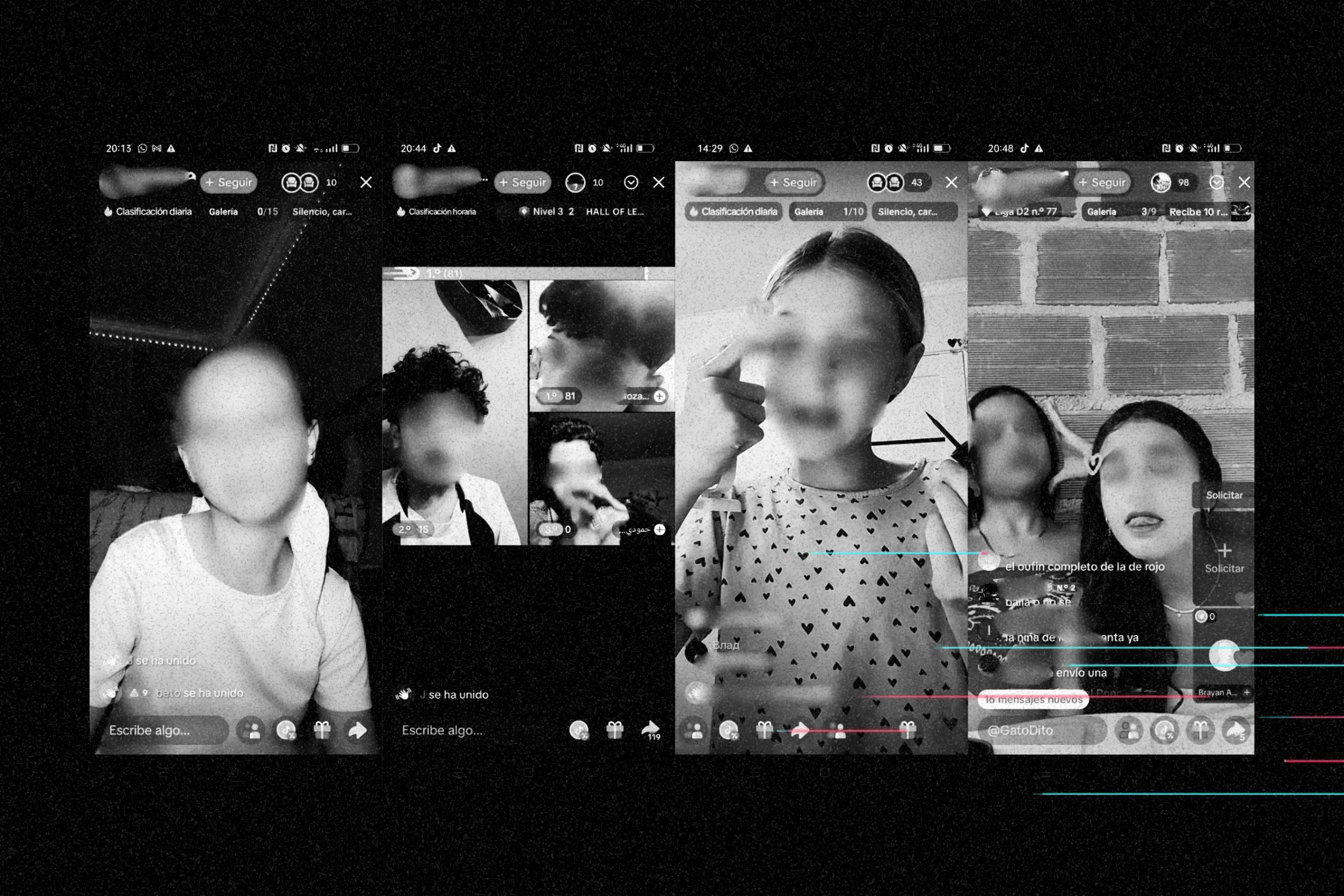
El Reglamento de Servicios Digitales también especifica que una forma de reducir los riesgos sistémicos es la adopción de medidas para proteger los derechos del niño "incluyendo la verificación de edad y los controles parentales". Ya hemos explicado en el párrafo anterior que los sistemas de verificación de la edad de TikTok no funcionan, lo que hace imposible que se cumplan algunas reglas de TikTok como la que prohíbe a los menores de 18 años hacer directos. Hemos registrado y notificado a la plataforma más de 40 directos cuyos protagonistas estaban indudablemente por debajo de los 18 años. La plataforma, una vez más, no ha hecho nada. En muchos de ellos, hemos documentado cómo hay adultos ofreciendo recompensas en la sección de comentarios si los menores realizan conductas sexualizantes.The Digital Services Act also specifies that one way to mitigate systemic risks is taking measures to protect the rights of the child, "including age verification and parental control tools." We explained in the previous section that TikTok's age verification systems don't work, which makes it impossible to enforce some of TikTok's rules, such as the one that bars users under 18 from conducting livestream videos. We have logged and reported to the platform more than 40 livestreams whose hosts were unquestionably under 18. Once again, the platform has done nothing. In many of them, we documented adults in the comments section offering rewards if the minors engaged in sexualized behavior.
Algunos de los directos de menores notificados a TikTok sobre los que la plataforma no ha tomado ninguna medida.Some of the livestreams by minors reported to TikTok on which the platform has taken no action.
Etiquetado de contenido manipuladoLabeling manipulated content
El último elemento que recoge el artículo 35 de la DSA como posible medida de reducción de riesgos es el de garantizar que las imágenes generadas o manipuladas que "se asemejan notablemente" a una persona y que pueden inducir "a pensar que son auténticas" se etiqueten para evitar confusiones. A lo largo de esta investigación (y como puede verse en este artículo) hemos registrado centenares de imágenes de menores de edad perfectamente identificables que acompañan en la misma publicación a imágenes de abuso sexual infantil donde no se distingue la identidad. El mensaje implícito es que las dos imágenes pertenecen al mismo menor y nunca hemos visto que llevaran advertencia alguna. Por otro lado, resultaría extraño que TikTok fuera capaz de identificar estos contenidos para aplicar esa medida concreta cuando es incapaz de borrarlos en cumplimiento de la legalidad y de sus propias condiciones de servicio.The last element listed in Article 35 of the DSA as a possible risk mitigation measure is ensuring that generated or manipulated images that "appreciably resemble" a person and could falsely appear "to be authentic" are labeled to avoid confusion. Throughout this investigation (and as can be seen in this article), we logged hundreds of images of clearly identifiable minors that appear in the same post alongside child sexual abuse images in which the person's identity cannot be made out. The implicit message is that both images show the same minor, and we never saw any of them carry a warning. Moreover, it would be strange for TikTok to be able to identify this content in order to apply that specific measure when it is unable to remove it as required by law and by its own terms of service.
La DSA propone 11 áreas clave para reducir el riesgo sistémico en las plataformas. En TikTok las 11 han sido aprovechadas por los pederastas para profundizar en el abuso a menores de edad.The DSA sets out 11 key areas for mitigating systemic risk on platforms. On TikTok, predators have exploited all 11 to deepen the abuse of minors.
TRANSPARENCIA: Maldita.es participa desde 2019 en el programa de verificación de datos externo de Meta.TRANSPARENCY: Maldita.es has been part of Meta's external fact-checking programme since 2019.
TikTok no cumple sus propias normas de protección a los menores. ¿Cuánto más vamos a esperar?Ayúdanos a exigirle responsabilidades.TikTok doesn't follow its own child protection rules. How much longer are we going to wait?Help us hold it to account.{{t.cadaCuanto}}{{t.unaVez}}{{t.pagoPuntual}}{{t.cadaMes}}{{t.apoyoContinuo}}{{t.cadaAnio}}{{t.cobroAnual}}{{t.cuanto}}{{a.tag}}{{a.txt}}{{a.unidad}}{{t.otraCantidad}}{{t.otraCantidadEuros}}€{{don.error}}{{don.texto}}{{don.texto}}{{t.pagoSeguro}}
{{t.siguientePublicacion}}{{t.politicas}}[EN PENDIENTE]{{sigAntes}}{{sigTramo}}{{sigDespues}}{{t.leer}}
{{t.siguientePublicacion}}{{t.politicas}}[EN PENDIENTE]{{sigAntes}}{{sigTramo}}{{sigDespues}}{{sigFecha}}
{{calTitulo}}{{calSub}}
{{g.n}}[EN PENDIENTE]{{g.tema}}{{g.datoTxt}}
{{t.politicas}}[EN PENDIENTE]{{p.antes}}{{p.tramo}}{{p.despues}}{{t.editorial}}{{t.politicas}}[EN PENDIENTE]{{p.antes}}{{p.tramo}}{{p.despues}}{{t.editorial}}{{t.politicas}}[EN PENDIENTE]{{p.antes}}{{p.tramo}}{{p.despues}}
[EN PENDIENTE] {{t.avisoLargo}}{{imgText}}
about 5 hours ago