
Germany suspends Sunday truck bans in four states as Rhine, Danube and Elbe hit historic lows
Story Timeline
1 day · 2 summary articles
Germany suspends Sunday truck bans in four states as Rhine, Danube and Elbe hit historic lows
German states lift Sunday truck ban to ease freight disruptions from low river levels
Continuation
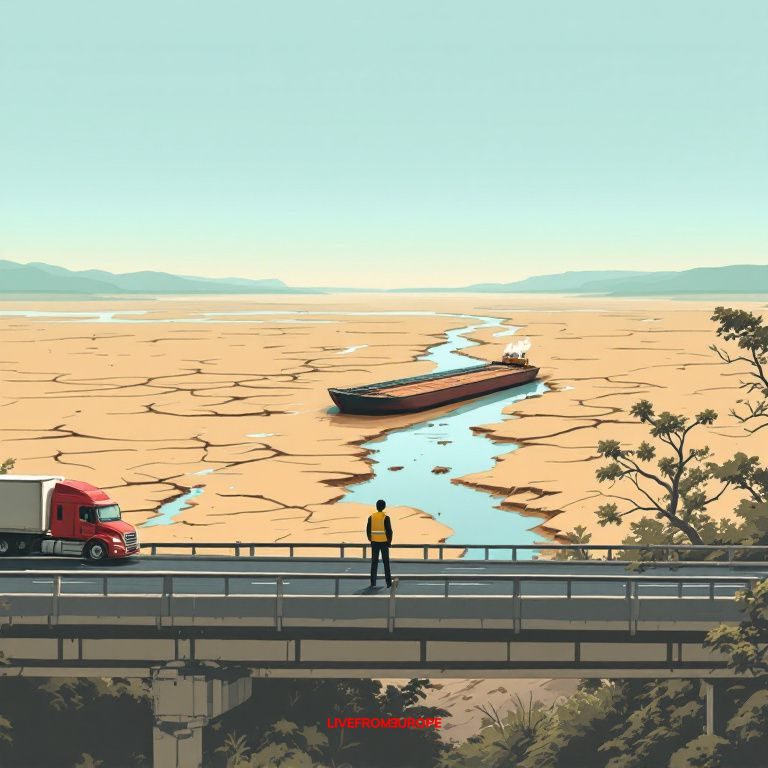
Four German states have suspended Sunday and holiday driving bans for trucks to mitigate supply chain disruptions caused by historic low water levels on the Rhine, Danube and Elbe rivers, which have severely restricted inland shipping. The measures took effect in Saarland, Rhineland-Palatinate and Lower Saxony on Friday, with Saarland and Rhineland-Palatinate extending the exemption until at least the end of September and Lower Saxony until the end of August. North Rhine-Westphalia, led by Green Party Transport Minister Oliver Krischer, also lifted the ban and permitted Saturday truck traffic during summer holidays to prevent shortages .
Federal Transport Minister Steffen Bilger of the CDU proposed the temporary suspension on Thursday following a low-water conference with industry representatives, framing it as part of a package of immediate measures that also includes reducing avoidable construction disruptions and expanding rail capacity. Bilger’s ministry emphasized long-term solutions such as adapting waterways and vessels to low-water conditions .
The move has drawn sharp criticism from environmental and political groups. Olaf Bandt, chairman of the environmental organization BUND, told the Rheinische Post that replacing inland shipping with “hundreds or thousands of truck trips” would burden “people and the climate,” arguing that low river levels are a symptom of the climate crisis. Bandt called for intact river landscapes to retain water and for rail infrastructure to better absorb inland shipping bottlenecks, stating, “Barge traffic must be adapted to the rivers—not the other way around” .
The Left Party also opposed the measure. Party co-leader Luigi Pantisano accused the federal government of reacting “far too late” and using the crisis as a pretext to weaken Sunday driving bans, shifting the burden onto truck drivers. Pantisano told AFP that the focus should be on supporting barge operators and rapidly expanding rail capacity, warning that more trucks would mean “more traffic jams, noise and pollution.” He referenced his party’s five-point plan to address water shortages in German rivers .
Reactions within the Green Party were mixed. Lisa Badum, the climate policy spokeswoman for the Green Party’s parliamentary group, told the Tagesspiegel that increasing truck traffic was “wrong” and that priority should be given to restoring rivers and creating a “heat-resistant” rail system. Deputy parliamentary group leader Andreas Audretsch, however, described the exemptions as understandable to avoid supply shortages, while criticizing Chancellor Friedrich Merz’s CDU for ignoring the climate crisis’s economic impact .
The Federation of German Industries (BDI) welcomed the relaxation, while the Ver.di trade union and BUND reiterated their opposition . The German Weather Service issued heat warnings as the drought persists .
Follow us for live European news
- 5
- 2
- 1
- 1
- 1
- 1
- 1
- 1
1 further source not geolocated
Articles
Dürre und Hitze: Fluss Po bei Cremona führt kaum noch Wasser, Weinlese in Burgund begann so früh wie nie Auch die Pegelstände der großen Seen Norditaliens sind deutlich unter den Normalwerten für die Jahreszeit. In Frankreichs Weinanbauregion Burgund hat die Weinlese sehr viel früher als sonst begonnen
der standard · about 2 hours ago

Nur noch Aperol Spritz?: Italien trinkt immer weniger Wein – und stürzt Produzenten in die Krise Bei italienischen Winzern stapeln sich die Fässer, Milliarden Flaschen wurden nicht verkauft. Die Weinnation erlebt einen Kulturwandel – sinken sollen die Preise dennoch nicht.
tagesspiegel · about 3 hours ago
Dürre und Hitzewellen: Fluss Po bei Cremona führt kaum noch Wasser Auch die Pegelstände der großen Seen Norditaliens sind deutlich unter den Normalwerten für die Jahreszeit. In der Lombardei ist weniger als die Hälfte der üblichen Wasserreserve vorhanden
der standard · about 3 hours ago
Dürre & Hitze: Trotz Trockenheit: kein Engpass an Kühlwasser für Kraftwerke
die zeit · about 3 hours ago
Autobahnen: Ekel und Schäden: Autobahn-Toiletten werden zum Problemfall
die zeit · about 4 hours ago
Primele efecte ale operațiunii de pe Dunăre: Apa a crescut cu 8 cm peste prognoză, Unitatea 2 funcționează normal Măsurile luate pe brațul Bala au oprit scăderea debitului în zona centralei nucleare de la Cernavodă. Directorul instituției a anunțat că reactorul are acum asigurată apa de răcire pentru următoarele nouă zile. „La Cernavodă, unitatea 2 funcționează în parametri nominali, fără probleme. Duminică dimineață a crescut nivelul în Dunăre la aspirația pompelor din bazinul de …
hotnews.ro · about 4 hours ago

Sonntagsfahrverbot für Lkw temporär ausgesetzt Wegen des historischen Niedrigwassers an Rhein, Donau und Elbe ist die Binnenschifffahrt stark eingeschränkt. Vier Bundesländer heben das Sonntagsfahrverbot für Lkw auf, um Lieferengpässe abzufedern. Der Deutsche Wetterdienst warnt vor Hitze.
welt.de · about 5 hours ago
Regeln zum Wasserverbrauch – Wo in der Schweiz der Rasen nicht bewässert werden darf Mindestens 151 Gemeinden haben diesen Sommer ihrer Bevölkerung angeordnet, den Wasserverbrauch einzuschränken.
srf.ch · about 5 hours ago
Abholzung im Amazonasgebiet auf Zehnjahrestief
orf.at · about 5 hours ago
Verdorrte Parks: Wo Hessens Städte gießen – und wo nicht
die zeit · about 9 hours ago
Nazi warships emerge from shrinking Danube as Europes record heat deepens drought
gdeltproject.org · about 11 hours ago
Umwelt: Abholzung im Amazonasgebiet auf Zehnjahrestief
die zeit · about 11 hours ago
Ausgetrocknete Flüsse: Linke und Grüne kritisieren Kurs der Bundesregierung bei Niedrigwasser Die Linke lehnt die geplante Lockerung des Fahrverbots für Lkw an Sonn- und Feiertagen ab. Bei den Grünen gibt es sowohl Unmut als auch Verständnis.
die zeit · about 13 hours ago
Debatte in Deutschland über Lkw-Fahrverbot Die Aussetzung des Fahrverbots für Lastwagen an Sonn- und Feiertagen in einigen deutschen Bundesländern wegen des Niedrigwassers und dadurch eingeschränkten Schiffsverkehrs hat für gemischte Reaktionen gesorgt. Während die Industrie den Schritt begrüßt, kommt von Umweltorganisationen scharfe Kritik. Auch die deutschen Grünen und die Linke fordern konkrete Klimaschutzmaßnahmen statt „Symptombekämpfung. Der deutsche Verkehrsminister Steffen Bilger (CDU) verteidigte sein Vorgehen am Samstag.
orf.at · about 13 hours ago
Od rýže ke krevetám. Klimatická změna, přehrady i těžba písku mění zemědělství v deltě Mekongu Vietnamské trhy jsou barevné, hlasité a plné zeleniny, ovoce, ryb a různorodých tvorů. Zemědělci z delty Mekongu si ale stále častěji musí poradit se slanou vodou, která se jim na pole dostává přes ramena řek i z několik kilometrů vzdáleného moře. Může za to klimatická změna, přehrady i těžba písku kvůli materiálům pro elektroniku.
irozhlas.cz · about 14 hours ago
Niedrigwasser in deutschen Flüssen: BUND kritisiert Aussetzung von Lkw-Fahrverbot Schiffstransport dürfe nicht wegen Niedrigwasser durch mehr Lkw-Fahrten ersetzt werden, warnt die Umweltorganisation. Die Industrie begrüßt dagegen die Lockerung. mehr...
taz.de · about 15 hours ago
Wasser in Deutschland: »Wir haben ein Problem mit der Verteilung von Wasser« Vertrocknete Wiesen, niedrige Flussstände – momentan scheint das Wasser in Deutschland knapp. Experte Markus Weitere erklärt, wie es um das Wasser wirklich steht.
die zeit · about 15 hours ago
Siccità, Lago Maggiore ai minimi storici tra barche in secca e canneti senzacqua. Il presidente del distretto dei Laghi: Serve investire sul territorio, non sugli armamenti Nella darsena di Arona, sulla sponda piemontese del lago Maggiore, le barche sono adagiate sul fango. Là dove cera lacqua, oggi cè la terra. Si riesce persino a camminarci sopra. I livelli del lago sono ai minimi storici racconta Diego, uno dei barcaioli. Lunedì il lago è sceso sotto il livello del 2022, uno degli […] Larticolo Siccità, Lago Maggiore ai minimi storici tra barche in secca e canneti senzacqua. Il presidente del distretto dei Laghi: Serve investire sul territorio, non sugli armamenti proviene da Il Fatto Quotidiano.
il fatto quotidiano · about 15 hours ago
Klima und Verkehr: Niedrigwasser: Grüne und Linke kritisieren Bundesregierung Wie reagieren Politik und Bundesregierung auf das extreme Niedrigwasser? Zwischen Lockerungen für Lkw und Forderungen nach mehr Schienenverkehr gibt es deutliche Kritik von Grünen und Linken.
handelsblatt · about 15 hours ago
Siccità e caldo record, il Po in secca: il livello del fiume a Cremona è allarmante. Le immagini dallalto Limpatto della siccità e del susseguirsi ininterrotto delle ondate di calore sulle risorse idriche è sempre più evidente nelle regioni del Nord: a testimoniarlo è il report settimanale dellOsservatorio Anbi sulle Risorse Idriche. In Lombardia: dei 1623 milioni di metri cubi, che normalmente rappresentano la riserva idrica di questo periodo, a oggi ne conta meno […] Larticolo Siccità e caldo record, il Po in secca: il livello del fiume a Cremona è allarmante. Le immagini dallalto proviene da Il Fatto Quotidiano.
il fatto quotidiano · about 15 hours ago
Pinkeln im See: In Fließgewässern Ist es okay, beim Baden in Gewässer zu urinieren? Kommt darauf an. Beim Freiwasserschwimmen sorgt das Wasserlassen für eine gewisse Gleichberechtigung. mehr...
taz.de · about 16 hours ago
Houseboat owners face damage and odor as drought leaves vessels on lake, river bottoms Many Dutch houseboats have sat skewed aground for weeks because of low water. Windows are crooked in their frames, doors jam, and shower water no longer drains.
nltimes.nl · about 16 hours ago

Uttorkade floder kan radera Tysklands tillväxt 2026 Tysklands största floder har sjunkit till rekordlåga nivåer efter sommarens torka. Nu varnar industrin för att lågvattnet kan utradera landets tillväxt i år.
dagens nyheter · about 16 hours ago

Bier am Strand? Vorsicht: Diese Alkoholregeln gelten in Europa In manchen Ländern ist öffentlicher Alkoholkonsum erlaubt, in anderen gelten Verbotszonen oder strenge lokale Regeln. Ein Überblick für Urlauberinnen und Urlauber
der standard · about 16 hours ago