
Paris appeals court clears Marine Le Pen to run in 2027 election with ankle tag

Story Timeline
3 days · 5 summary articles
A Paris appeals court on Tuesday upheld far-right leader Marine Le Pen’s conviction for embezzling €2.9 million in European Parliament funds between 2004 and 2016, but reduced her ban on holding public office to 15 months, theoretically clearing the way for her to run in France’s 2027 presidential election—provided she accepts wearing an electronic ankle tag for one year of her three-year prison sentence.
The court sentenced Le Pen to three years in prison, with two years suspended and one year to be served under electronic monitoring, and imposed a €100,000 fine. The 15-month ineligibility period, which began in March 2025, has already been served, meaning she is now eligible to stand as a candidate. However, Le Pen has repeatedly stated that she would not campaign while under electronic surveillance, arguing that it would restrict her mobility and undermine her campaign. “When you’re a presidential candidate, you need to be completely free to move around,” she told French television last week. “I can’t depend on a magistrate to allow me to go to a rally.”
Le Pen is scheduled to address the nation in a prime-time interview on TF1 at 8 p.m. local time, where she is expected to announce her decision on whether to seek the presidency for a fourth consecutive time. Her party, the Rassemblement National (RN), has already begun preparing for a potential transition to its president, Jordan Bardella, who has polled ahead of Le Pen in several surveys this year. Bardella has been a prominent figure in the RN’s campaign strategy, and Le Pen has previously pledged to support him if she were barred from running.
The appeals court’s ruling comes after Le Pen and 11 other RN officials were convicted in March 2025 of misusing EU funds by paying party staff as European Parliament assistants while they performed other duties. The court confirmed the embezzlement conviction but reduced the original five-year ineligibility ban, citing proportionality and the need to preserve voters’ freedom of choice. The decision has sparked debate over whether a candidate serving a sentence under electronic monitoring can effectively campaign, with critics arguing that the ankle tag would hinder her ability to travel freely and hold rallies.
Political analysts suggest that Le Pen’s candidacy, if confirmed, could reshape the 2027 presidential race. Polls currently place the RN at the top of the first-round voting intentions, with Bardella slightly favored over Le Pen in hypothetical head-to-head matchups. The far-right party’s strong showing in recent European and local elections has made it a formidable force in French politics, and a Le Pen candidacy could galvanize her base while also drawing legal and ethical scrutiny.
The court’s decision also leaves open the possibility of further appeals, including a potential review by France’s highest court, the Cour de cassation. If such an appeal were filed, it could delay the final resolution of Le Pen’s eligibility until after the presidential election, adding another layer of uncertainty to the campaign. For now, France’s political future remains suspended between legal judgment and democratic choice, with Le Pen’s next move the most closely watched development in the lead-up to 2027.
Follow us for live European news
- 3
- 2
- 2
- 2
- 1
- 1
- 1
- 1
- 1
- 1
- 1
- 1
6 further sources not geolocated
Articles

The court has sentenced French far-right leader Marine Le Pen to house arrest while making it technically possible for her to run in next years presidential election. The question is: Will she? Everything is possible, @msolletty.bsky.social says 👇 Live: www.politico.eu/article/live...
bluesky_Politico Europe · 1 day ago

France: the Paris Court of Appeal has upheld Marine Le Pens (RN-PfE) embezzlement conviction but reduced her public office ban to 15 months (starting 31 March 2025). She is also sentenced to one year in prison, to be served under electronic monitoring. As the reduced ban will expire before the 2027 presidential election, Le Pen is legally eligible again to run. However, she previously stated that she would not campaign with an electronic tag. ➤
telegram_Europe Elects · 1 day ago
Fotboja för Le Pen – antas inte kandidera Den franska ytterhögerns galjonsfigur Marine Le Pen stoppas inte längre automatiskt från nästa års presidentval.Men hon måste bära fotboja i upp till ett år – och väntas därför inte ställa upp.
svenska dagbladet · 1 day ago

Marine Le Pen condamnée mais éligible : fera-t-elle campagne sous bracelet électronique ? Marine Le Pen a été condamnée mardi par la cour dappel de Paris à trois ans de prison, dont un an ferme sous bracelet électronique, et quarante-cinq mois dinéligibilité, dont quinze mois ferme. La cheffe de file du RN peut techniquement se présenter à lélection présidentielle 2027, mais avait indiqué ne pas vouloir faire campagne sous bracelet électronique. Tout reste en suspens, observe la presse internationale. Marine Le Pen est linvitée du 20 heures de TF1 mardi soir.
courrier international · 1 day ago

Marine Le Pen skazana. A i tak będzie mogła wystartować w wyborach Sąd Apelacyjny w Paryżu rozpatrzył we wtorek odwołanie liderki skrajnej prawicy Marine Le Pen. Choć polityczka została uznana za winną w aferze dotyczącej zatrudniania asystentów w Parlamencie Europejskim, wyrok nie zamyka jej drogi do startowania w wyborach prezydenckich.
gazeta.pl · 1 day ago
Behind the scenes: Marine Le Pens appeal verdict 🇫🇷 ⚖️ #French far-right figurehead Marine #LePen was found guilty in a #Paris court ruling that upheld her embezzlement conviction but enabled her to run in the 2027 presidential race. FRANCE 24s Catherine Norris-Trent takes us behind the scenes at the courthouse ▶️
france24 · 1 day ago
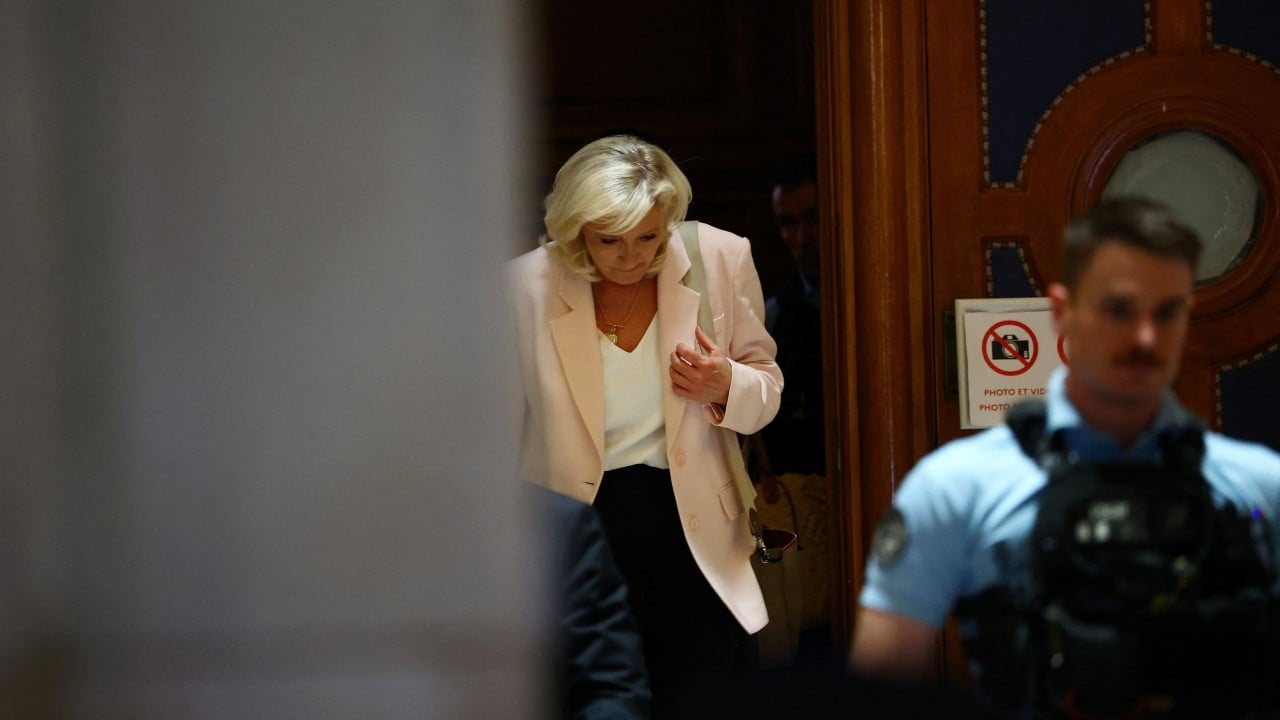
French court opens door to Le Pen presidential run, with ankle tag A French appeal court on Tuesday upheld Marine Le Pens conviction for misusing EU funds but shortened her ban on running for public office, in theory preserving a path for the far-right leader to run in the 2027 presidential election. However, the court also sentenced Le Pen to a three-year jail term: two suspended and one with an electronic ankle tag. This would make a presidential campaign politically and logistically difficult, and casts doubt on whether she will in fact continue to seek...
south china morning post · 1 day ago
French far-right leader Le Pen cleared to run for president Appeals court shortens sentence for embezzlement but she must now decide whether to run
financial times · 1 day ago
France appeals court opens door for Le Pen presidential run, with ankle tag Paris appeals court rules Le Pen guilty of misusing public funds but reduces the ban on her holding public office.
aljazeera · 1 day ago
Frances Le Pen cleared to run for president in 2027 but with ankle bracelet Marine Le Pens path to the French presidency was thrown back into uncertainty on Tuesday after an appeals court cleared the far-right leader to run in next years presidential election but ordered her to serve a one-year sentence with an ankle bracelet, raising questions over whether she could effectively campaign.
france24 · 1 day ago
Marine Le Pen found guilty, but court clears way for presidential run if she wears tag The National Rally leader now has to decide whether she will run with an electronic tag and will speak on TV later.
bbc · 1 day ago

🇫🇷 Frances far-right chief Marine Le Pen has arrived in court for a key verdict that will determine if she can run in next years presidential elections, when her party has its best chance yet of winning power. ➡️ u.afp.com/SKnU
bluesky_AFP English · 1 day ago

National Rally leader Marine Le Pen has stepped inside the courtroom, where she will hear the verdict on her appeal in a matter of minutes. It will determine whether she can run in the French presidential election next year. Live: www.politico.eu/article/live...
bluesky_Politico Europe · 1 day ago

Marine Le Pen verdict live: Court shortens Frances far-right leaders ban from office reut.rs/4p4xWvo
bluesky_Reuters · 1 day ago
JUST IN - Marine Le Pen loses her appeal case and is found guilty, upholding the March 2025 verdict, she is given a fine and 3 years imprisonment, 2 suspended and 1 year with a electronic bracelet. MORE - As 30 of the 45 months are suspended, Le Pen is barred from public office for 15 months, meaning she could still run for presidency in 2027. Le Pen has stated previously that she would not run if she had to wear a tag, as it would prevent her from campaigning properly, as she would need to seek approval for every rally. Le Pen will make a statement later tonight. Read here: @disclosetv
telegram_Disclose.tv · 1 day ago
French far-right leader Le Pen handed three-year sentence, two years suspended A French appeals court on Tuesday upheld Marine Le Pens conviction for misusing EU funds but shortened her ban on running for elected office, potentially reopening a path for the far-right leader to run in the 2027 presidential race, Reuters reported. The court ruled that Le Pen serve a three-year jail term. Two years were […]
in-cyprus · 1 day ago

Marine Le Pen condamnée à trois ans de prison, dont un an sous bracelet électronique Marine Le Pen avait rendez-vous ce mardi avec son destin politique lors du procès en appel des assistants parlementaires deurodéputés du Front national. ...
la libre · 1 day ago
Jetzt muss sie selber entscheiden: Ein kluges Urteil gegen Marine Le Pen Damit hatte niemand gerechnet: Das Gericht spricht Marine Le Pen schuldig, lässt aber eine Kandidatur zu. Allerdings mit Fußfessel. Damit ist die Frage keine juristische mehr, sondern eine moralische.
tagesspiegel · 1 day ago
French appeals court clears Le Pen for 2027 presidential election The Paris Court of Appeal on Tuesday shortened National Rally leader Marine Le Pens ineligibility ban to 45 months with 30 suspended, clearing the way for her to run in the 2027 presidential election while serving her prison sentence under electronic monitoring for misuse of European Parliament funds.
yenisafak · 1 day ago
Marine Le Pen condamnée : la presse étrangère scrute «la chute de la maison Le Pen» Condamnée à 15 mois ferme dinéligibilité, une peine quelle a déjà exécutée entre mars 2025 et juin 2026, Marine Le Pen peut encore viser 2027. De lEspagne au Royaume-Uni, les médias étrangers sinterrogent sur son avenir et lhypothèse Bardella.
liberation · 1 day ago
Marine Le Pen, Julien Odoul, Bruno Gollnisch… La liste des condamnations après le procès en appel des assistants parlementaires du FN La cour dappel de Paris a confirmé ce mardi les condamnations des douze prévenus qui avaient fait appel, dont Marine Le Pen. La cheffe de file RN a toutefois écopé dune peine inférieure à ce qui avait été décidé en première instance.
liberation · 1 day ago
Marine Le Pen bleibt im Spiel, aber sie muss eine Fußfessel tragen [premium] Das Pariser Berufungsgericht bestätigte das Urteil gegen die Rechtspopulistin. Kann und will Marine Le Pen mit einer Fußfessel bei der Präsidentschaftswahl kandidieren?
die presse · 1 day ago

Le Pen kann doch kandidieren Auf des Messers Schneide: Ein französisches Berufungsgericht überlässt es faktisch der Rechtspopulistin Marine Le Pen, ob sie bei der Präsidentschaftswahl 2027 antreten will
der standard · 1 day ago
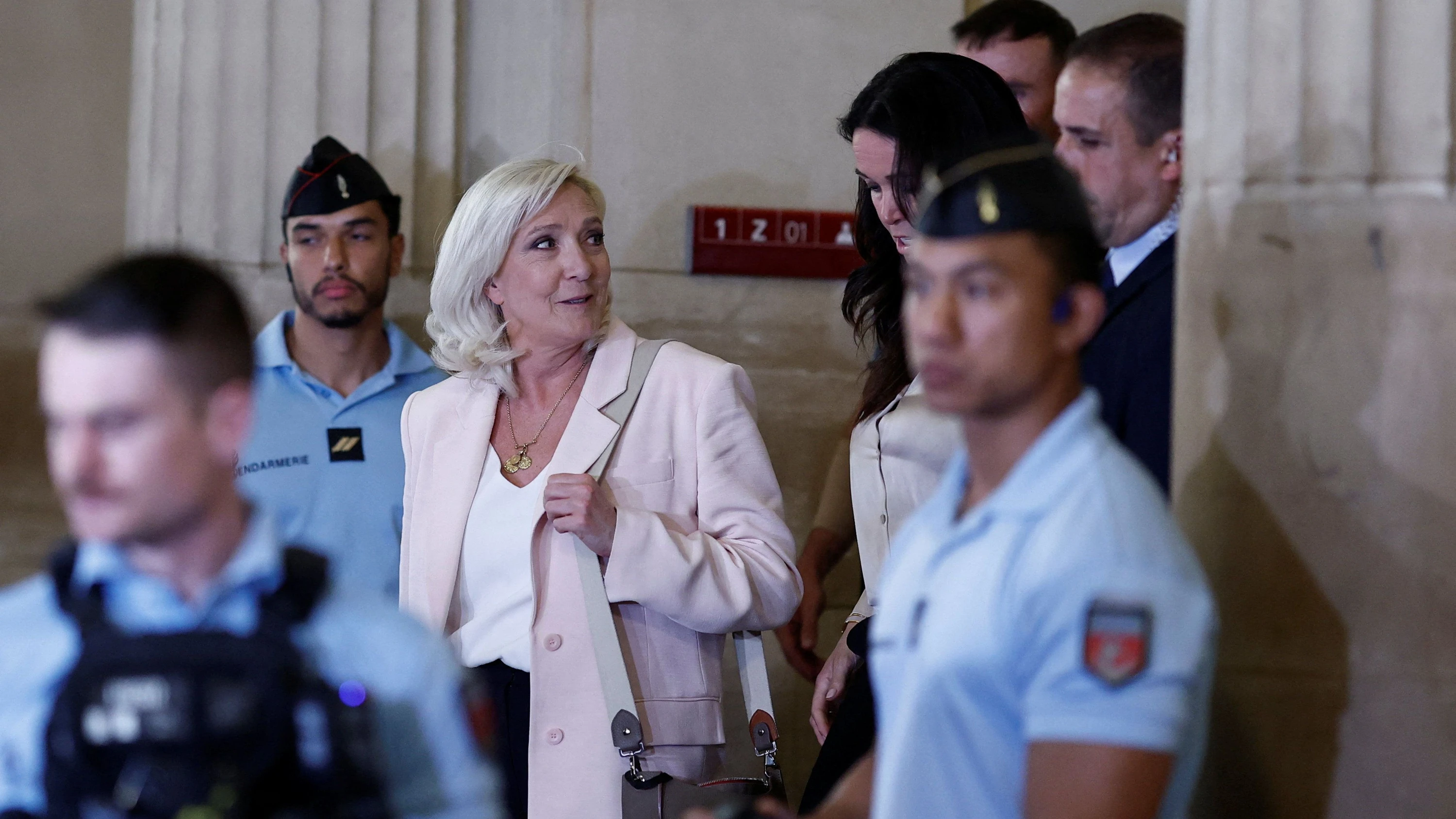
Berufungsurteil: Le Pen darf bei Präsidentenwahlen antreten – mit Fußfessel Das Berufungsgericht in Paris hat im Verfahren gegen Marine Le Pen ein Urteil gesprochen. Von diesem hängt ihre politische Zukunft ab.
faz · 1 day ago
Debate: France: will Le Pen be barred from running for president? The verdict in the appeal case against Marine Le Pen is expected today, Tuesday. A Paris court will decide whether to uphold the first-instance ruling and find Le Pen guilty of misappropriating EU funds. In addition to a prison sentence and a fine, Le Pen would be barred from standing for election for five years, as of spring 2025.
eurotopics.net · 1 day ago

French Appeals Court Allows Le Pen to Run in Next Years Presidential Race Judges upheld the far-right leaders embezzlement conviction but reduced a lower court sentence that barred her from running for public office.
wsj · 1 day ago
What has French far-right leader Marine Le Pen been found guilty of and sentenced to? French far-right leader Marine Le Pen has been found guilty of embezzling EU fund, with the appeals court sentencing her to a 15-month ineligibility for office and a year with an electronic tag. Technically this would allow her to run for the presidential election, but she has said she would not run with an electronic tag. FRANCE 2s Catherine Norris-Trent is at the appeals court in Paris and tells us more.
france24 · 1 day ago
Le Pen now has a choice to run in the election or not A Paris appeals court cleared the way July 7 for popular far-right leader Marine Le Pen to possibly run for the French presidency in 2027, but said she must wear an electronic bracelet. But she has said she would not in those conditions in the past. Now, the ball is in her court: she must decide whether she has to campaign with a monitoring bracelet or not. FRANCE 24s Marc Perelman tells us more.
france24 · 1 day ago
Decision time for far right National Rally as ruling clears Le Pens way for election run Will Marine Le Pen leader be running in the 2027 presidential election? Or will she step back and let her popular 30-year-old protégé Jordan Bardella run instead? That is the question the party will have to answer following the appeal courts decision to bar Le Pen for office for 15 months, which could in theory allow her to run - although with an electronic tag, which she has already said would be a no-go. FRANCE 24s Marc Perelman and Luke Shrago tell us more.
france24 · 1 day ago
Marine Le Pen branding as victim of judicial harassment would be political stretch Marine Le Pen is set to give a crucial interview on French primetime television on July 7 following a sentence handed down by a court of appeal after she was found guilty of systemising the embezzlement of EU funds within her party, the National Rally. Although she has said she would not run with an electronic tag on, she could well change her mind. FRANCE 24s Catherine Norris-Trent looks at the implications of such a decision.
france24 · 1 day ago