 Wednesday, May 20Wednesday, May 20
Taiwan-China Tensions and U.S. Involvement Under Trump-Xi Dynamics
Taiwanese leader William Lai Ching-te reaffirmed Taiwan’s sovereignty on Sunday, prompting China to assert that Taiwan has "never been a country" and remains an inalienable part of its territory. This exchange underscores the ongoing dispute over Taiwan’s status, a core issue in U.S.-China relations . China has repeatedly condemned diplomatic engagements involving Taiwan, including the recent visit of Taiwan’s foreign minister to Geneva for the World Health Assembly (WHA), which Beijing blocked Taipei from attending .
The Taiwan issue dominated discussions during U.S. President Donald Trump’s recent high-stakes summit with Chinese leader Xi Jinping. Xi emphasized that Taiwan is the "top priority" in U.S.-China relations, warning that mishandling the issue could lead to "an extremely dangerous situation." Trump, however, has not yet approved a U.S. arms package for Taiwan, describing it as a "useful bargaining chip" in negotiations with China . A senior Taiwanese diplomat indicated openness to a direct call between Trump and Lai, signaling potential diplomatic engagement despite Beijing’s objections .
The Trump-Xi summit, held just days before Xi’s meeting with Russian President Vladimir Putin, highlighted China’s efforts to position itself as a central player in global diplomacy. While Trump and Xi exchanged friendly rhetoric, analysts note that Taiwan remains a critical flashpoint, with China warning that U.S. support for the island could provoke conflict. Some experts argue that China overestimates Taiwan’s dependence on U.S. backing, suggesting that Beijing’s assumptions about Taiwan’s vulnerability may be misplaced .
The broader geopolitical context includes China’s deepening ties with Russia, as Xi and Putin exchanged congratulatory letters ahead of Putin’s visit to Beijing, marking the 30th anniversary of their strategic partnership. This alignment has raised concerns in the West, particularly given Russia’s ongoing war in Ukraine and China’s stance on Taiwan . Meanwhile, Japan has expressed anxiety over the Trump-Xi rapprochement, fearing it could undermine regional stability, particularly regarding Taiwan .
The aftermath of Nancy Pelosi’s 2022 visit to Taiwan continues to shape U.S.-China-Russia dynamics. While the visit was initially framed as a U.S. strategic victory, analysts now assess its long-term consequences, including heightened Chinese military posturing and the potential for miscalculation in the Taiwan Strait .
> Background: **Trump halts Taiwan arms deal to pressure China in trade talks.** — *11 hours ago*
More LFE coverage on this topic

Putin Headed to Beijing With Entourage of Ministers and CEOs The president intends to make a renewed push to convince Chinese leader Xi Jinping to finalize the stalled Power of Siberia 2 pipeline project.
themoscowtimes · 2 days ago
China says Taiwan never a country after Taiwan asserts sovereignty, independence Saadet Gokce 18 May 2026•Update: 18 May 2026 Taiwanese leader William Lai Ching-tes said on Sunday that Taiwan…
europesays.com · 2 days ago
Opinion: The future of the China-US-Russia triangle after Pelosis visit to Taiwan Since February 24, 2022, the international communitys focus was concentrated entirely on the war in Ukraine and the growing Russia – West confrontation. It seemed that nothing could change the situation until the end of hostilities in Ukraine. However, on August 2 and 3, almost everyones attention shifted from Ukraine to Taiwan. As the Speaker of the US House of Representatives, Nancy Pelosi, stated her intention to visit Taiwan, up to half a million people were watching the trajectory of her plane on air flight tracking sites. The negative reaction of China, including the warning of President Xi during his conversation with President Biden that those who played with fire would be perished by it, created hype around this visit. Many were discussing the possibility of Chinese military jets closing the airspace over Taiwan and preventing Pelosis plane from landing in Taiwan, while some enthusiasts were even contemplating the possibility of a US-China direct military clash. As Pelosi landed in Taiwan and met with the Taiwanese President, the global social media was full of amateur assessments about the strategic victory of the US and the confirmation of the US global hegemony. However, as the dust settles down, and information noise and manipulation eventually decreases, a more serious assessment is needed to understand the real consequences of this visit.
commonspace · 2 days ago
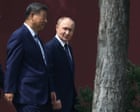
Xi prepares to welcome Putin to China four days after hosting Trump Chinese state media say Beijing emerging as focal point of global diplomacy with Russian leader arriving on TuesdayXi Jinping and Vladimir Putin exchanged congratulatory letters on Sunday ahead of the Russian presidents visit to Beijing this week, four days after Donald Trump left China after a high-stakes summit.Xi said bilateral cooperation between Russia and China had continuously deepened and solidified, Chinese state media reported, with this year marking the 30th anniversary of the two countries strategic partnership. Continue reading...
theguardian · 2 days ago
Xi Jinping prepares to welcome Vladimir Putin to China, four days after hosting Donald Trump Chinas deep relationship with Russia remains a continuing cause for concern in the west, particularly since Moscow launched its invasion of UkraineXi Jinping and Vladimir Putin exchanged congratulatory letters on Sunday ahead of the Russian presidents visit to Beijing this week, four days since Donald Trump left China after a high-stakes summit.Xi, Chinas leader, said bilateral cooperation between Russia and China had continuously deepened and solidified, with this year marking the 30th anniversary of the two countries strategic partnership, according to Chinese state media. Continue reading...
theguardian · 2 days ago
Trumps China Opening and Japans Taiwan Anxiety – The Diplomat The apparent closeness between U.S. President Donald Trump and Chinese President Xi Jinping at their recent Beijing summit…
europesays.com · 2 days ago
Harri Tiido: Former U.S. ambassador reflects on autocracy and democracy In this installment of Harri Tiidos background series, Russia, China, and the West are examined through the lens of Michael McFaul. Both Russia and China seek to reshape the global order — much like the Soviet Union during the Cold War — but the ideological conflict today is less intense than it was 40 years ago, Tiido notes.
news.err · 2 days ago
Taiwan Open To Trump–Lai Call After Xi Summit Remarks A senior Taiwanese diplomat said on Monday that Taiwan would welcome a direct phone call between U.S. President…
europesays.com · 2 days ago
Trump and Xi will not determine Taiwans fate China assumes that the island would be helpless without American support — that is a dangerous mistake
financial times · 3 days ago
Debate: Trump visits Xi: the international fallout? As well as friendly words about collaboration, Chinas head of state Xi also issued a stark warning to the visiting US president. The Taiwan issue has top priority in their bilateral relations, Xi insisted. If it was not handled properly, it could result in an extremely dangerous situation. Trump, meanwhile, has said he has yet to greenlight a US arms package to Taiwan, describing it as a useful bargaining chip against China.
eurotopics.net · 3 days ago

China denounces Taiwan foreign ministers Geneva visit amid WHO assembly
news.yahoo.com · 3 days ago
Taiwan, WHA and the geopolitics of healthcare in the age of AI Excluded from Geneva: Beijing keeps Taipei out of the World Health Assembly, but Taiwan is turning digital healthcare…
europesays.com · 3 days ago