France and Germany on Friday submitted their candidates for two vacancies on the European Central Bank's Executive Board, completing a political package that will set the institution's leadership for years.
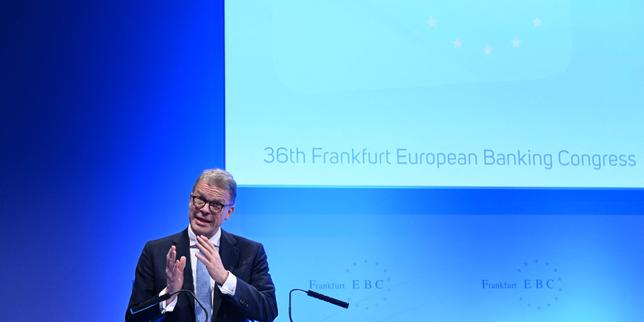
Berlin nominated Markus Brunnermeier, a professor at Princeton University, as the ECB's next chief economist after the Irish incumbent Philip Lane concludes his eight-year term on May 31. Paris put forward Laurence Boone to take over the markets portfolio when Isabel Schnabel leaves on Jan. 4 for a job at the International Monetary Fund. Boone, a former minister of Europe from 2022 to 2024 and political ally of President Emmanuel Macron, now heads corporate and investment banking at Santander.
The nominations clear the way for Pablo Hernández de Cos to succeed Christine Lagarde as ECB president. Lagarde departs on Feb. 7. The former governor of the Bank of Spain faces Dutch candidate Klaas Knot, who has not withdrawn. Eurogroup President Kyriakos Pierrakakis confirmed both candidacies and informed European Council President António Costa, starting the formal selection process after the Friday deadline for submissions.
The Council of the European Union will evaluate the candidates and issue a recommendation to the European Council, which makes the final decision after consulting the European Parliament and the ECB. The Executive Board comprises six members appointed for non-renewable eight-year terms. Approval requires a qualified majority of at least 16 of the 21 eurozone member states representing 65 percent of the population.
Boone, 57, previously served as chief economist at the OECD and held positions at Barclays, Bank of America Merrill Lynch and AXA. If confirmed, she would be the only woman on the ECB's six-member Executive Board and its 27-member Governing Council. Germany secured the chief economist post, a position considered the second-most influential at the institution.
Portugal, which had considered submitting a candidate, did not present a name before the deadline.