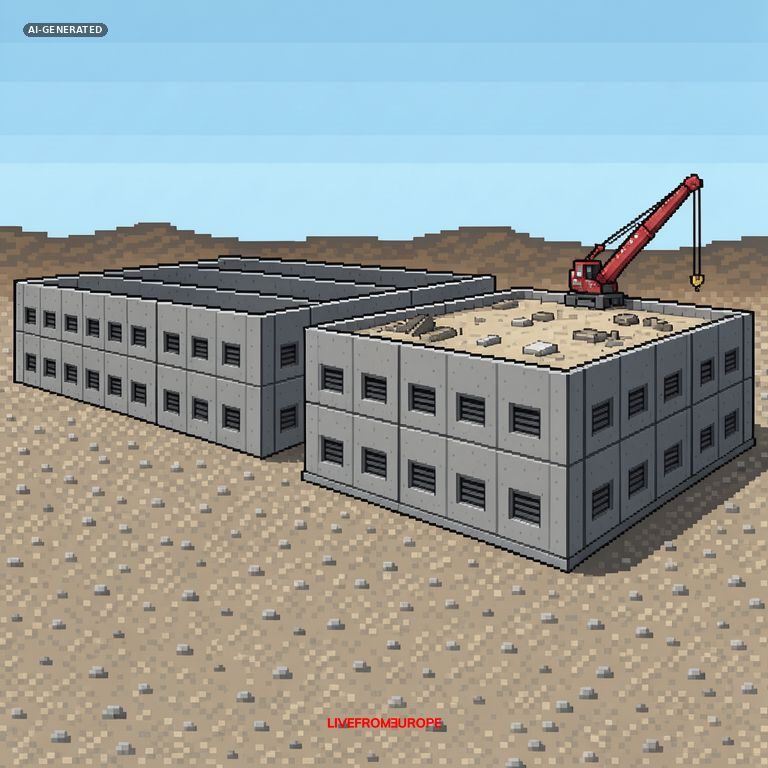
The International Atomic Energy Agency reported on Wednesday that North Korea has expanded its uranium enrichment facility at Yongbyon since September, a site capable of producing weapons-grade material.
IAEA Director General Rafael Grossi told the agency's 35-member Board of Governors that construction of an additional annex to the original enrichment facility began in mid-September 2026. External works on the new section were completed by the end of October, he said. "The continued expansion of the DPRK's uranium enrichment program still raises great concern," Grossi said.
Highly enriched uranium can be used to build nuclear weapons. The IAEA has previously reported on enrichment facilities at Kangson near Pyongyang and at Yongbyon. It has also reported the construction of another enrichment facility at Yongbyon. South Korea's Unification Minister Chung Dong-young said last year that North Korea operates four such facilities. Since the 2019 failed talks between Kim Jong Un and Trump, North Korea has built additional uranium enrichment facilities in Yongbyon and elsewhere.
North Korea calls the Yongbyon complex the "heart" of its nuclear program. Grossi said the five-megawatt reactor at Yongbyon appears to remain operational. The reactor produces plutonium from spent fuel and is in its seventh irradiation cycle. A light-water reactor has also been operating at Yongbyon since April.
The IAEA has had no access to North Korea since Pyongyang expelled its inspectors in 2009. The agency now monitors the country's nuclear sites primarily through satellite imagery. North Korea has conducted several nuclear tests and appears to continue producing both highly enriched uranium and plutonium.
North Korean Foreign Minister Choe Son Hui said last week that possessing such weapons is the "strongest guarantee" of the country's sovereignty. She rejected a recent G7 demand for North Korea's complete nuclear disarmament.
US President Donald Trump has expressed a desire to meet North Korean leader Kim Jong Un during his Asia trip. Secretary of State Marco Rubio said no such meeting was scheduled during the president's visit to China. Nuclear disarmament is likely to be discussed at a summit in Shenzhen on Thursday. The meeting brings together Trump, Chinese President Xi Jinping and Russian President Vladimir Putin.
Kim has previously said he could return to negotiations if the US abandoned its "hostile policy". He also demanded recognition of North Korea as a nuclear state. Experts say Pyongyang seeks international recognition as a nuclear state to demand the lifting of UN sanctions.