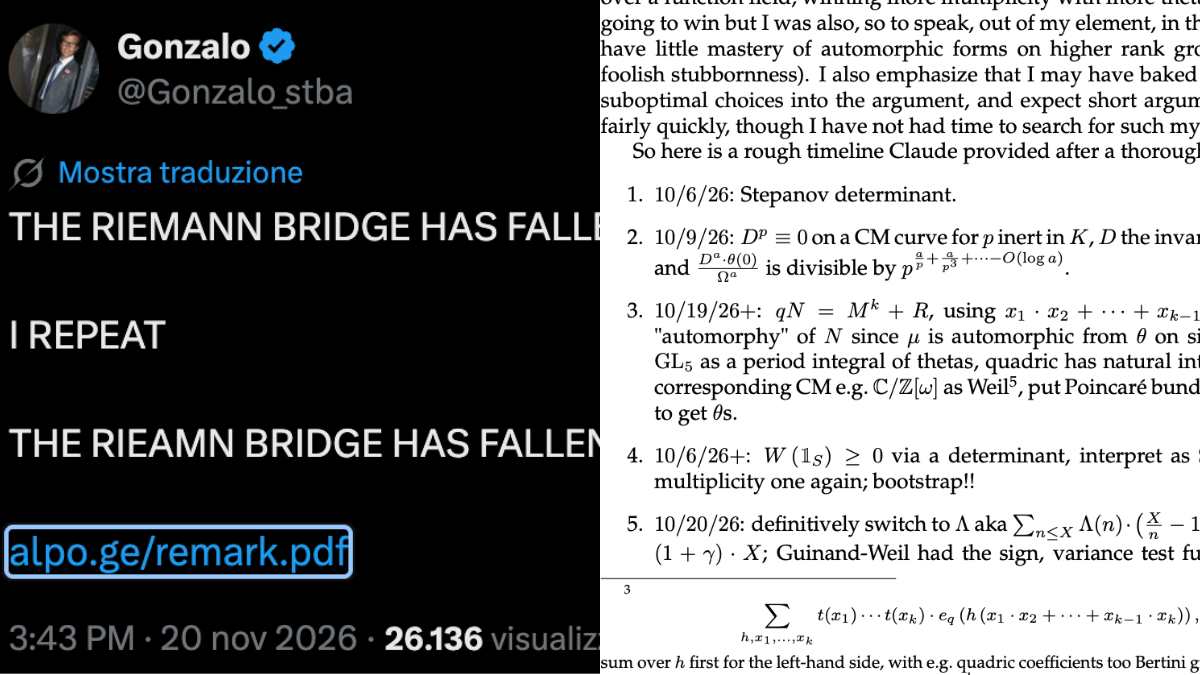
Levent Alpöge, a mathematician at the AI company Anthropic, announced on Friday that he had used the company's chatbot Claude to prove the Riemann hypothesis, a 167-year-old problem in mathematics [1].
Alpöge posted the proof on his website in Lean, a programming language that allows computers to verify mathematical arguments line by line [2]. He described the AI-written version as "incredibly long," running to more than 250,000 pages. He said he produced the result over about six weeks using a non-public version of Claude. He finished late Sunday night into Monday, days before Anthropic's stock market debut.
The Riemann hypothesis, proposed by Bernhard Riemann in 1859, posits that prime numbers have a determined order along the number line. It is one of the seven Millennium Prize Problems selected by the Clay Mathematics Institute in 2000, each carrying a $1 million prize [1]. Humans alone have solved only one of these problems. If verified, Alpöge's proof would be the second solved by artificial intelligence. It would follow an OpenAI model's claimed solution to the Navier-Stokes equations in September [2].
Andrew Sutherland, a mathematician at the Massachusetts Institute of Technology, said he had compiled Alpöge's code in Lean on his own computer [3]. He had seen at least three similar checks by other professional mathematicians. Terrance Tao, a prominent mathematician, said verification of the proof was still some way off [1]. He noted that at least a human author was available to assist with the task.
Alpöge said he messaged Anthropic chief executive Dario Amodei on Sunday to ask permission to announce the discovery, calling the timing "horrible" given the company's public listing [2]. Anthropic did not respond to a request for comment after Alpöge posted his findings on Friday morning, as the company's stock price dropped on its first full day of trading.
Brian Conrey, a leading expert on the Riemann hypothesis, told AFP that if confirmed it would be a "historic moment in human history," though he had not yet seen the full proof [4]. Steven Strogatz, a professor at Cornell University, compared the achievement to winning a mathematical Olympics and likened the human-AI collaboration to a jockey guiding a fast horse [5].
The announcement came hours after the American Mathematical Society noted that mathematician Alessandro Masullo had circulated a 940-page draft proof of the hypothesis several months earlier without AI [4]. Masullo said it required substantial corrections. Alpöge wrote that he "could not live if I waited even longer," adding that he hoped the argument would show the joy and wonder to be found in the simplest things [2].