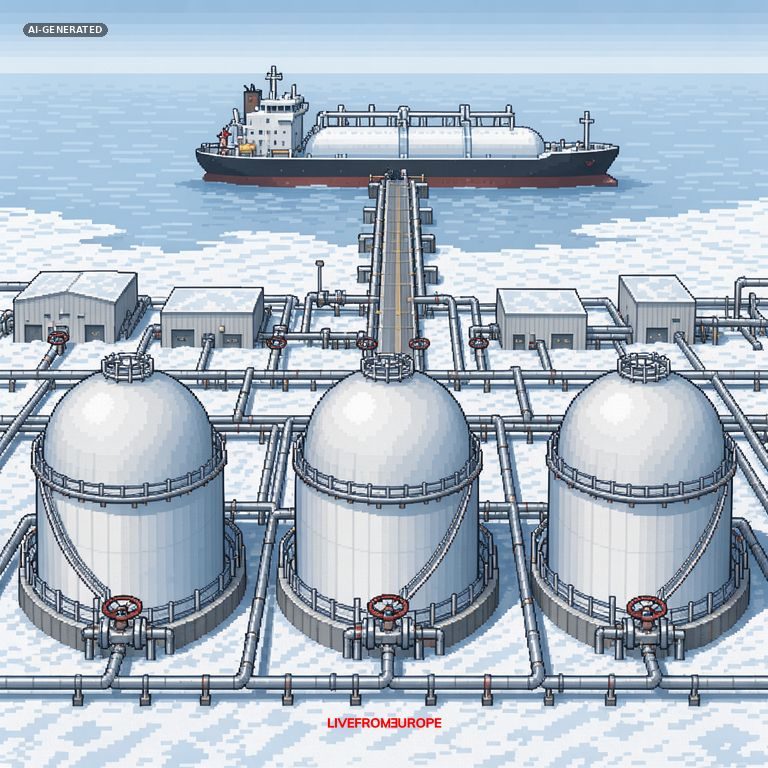
The European Union will ban imports of Russian liquefied natural gas from the Yamal project starting Jan. 1, 2027, forcing Moscow to redirect its flagship Arctic exports to new markets. The Yamal project sits on the Arctic coast of Siberia. LNG from the facility travels west through the Kara and Barents Seas, around northern Norway, to European waters.
Between January and October 2026, 81 percent of registered deliveries went to Europe, according to an analysis by Urgewald. Europe paid €8.7 billion for the gas in that period, already exceeding the €7.2 billion forecast for all of 2025. The embargo ends long-term contracts binding Yamal to Europe.
Russia will need to find new buyers, most likely in Asia, and reorganize its transport network. Longer routes mean higher costs and fewer voyages per tanker each year. "Trade will look completely different," said Malte Humpert, an analyst and founder of the Arctic Institute.
The embargo gives Moscow "greater motivation" to find another route, Humpert added. "It is not easy. It is not cheap. It is very slow, but Russia will manage." Europe was the nearest large market, with voyages taking six to 10 days.
If buyers are only China, South Korea or Japan, tankers "will have to sail really far," Humpert said. "Imagine that for the last seven years you drove to the gas station around the corner, and suddenly the nearest one is three to four times farther." If Moscow sells to Turkey, Egypt, Pakistan or Vietnam, the distance will be shorter.
Russia has two main ways to deliver Yamal gas to Asia. One is eastward through Arctic waters via the Northern Sea Route. Russia has only 15 specialized ice-class LNG carriers for winter navigation, according to Sebastian Rötters of Urgewald. They are very expensive to maintain and have been used mainly on shorter routes to Europe.
A rise in black-market LNG trade could be one solution. A classic "shadow fleet" has not been needed so far because Yamal was not under sanctions, Rötters explained. But a shadow fleet would not work well here. It usually consists of old, deregistered oil tankers that are easy to hide.
Globally, there are far fewer LNG carriers, they move on limited routes and are easier to track, said Martin Vladimirov, a senior analyst at the Center for the Study of Democracy. One possible workaround is virtual swap. Russia could sell more gas to countries like Turkey or China, which could then increase exports of their own or other gas to Europe. This would allow Russia to maintain revenues even if its LNG no longer reaches European ports, Vladimirov explained.
Even if Moscow finds new buyers, it must deliver the gas to them. Tankers unable to enter Europe will have to travel longer routes or transfer cargo to other ships en route to new markets. Officials are already preparing for an expected rise in the black market.
The issue requires "greater attention at the European level," said Lukas Savickas, Lithuania's energy minister, whose country takes over the six-month EU presidency in January. He called for a comprehensive approach strengthening monitoring of connection points, pipelines and ports across the EU.