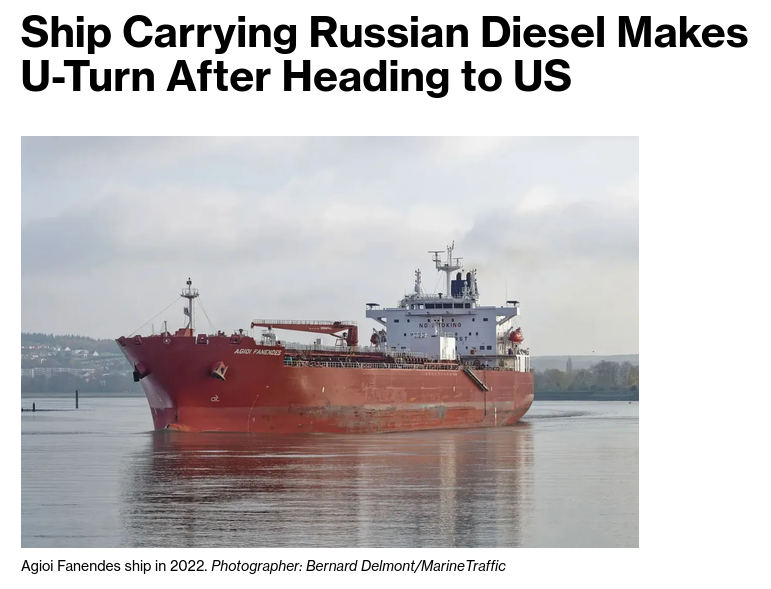
The last tanker carrying Russian diesel under the Trump-Putin deal has turned around about 740 kilometers from New York and is no longer bound for the United States.
The Agioi Fanendes left the Russian Baltic port of Primorsk on October 22 carrying 40,000 metric tons of ultra-low-sulfur diesel. It was expected to arrive in New York by November 7. During the voyage, the vessel changed its listed destination to "for orders." On Monday, the tanker began moving slowly away from the U.S. East Coast in a zigzag pattern, according to ship-tracking data cited by Bloomberg. Its owner, the Greek shipping company Eastern Mediterranean Maritime, said the vessel is "proceeding for orders as the discharging port is not confirmed yet."
In early October, U.S. President Donald Trump and Russian President Vladimir Putin agreed to deliver Russian diesel to U.S. and global markets. The U.S. Treasury Department temporarily authorized transactions involving sanctioned Russian diesel. The deal was intended to lower fuel prices ahead of the U.S. midterm congressional elections, which the Democrats won. Russia sent four tankers under the agreement.
The other three vessels have also altered course. The Talisman anchored in the Egyptian port of El Dekheila near Alexandria on Monday. The Leruo sailed toward Brazil and then stopped transmitting its coordinates. As of Saturday, the Beast remained off the British coast, signaling "Brazil, awaiting orders." No shipments of Russian diesel have arrived in the United States.
The Kremlin said U.S. purchases of Russian diesel, and specifically the routes taken by the tankers, had nothing to do with the U.S. elections. "All the diesel will find buyers," Kremlin spokesman Dmitry Peskov said. Kirill Dmitriev, head of the Russian Direct Investment Fund (RFPI), called reports that the tankers changed course "fake."
New Jersey Governor Mikie Sherrill warned port officials and terminal operators against accepting Russian diesel, saying the shipments would break federal law and calling the deal "illegal." Former President Joe Biden had imposed a ban on U.S. imports of Russian oil and petroleum products in 2022. Trump waived parts of a new sanctions law to approve the deal. He promised Russia would export 300,000 tons, or 2.25 million barrels, immediately, followed by 500,000 tons in November and 1 million tons thereafter.
Six Russian refineries have been attacked since early November, with a combined capacity of approximately 1.7 million barrels per day, according to Bloomberg estimates. Russian Deputy Prime Minister Alexander Novak said in late October that Russia planned to export more than 2 million metric tons of diesel to global markets in November. He acknowledged that Ukrainian attacks could reduce the volumes of fuel available for export.