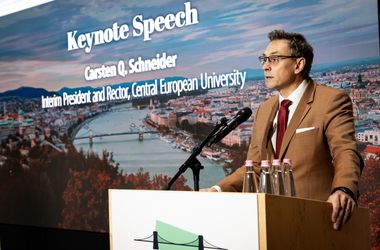
The Central European University is open to expanding its academic programmes in Budapest, though its interim rector said a full return from Vienna is not currently on the agenda.
Carsten Q. Schneider, the university's interim president and rector, told The Guardian that both the institution and Hungary's new government are willing to discuss the idea. "We are extending our hand, they are extending their hand, but they have a lot of other things to deal with at the moment," he said. No official negotiations have begun.
The university employs 312 staff in Budapest, mostly in administrative roles, while all teaching takes place in Vienna, where 476 employees work. Schneider said any expansion would need to preserve educational quality and avoid requiring students to travel the 200 kilometres between the two cities. The CEU has more than 1,400 students from 103 countries.
Founded by George Soros in 1991, the CEU moved its main operations from Budapest to Vienna in 2019 after the Orbán government passed the 2017 "Lex CEU" law. The legislation required foreign universities to offer programmes in their home country; when the CEU tried to comply, the government refused to sign the necessary agreement with New York State. The Court of Justice of the European Union ruled in 2020 that the law violated EU law, but the decision came too late to reverse the move.
Hungary's new government, led by Prime Minister Péter Magyar of the Tisza Party, has said it is open to the university's return. Sándor Katz, state secretary for higher education at the Ministry of Education and Children's Affairs, told Kossuth Radio that the government is open to the CEU again becoming a full degree-granting university in Budapest. He added that the rest would depend on the institution. He confirmed that talks are ongoing, though he did not specify their content. The HVG news site reported that discussions partly concern the case the CEU filed against Hungary at the European Court of Human Rights in 2023, which remains pending in Strasbourg.
Schneider said strengthening the Budapest presence could symbolise academic freedom and resilience, but would require funding independent of the Hungarian government. "We do not want special treatment," he said. "We are a great value, so let us find a solution." Any decision on the university's future in Hungary rests with its 13-member Board of Trustees, which includes founder George Soros and his son Alexander Soros.
The CEU has also seen a rise in American applicants since Donald Trump returned to the White House. For the first time in 25 years, students from the United States make up the largest single group among master's students, accounting for 10 percent of the total, according to Schneider.