Loading…
 Saturday, August 29Saturday, August 29
2 months · 4 summary articles
Volkswagen faces existential crisis as restructuring plan sparks global alarm
Volkswagen’s radical plan to slash 100,000 jobs worldwide and close four German factories has triggered a political and industrial earthquake, with the company’s own supervisory board rejecting the proposals in a tense Thursday session. The crisis deepened on Friday as the Wolfsburg-based giant reported a 9% drop in second-quarter vehicle sales, the steepest decline in four years, while its shares hit their lowest level since summer 2010.
Auto industry oracle Ferdinand Dudenhöffer has called for an immediate return to the 40-hour workweek at Volkswagen without compensation, arguing that Germany’s 35-hour standard has become a competitive millstone. “We have to scrap collective bargaining autonomy for a few years,” the head of the Center Automotive Research (CAR) told the *Neue Osnabrücker Zeitung*. “Employees will have to make sacrifices.” Dudenhöffer dismissed claims that German automakers “slept through” the electric transition, pointing to Volkswagen’s 2019 investment in a dedicated EV plant and the competitive success of its Czech subsidiary Škoda. “Škoda can do it—so the blanket accusation that carmakers missed the boat is wrong.”
The restructuring blueprint, presented to the supervisory board on Thursday, envisages cutting the model range by 50% and trimming annual production capacity from 12 million to 9 million vehicles. Four German plants—Hannover, Emden, Zwickau, and Neckarsulm—are reportedly on the closure list, though Volkswagen has not confirmed details. The plan’s rejection by employee representatives and Lower Saxony’s state government, which owns 20% of the company, has left CEO Oliver Blume scrambling for a revised proposal. “We categorically reject generalized reduction targets,” the powerful IG Metall union and Volkswagen’s works council said in a joint statement, demanding “independent, responsible analysis” rather than “imposed concepts.”
The crisis has exposed deep divisions within the Volkswagen Group. While German operations hemorrhage jobs and capacity, Spain’s plants—Seat in Martorell and Volkswagen Navarra—are expanding. Seat has converted 500 temporary workers to permanent contracts and plans to hire up to 1,000 more by 2027 to meet surging demand for electric models, including the upcoming Škoda Epiq and second-generation Cupra Formentor. “Short-term employment in Spain is safe,” said Matías Carnero, UGT secretary-general at Seat and a Volkswagen supervisory board member. “The real threat is losing future model assignments to Germany.” Union leaders warn that halving the model range could jeopardize Martorell’s bid for a second electric platform, leaving the plant dependent on just three models—Ibiza, Arona, and León.
The restructuring’s global fallout is already visible. CNBC reported that Volkswagen will eliminate up to 50% of its current model lineup to focus on profitable segments, though the company has not confirmed mass layoffs or plant closures. Analysts at Boston Consulting Group (BCG) estimate European auto plants are operating at just 59% capacity, requiring 80% utilization to remain viable—a gap equivalent to the output of 90 factories. The specter of Chinese automakers producing vehicles in European Volkswagen plants, once unthinkable, is now under active discussion. “The debate has fundamentally changed,” noted German broadcaster NTV, pointing to Volkswagen’s exploratory talks with Chinese EV maker Xpeng, in which Volkswagen holds a stake, about potential European production.
Volkswagen’s predicament mirrors broader structural challenges facing Europe’s auto sector. The group’s software unit Cariad has faced repeated delays, battery venture PowerCo has racked up cost overruns, and strategic alliances with Chinese manufacturers remain embryonic. “The problem isn’t just the measures—it’s the accumulation of strategic errors over years,” said Rafa Guerrero, CCOO secretary-general at Seat. “We need negotiated solutions that preserve consensus, not blanket cuts.” With the supervisory board deadlocked and the German government watching closely, Volkswagen’s existential gamble risks tearing apart the very consensus that built Europe’s largest automaker.
Follow us for live European news

Gigant auto, lovit de cea mai mare scădere a livrărilor din ultimii patru ani. Skoda susține că restructurarea Volkswagen nu îi afectează activitatea Producătorul ceh de automobile Skoda Auto a anunțat vineri că planul de restructurare al grupului Volkswagen nu va avea, în acest moment, un impact direct asupra operațiunilor sale.
adevarul · about 2 months ago
VW: Dudenhöffer fordert Ende der 35-Stunden-Woche bei VW Autoexperte Ferdinand Dudenhöffer sieht in Mehrarbeit ohne Lohnausgleich einen Weg, die hohen Produktionskosten bei Volkswagen zu senken. Zugleich erwartet er harte Zeiten.
handelsblatt · about 2 months ago
Auto: Dudenhöffer fordert Ende der 35-Stunden-Woche bei VW Autoexperte Ferdinand Dudenhöffer sieht in Mehrarbeit ohne Lohnausgleich einen Weg, die hohen Produktionskosten bei Volkswagen zu senken. Zugleich erwartet er harte Zeiten.
tagesspiegel · about 2 months ago
Criza la Volkswagen: Nemții taie jumătate din modele și reduc masiv producția / Ce urmează pentru angajați Volkswagen a intrat într-o reorganizare profundă, pe fondul presiunilor generate de concurența din China și de încetinirea pieței auto globale, potrivit CNBC. Grupul german a anunțat un nou plan prin care reduce numărul de modele și capacitatea anuală de producție. Conducerea nu a confirmat însă informațiile privind concedieri masive sau închiderea unor fabrici din Germania. …
hotnews.ro · about 2 months ago
Volkswagen sales plunge as German automaker lays out plan to slash number of brands Volkswagen reported weak sales numbers on Friday, a day after the giant German automaker announced plans to slash the number of models by nearly half as sales plunged,…
japantoday · about 2 months ago
Automobilindustrie: Audi-Standort Neckarsulm: OB fordert Klarheit von Volkswagen
die zeit · about 2 months ago
Rütteln an Tabu in der Autoindustrie Die europäische Autoindustrie steckt in einer tiefen Krise. Der größte Hersteller Volkswagen (VW) streicht seine Modellpalette zusammen, wie der deutsche Konzern am Donnerstag mitgeteilt hatte. Weitere Sparmaßnahmen, die Streichung Zehntausender Stellen und Werksschließungen sind im Gespräch. Viele Fragen dazu blieben bisher offen. Die Lage ist jedenfalls ernst genug für einen möglichen Tabubruch: produzieren in Europa für den Rivalen China.
orf.at · about 2 months ago
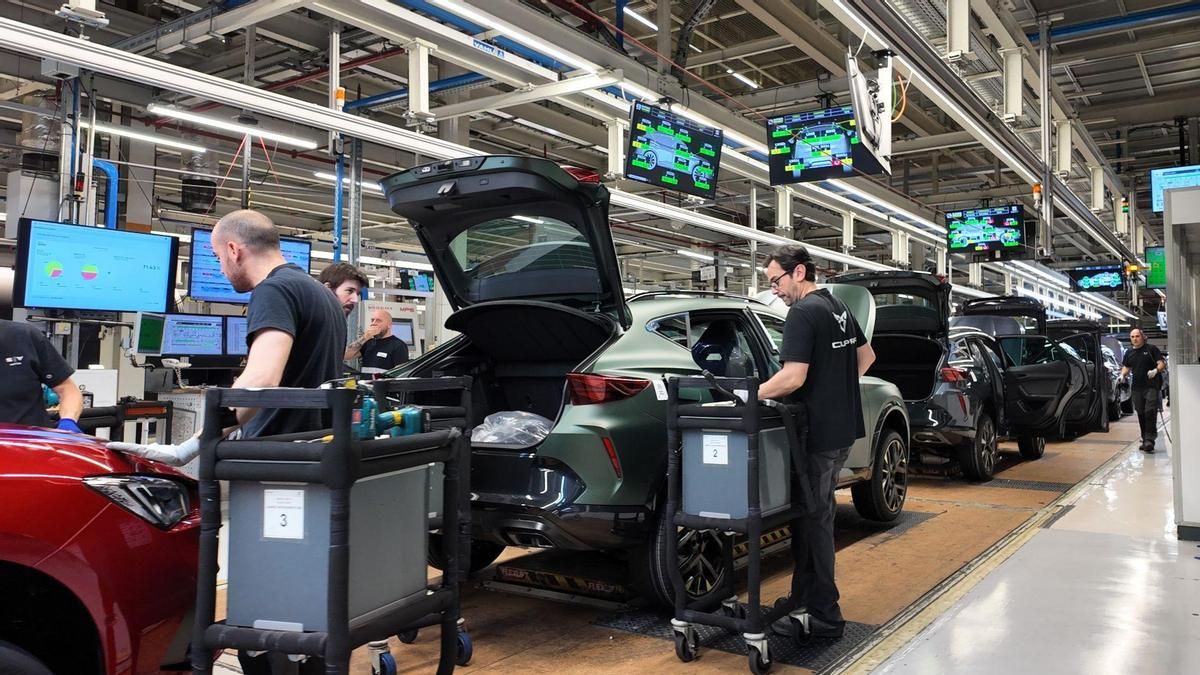
Los 23.000 trabajadores del grupo Volkswagen en España se salvan (por ahora) de la traumática reconversión Los sindicatos descartan riesgos a corto plazo para los empleados de Seat y de Landaben (Navarra), aunque alertan del peligro de perder la asignación de futuros modelos, que podrían quedarse en Alemania o suprimirseLa patronal de automoción de Alemania avisa: el fin de los privilegios afectará al empleo Los 23.000 trabajadores que el Grupo Volkswagen tiene en España contemplan, a distancia pero con expectación, la que va camino de convertirse en la mayor crisis laboral que ha vivido el fabricante alemán en décadas. Mientras la dirección defiende, por ahora con el rechazo de la mayoría del consejo de administración, una reestructuración radical que podría alcanzar los 100.000 empleos y reducir drásticamente la capacidad industrial del consorcio, las plantas españolas se benefician del aumento de la producción y de la plantilla gracias al despliegue de los primeros modelos eléctricos Made in Spain. La paradoja resume el cambio de equilibrio que atraviesa el grupo. Alemania intenta adelgazar una estructura que considera sobredimensionada y con un grave problema de competitividad. España, en cambio, se ha convertido en uno de los pilares de la ofensiva eléctrica con la que Volkswagen pretende contraatacar a los fabricantes chinos con el lanzamiento de cuatro modelos eléctricos urbanos de cuatro metros de longitud de las marcas VW, Cupra y Skoda, a los que se puede añadir otro de Audi, tal como admitió Oliver Blume, consejero delegado de Volkswagen, en su última visita a Martorell. La fábrica de Seat de Martorell acaba de incorporar a 500 empleados temporales como indefinidos en plantilla, formada por unos 14.000 empleados en toda la compañía, y prevé ampliar la cifra con más trabajadores de la bolsa de 1.300 eventuales después del verano por el aumento de la actividad. En la factoría de Volkswagen de Navarra, la plantilla de 4.000 empleados también se está reforzando con contratos de relevo y con la previsión de incorporar hasta 1.000 trabajadores en 2027 para hacer frente al aumento de producción. Por eso, el mensaje de los sindicatos españoles coincide en que el empleo no corre peligro inmediato tras varios años de ajustes previos llevados a cabo. En cambio, la verdadera amenaza puede llegar cuando el grupo tenga que decidir dónde fabrica la siguiente generación de vehículos eléctricos. La amenaza de pérdida de futuros modelos El secretario general de UGT en Seat y miembro del consejo de supervisión del Grupo Volkswagen, Matías Carnero, descarta consecuencias inmediatas para las plantillas españolas, pero advierte de que el escenario abierto en Alemania puede condicionar el futuro industrial de las fábricas españolas. A corto plazo no prevemos un efecto negativo en la plantilla en España, pero seguimos con mucha preocupación la situación del grupo, explica. Pero el dirigente sindical pone el foco donde probablemente se librará la verdadera batalla de los próximos años. El escenario que tenemos por delante --recortes de empleo y de gama de modelos-- complica la asignación de una segunda plataforma de vehículos eléctricos a la planta de Martorell y puede provocar un problema de rentabilidad. Necesitamos esa segunda plataforma de cara al futuro, advirtió Carnero. Producción del eléctrico Skoda Epiq en Navarra La plantilla de Martorell lleva ya varios años a la espera de ese nuevo modelo, para el que se perfila la segunda generación eléctrica del Cupra Formentor. De hecho, Seat ha abonado recientemente una compensación a la plantilla por una subida salarial adicional prevista en el convenio colectivo debido a la falta de asignación del nuevo vehículo. Como telón de fondo se mantiene la incertidumbre sobre el futuro de la marca Seat, que ha quedado con solo tres modelos (Ibiza, Arona y León) a la venta y a la espera de recibir futuros nuevos vehículos electrificados, una decisión que también puede verse dificultada en el nuevo contexto. El futuro de la marca Seat Para Matías Carnero, la prioridad pasa por encontrar una salida pactada que permita recuperar competitividad sin destruir el consenso interno que históricamente ha caracterizado a Volkswagen. Hay que buscar soluciones negociadas y compartidas para reducir costes y mejorar la situación de la compañía. Para Rafa Guerrero, secretario general de CCOO en Seat, a corto plazo ninguna de las medidas tiene que afectar a España, aunque reconoce que puede haber algún impacto a medio y largo plazo dependiendo de cómo se concrete el plan. Si hablamos de segunda plataforma y si se reducen los modelos a la mitad progresivamente, el escenario es mucho peor, destaca Guerrero, que atribuye la situación del grupo a una cadena de decisiones equivocadas acumuladas durante años. El problema aquí no es tanto las medidas, que lo son, sino que son consecuencia de errores estratégicos del Grupo Volkswagen, afirma. Entre esos errores sitúa las dificultades del desarrollo de software con Cariad, los sobrecostes por el proyecto de baterías de PowerCo y la falta de alianzas tecnológicas con fabricantes chinos. Rechazo al plan en el consejo de VW En la sede central de Volkswagen en Wolfsburg, Oliver Blume tendrá que someterse a una segunda vuelta para intentar sacar adelante su plan de competitividad, después del rechazo en el consejo celebrado el pasado jueves 9 de julio con los votos en contra de los representantes sindicales y del Estado de Baja Sajonia, que posee un 20 del capital. El plan contempla reducir costes estructurales, simplificar hasta un 50 la gama de modelos, concentrar inversiones y adaptar la capacidad de producción pasando de 12 millones de vehículos anuales a nueve. El poderoso sindicato IG Metall, el comité de empresa de Volkswagen e incluso la agrupación de los mandos y directivos del grupo reaccionaron a la tensa reunión del consejo haciendo un llamamiento a mantener el espíritu negociador de la compañía. Rechazamos categóricamente los objetivos de reducción generalizados. La realidad de nuestra empresa no puede abordarse con conceptos impuestos y uniformes, sino con un análisis independiente y responsable en el marco de una visión integral, indicaron en una carta enviada a los trabajadores.
eldiario.es · about 2 months ago
„Die Mitarbeiter müssen verzichten – Auto-Experte fordert Abkehr von 35-Stunden-Woche bei VW Ferdinand Dudenhöffer plädiert in der VW-Krise für die Rückkehr zur 40-Stunden-Woche – ohne Lohnausgleich. Für die deutsche Autoindustrie sieht er Chancen – trotz der aktuellen Schieflage.
welt.de · about 2 months ago
Volkswagen: Nahostkonflikt erreicht VW – Katar stellt sich gegen Deal mit Israel Eine Rüstungskooperation mit dem israelischen Konzern Rafael sollte das VW-Werk in Osnabrück retten. Doch ein Großaktionär sperrt sich gegen den Plan. Es geht um Hunderte Jobs.
handelsblatt · about 2 months ago
Auto: Dudenhöffer fordert Ende der 35-Stunden-Woche bei VW
die zeit · about 2 months ago