
Tens of thousands protest in Prague against Czech governments public broadcaster funding plan
Story Timeline
3 months · 10 summary articles
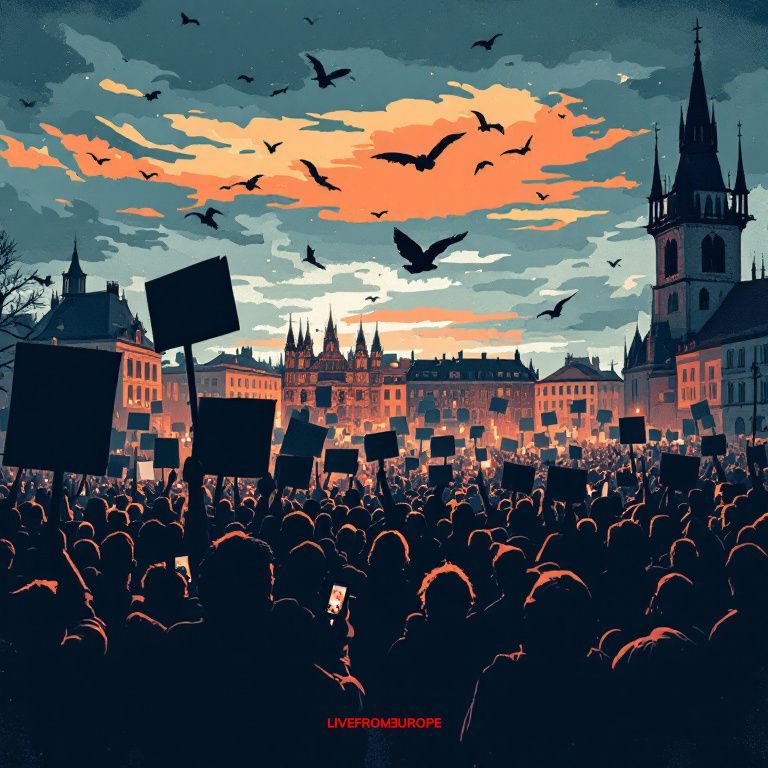
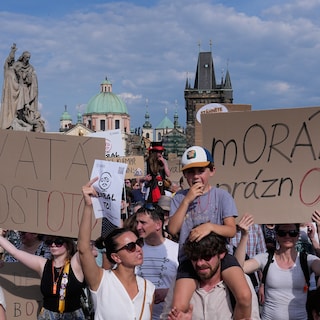
Tens of thousands of protesters filled Prague’s Wenceslas Square on Sunday night to oppose the radical-right Czech government’s plan to strip the country’s public broadcaster of its independent funding model, replacing mandatory licence fees with direct state budget allocations. The demonstration, which drew crowds estimated at 30,000 by local police, followed a 24-hour warning strike staged by journalists and technicians at Czech Television (ČT) and Czech Radio (ČRo) on Saturday. Employees walked out after Prime Minister Andrej Babiš’s cabinet tabled legislation that would abolish the monthly broadcast fee and replace it with annual budget allocations subject to parliamentary vote, a move critics say would expose the outlets to political interference .
The strike paralysed live news and cultural programming, with ČT’s flagship evening news broadcast replaced by a looped slide reading “Public media on strike.” Union leaders warned that the bill, expected to reach the lower house on Wednesday, would turn the broadcaster into “a government mouthpiece.” “This is not about money; it is about control,” said Alena Bušová, chair of the ČT journalists’ union. “If the budget replaces the fee, every prime minister can decide tomorrow whether we cover corruption scandals or ignore them.” The government argues the change will save households roughly 220 koruna (€9) a year and modernise funding, but coalition partners have already signalled unease, with the mayor of Prague, Bohuslav Svoboda, calling the plan “a step toward Orbanisation” .
Across Central Europe, the Czech crisis has reignited debates about media independence. In Hungary, where public broadcasters were fully absorbed into state control in 2010, the opposition Democratic Coalition accused Babiš of “copying Viktor Orbán’s playbook.” Hungarian public television employees staged solidarity protests outside the Czech embassy in Budapest on Monday morning. “We know what happens next,” said DK MP Klára Dobrev. “First the fees go, then the editorial line bends, then the journalists leave.” The European Broadcasting Union, which groups 116 public-service media organisations, has urged Prague to withdraw the bill, warning it would breach the European Convention on Human Rights .
Meanwhile, in Amsterdam, actor and director Thijs Römer faced protests outside the Stadsschouwburg theatre where his new play opened on Sunday. Demonstrators held signs reading “Abuse is not a business model,” a reference to Römer’s 2023 conviction for sexual assault. Police reported “serious threats” and arrested two individuals for public-order offences. The theatre said it would review security measures but insisted the show would continue. Römer has not publicly commented since the verdict .
Follow us for live European news
- 2
- 1
- 1
- 1
- 1
1 further source not geolocated
Articles
Tsjechische publieke omroep staakt uit protest tegen plannen van radicaal-rechtse regering
de volkskrant · 3 months ago
Tausende demonstrieren in Prag für öffentlich-rechtliche Medien Der Protest richtete sich gegen die geplante Finanzierung des Tschechischen Fernsehens (CT) und des Rundfunks (CRo) aus dem Staatsbudget
der standard · 3 months ago

«Esimesed, kes kirjutasid sõna «sõda»»: kuidas sõltumatu väljaanne jääb ellu linnas, kus ebamugavaid küsimusi ei armastata Daugavpilsis on paljud meediakanalid olnud ajalooliselt tihedalt seotud poliitikute või ärihuvidega. Sõltumatu väljaanne «Tšaika» otsustas tegutseda teistsuguste reeglite järgi. Kuidas töötab toimetus piirilinnas, miks lugejad ajakirjanikke korraga armastavad ja vihkavad ning kuidas linn on aastatega muutunud, rääkis «Tšaika» peatoimetaja Inna Plavoka Rus.Postimehele.
postimees · 3 months ago
Demonstranten en ernstige bedreigingen bij theater waar Thijs Römer optreedt Een aantal mensen heeft zondagavond gedemonstreerd bij het theater waar de veroordeelde Thijs Römer met zijn nieuwe voorstelling op het podium staat. De Telegraaf schrijft dat de betogers bordjes vasthielden met teksten als: "Misbruik is geen verdienmodel."
nu.nl · 3 months ago
Na javni češki radioteleviziji zaradi vladnih načrtov poteka 24-urna opozorilna stavka Zaposleni na češki javni televiziji in radiu so začeli 24-urno opozorilno stavko, saj je vlada predlagala zakon, po katerem bi ukinili plačevanje prispevka za javne medije in ga nadomestili s proračunskimi sredstvi.
rtv slovenia · 3 months ago
24 órás sztrájkot hirdettek a cseh közmédia dolgozói a finanszírozásuk átalakítása miatt Ezekben az őrült időkben ez akár Magyarországon is történhetne, de itt most bizony Csehországról van szó, ahol Andrej Babiš a közmédiát közvetlenül az állami költségvetésből finanszírozná.
444.hu · 3 months ago
Nedělní demonstrace za ČT a ČRo byla o penězích, ne o hodnotách či nezávislosti, tvrdí Klempíř Nedělní manifestace na podporu veřejnoprávních médií byla podle ministra kultury Oty Klempíře (Motoristé) o penězích, ne o hodnotách či nezávislosti. Plníme, co jsme slíbili voličům, uvedl dnes časně ráno ministr na síti X. Reagoval tak na demonstraci svolanou spolkem Milion chvilek, při níž v neděli v Praze několik tisíc lidí vyjádřilo nesouhlas se změnou financování České televize (ČT) a Českého rozhlasu (ČRo) a vyzvalo k odvolání Klempíře.
irozhlas.cz · 3 months ago