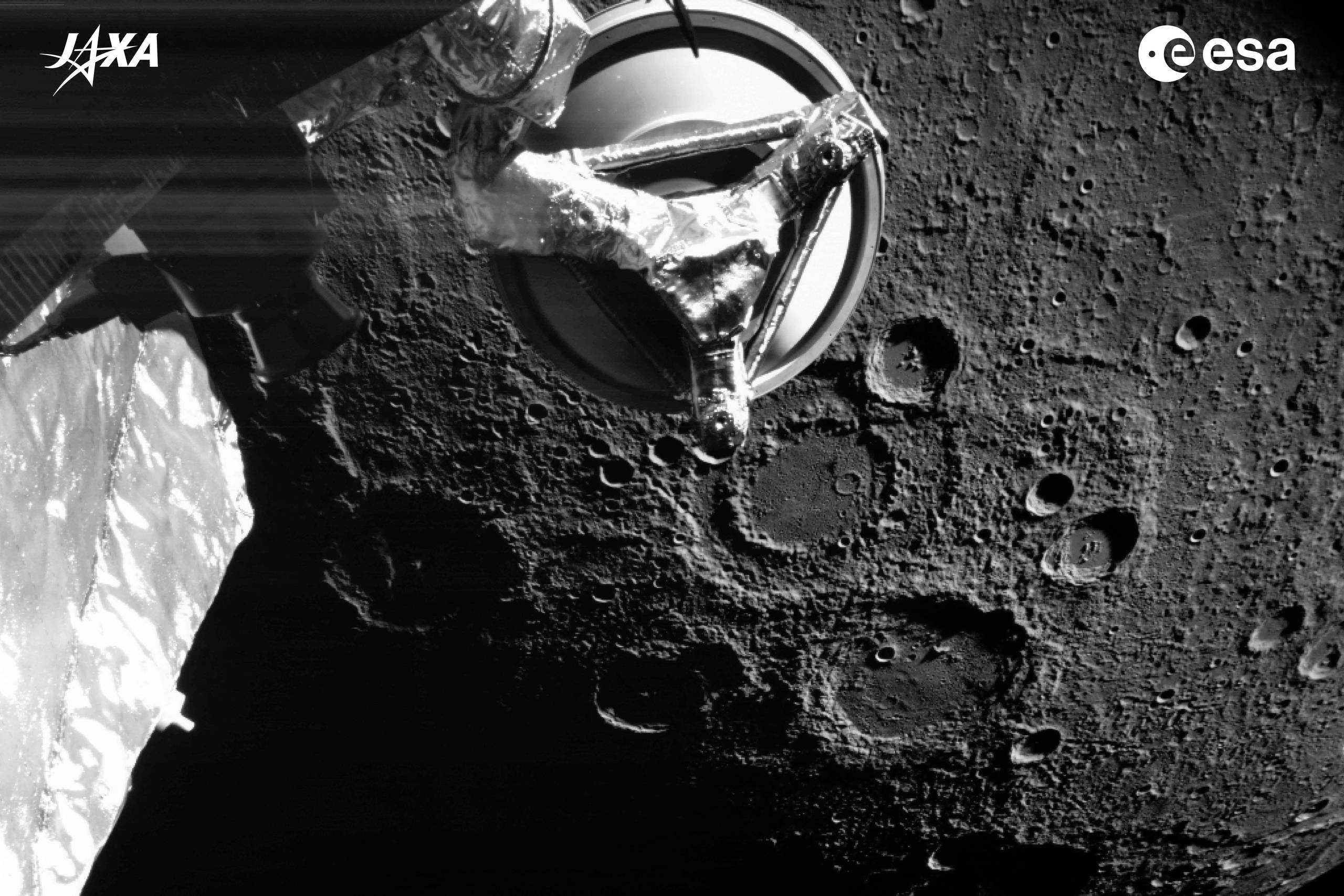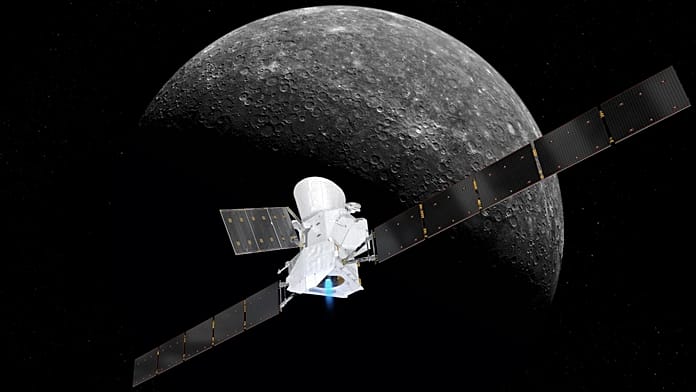
The Japanese-European BepiColombo spacecraft has entered orbit around Mercury after an eight-year journey through space, the European Space Agency (ESA) said on Sunday [1].
The mission is a joint venture between ESA and the Japan Aerospace Exploration Agency (JAXA) [2]. Launched in October 2018 from French Guiana, the four-tonne probe traveled more than 10 billion kilometers [1]. It reached the smallest and least understood planet in the solar system after nine planetary flybys [3].
ESA said the spacecraft achieved orbital capture after firing its thrusters for more than half an hour [1]. The probe is already analyzing data it has collected and is in contact with ground control [2].
According to the mission plan, the European and Japanese portions of the probe will separate on December 9 and 10 [1]. The European orbiter, called the Mercury Planet Orbiter, will study the planet's surface from as close as 480 kilometers above Mercury [3]. The Japanese orbiter, the Mercury Magnetospheric Orbiter, will follow an elliptical path reaching 11,000 kilometers from the planet to study its magnetic field [3].
The mission's science phase is scheduled to begin in April 2027 [2]. ESA describes BepiColombo as the second and most complex mission ever to orbit Mercury [2]. The planet is more difficult for an orbiter to reach than Saturn because of its proximity to the Sun [2]. Mercury experiences extreme temperature swings, from minus 180 degrees Celsius to 450 degrees Celsius, and is bombarded by intense solar radiation [1].
NASA's Mariner 10 became the first spacecraft to visit Mercury in 1974 [1]. ESA mission chief Santa Martinez said earlier this year that the mission would "offer humanity never-before-seen views of Mercury and open a new chapter in our understanding of the solar system" [1].