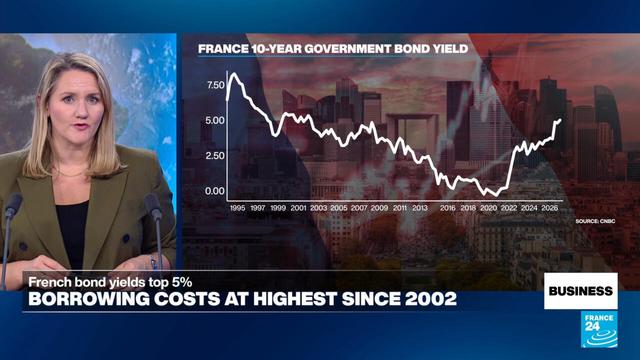
French 10-year bond yields surpassed 5% for the first time since 2002 on Wednesday, as investors demanded higher returns amid escalating economic and social unrest. The benchmark OAT yield peaked at 5.01% during the session before easing slightly, with the spread over German bunds widening to 1.59 percentage points—a level last seen during the 2011 eurozone debt crisis .
The surge follows weekend protests that turned violent, with riots and clashes intensifying concerns over France’s ability to stabilize its finances. Finance Minister Roland Lescure stated the government would implement spending cuts regardless of parliamentary approval, as lawmakers negotiate the 2027 budget under pressure to reduce the deficit .
Analysts attributed the yield spike to a combination of political instability, fiscal imbalances, and rising energy prices. Andrea Tueni of Saxo Banque France told AFP there is “a very clear distrust” toward France, noting the country now borrows at higher rates than Italy and Spain, traditionally seen as more fiscally vulnerable . The French Economy Ministry responded that fiscal consolidation remains the “only credible answer” to market pressures, reaffirming its 5% deficit target for 2027 .
Nobel laureate Paul Krugman warned in a Substack post that France may have become “too big to save,” citing its rapidly rising borrowing costs and structural fiscal challenges. He noted the country’s deficit is projected at 5.1% of GDP for 2026, with 2027’s expected to worsen to 5.7%, while public debt exceeds 119% of GDP . IMF Managing Director Kristalina Georgieva urged Paris to “get its house in order,” though she dismissed comparisons to the eurozone’s past debt crises, citing stronger EU financial safeguards .
The military was deployed to support police operations as unrest persisted, with Interior Minister Laurent Nuñez stating the Sentinelle force would handle static security to free up officers for crowd control . Moody’s is set to review France’s credit rating on Friday, adding to the immediate pressure on policymakers .