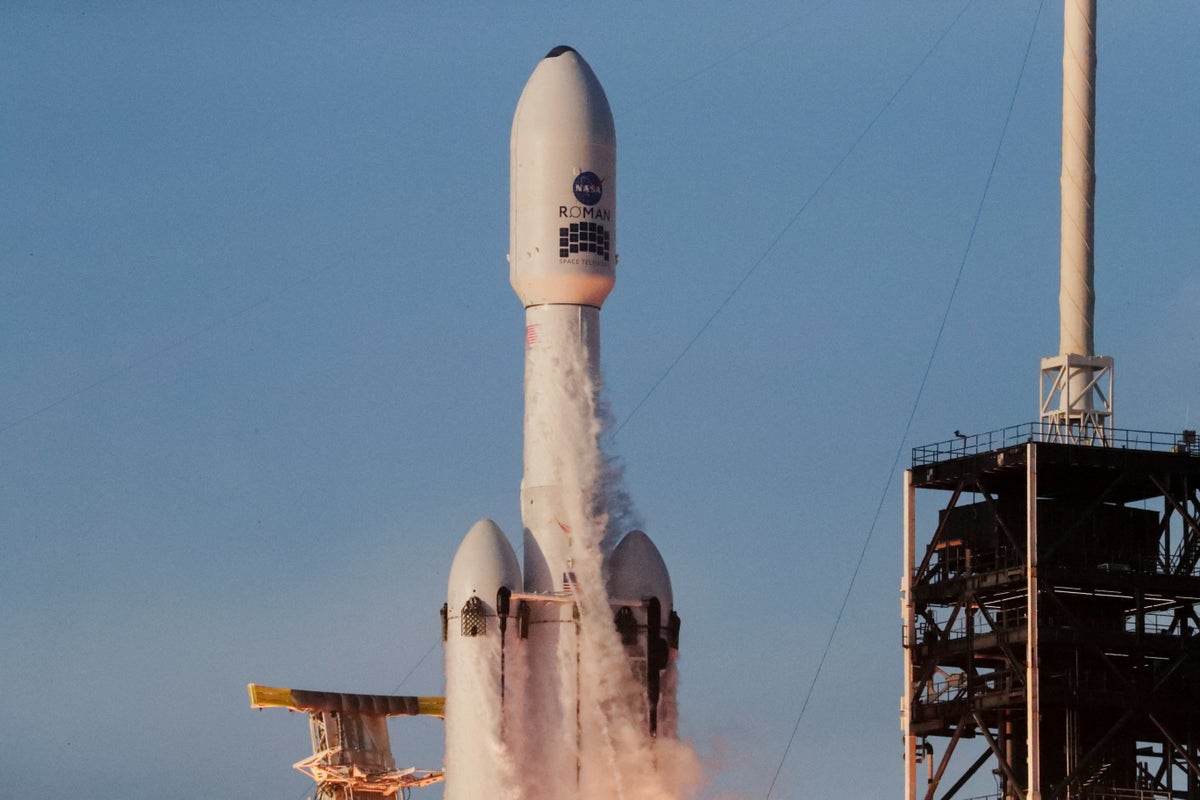
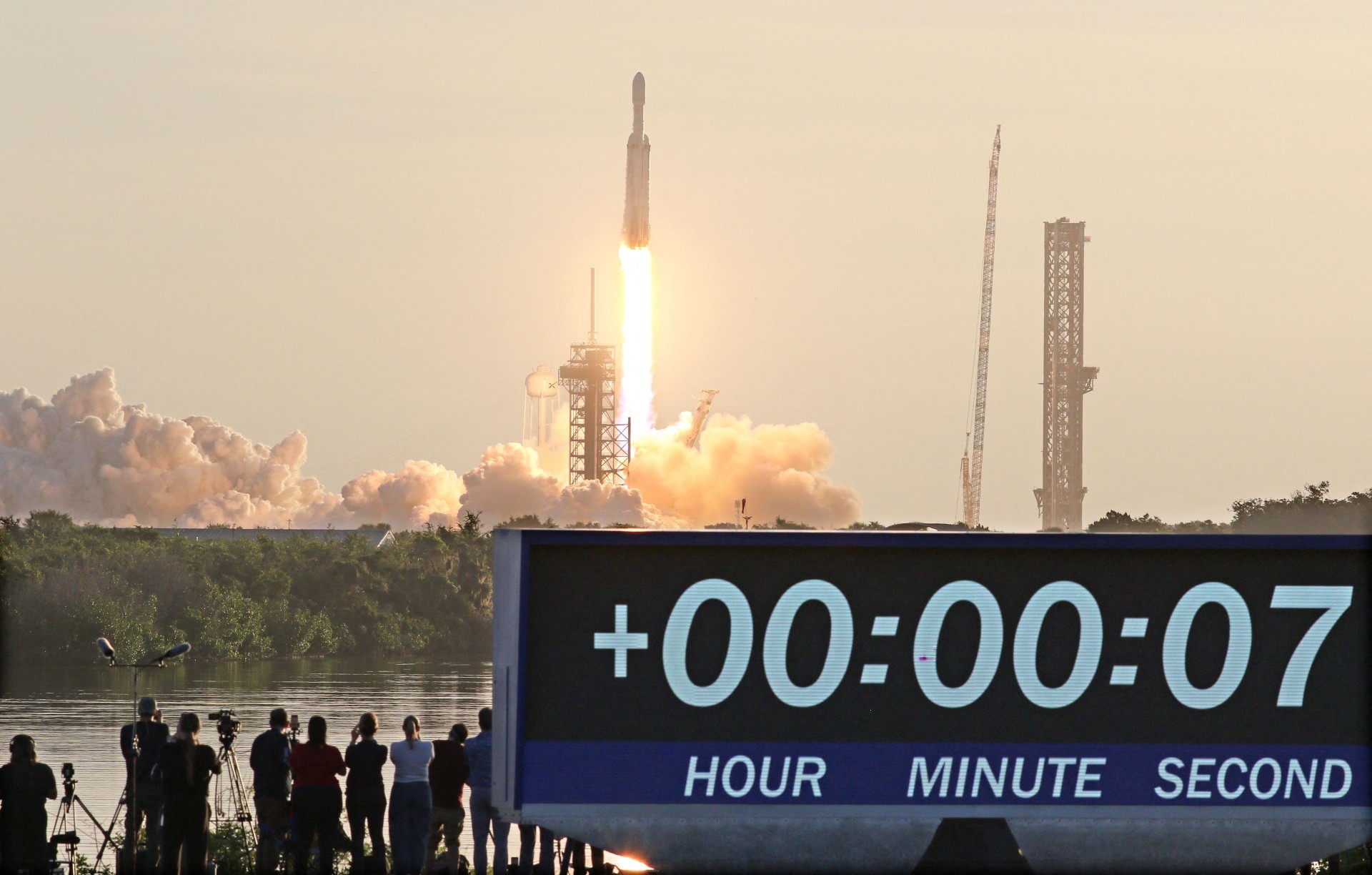
NASA’s Nancy Grace Roman Space Telescope launched on Sunday from Kennedy Space Center in Florida aboard a SpaceX Falcon Heavy rocket, beginning a mission to explore dark energy, dark matter, and exoplanets while testing gravity at vast cosmic scales.
The observatory lifted off at 7:26 a.m. local time from Launch Complex 39A, with the first stage of the rocket returning to Earth for a controlled landing 15 minutes later. At 8:06 a.m., NASA confirmed the second stage had separated, sending the telescope toward Lagrange Point 2, a gravitational balance point 1.6 million kilometers from Earth. The journey to its destination will take approximately 100 days.
The $4.3 billion telescope, named after Nancy Grace Roman (1925–2018), NASA’s first chief of astronomy, is designed for a minimum five-year mission, though officials said it may have enough fuel for a decade. Its field of view is at least 100 times wider than that of the Hubble Space Telescope, which Roman helped pioneer. “Roman is exactly the type of success story we want to see in all of NASA,” agency director Jared Isaacman said .
The telescope will conduct surveys covering over 2 billion galaxies, aiming to provide the first statistical census of planetary systems similar to Earth’s. It will also investigate the universe’s expansion, driven by dark energy, which constitutes roughly 68% of the cosmos, while dark matter accounts for about 27%. Ordinary matter makes up the remaining 5%.
NASA’s Nicky Fox, director of scientific missions, called the launch “a marvelous day,” adding that the telescope “will revolutionize the way we observe the cosmos” . Julie McEnery, the project’s senior scientist, noted that Roman’s sensitivity matches Hubble’s but will survey the sky far faster. “One month of observations to map our galaxy, the Milky Way, would take about a century with Hubble,” she said .
The telescope was originally developed for a U.S. intelligence spy satellite program before being repurposed for cosmic exploration after the program was terminated. Mission scientists will spend the next 90 days commissioning the observatory, with first high-resolution images expected before the winter holidays, project manager Jackie Townsend said .
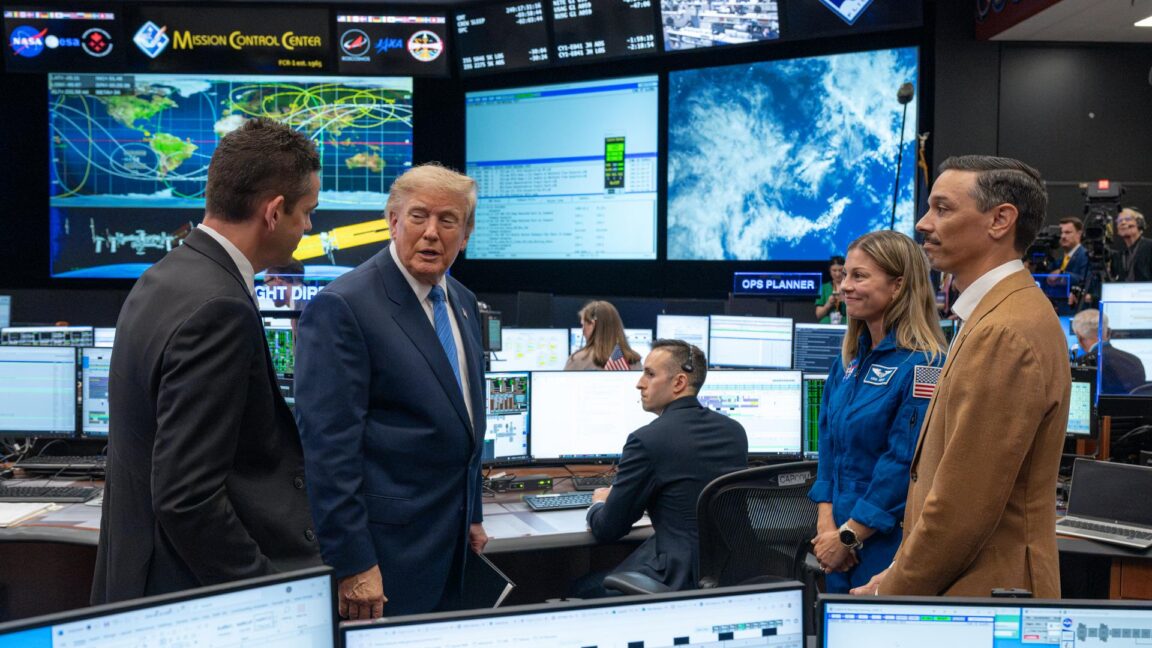
Former U.S. President Donald Trump interrupted a post-launch press conference with NASA’s Isaacman to congratulate the agency, saying, “That looked beautiful on television. You’re the hottest in space” .