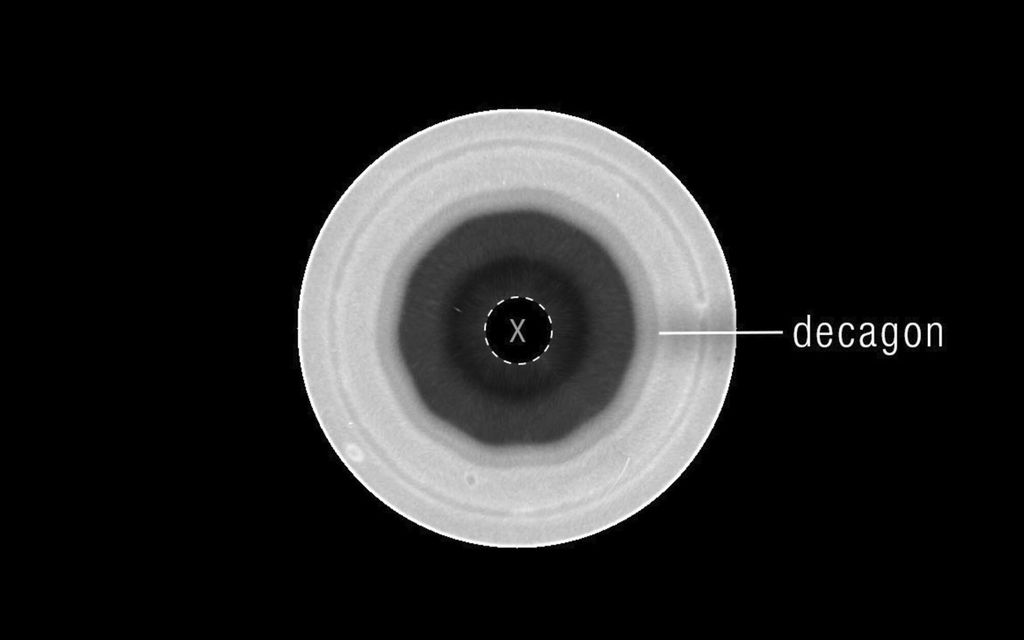
A massive decagonal storm system has been observed encircling Saturn’s south pole, with each side measuring roughly 16,700 kilometers, according to the Associated Press. The formation spans multiple layers of the planet’s atmosphere, indicating it is not merely a surface-level phenomenon.
NASA researcher Amy Simon stated in a release that the structure is unprecedented in Saturn’s southern hemisphere. “We have never seen anything like this on Saturn’s southern side,” Simon said. Unlike the long-standing hexagonal storm at the planet’s north pole, which has remained nearly stationary for over 40 years, the decagon appears to be intensifying and moving eastward at approximately 10 kilometers per hour.
The discovery was enabled by Saturn’s orbital position, which has made its south pole more visible from Earth. Hubble Space Telescope images confirm the decagon existed by at least 2023, though it was absent in Cassini probe data from 2004–2017, according to Agustín Sánchez-Lavega of the University of the Basque Country, who spoke to the BBC. Amateur astronomers contributed to the findings by sharing observations online, providing early indications of the phenomenon, noted Leigh Fletcher of the University of Leicester.
A peer-reviewed study, *A decagon wave around Saturn’s south pole*, was published in *Science Advances* earlier this month .