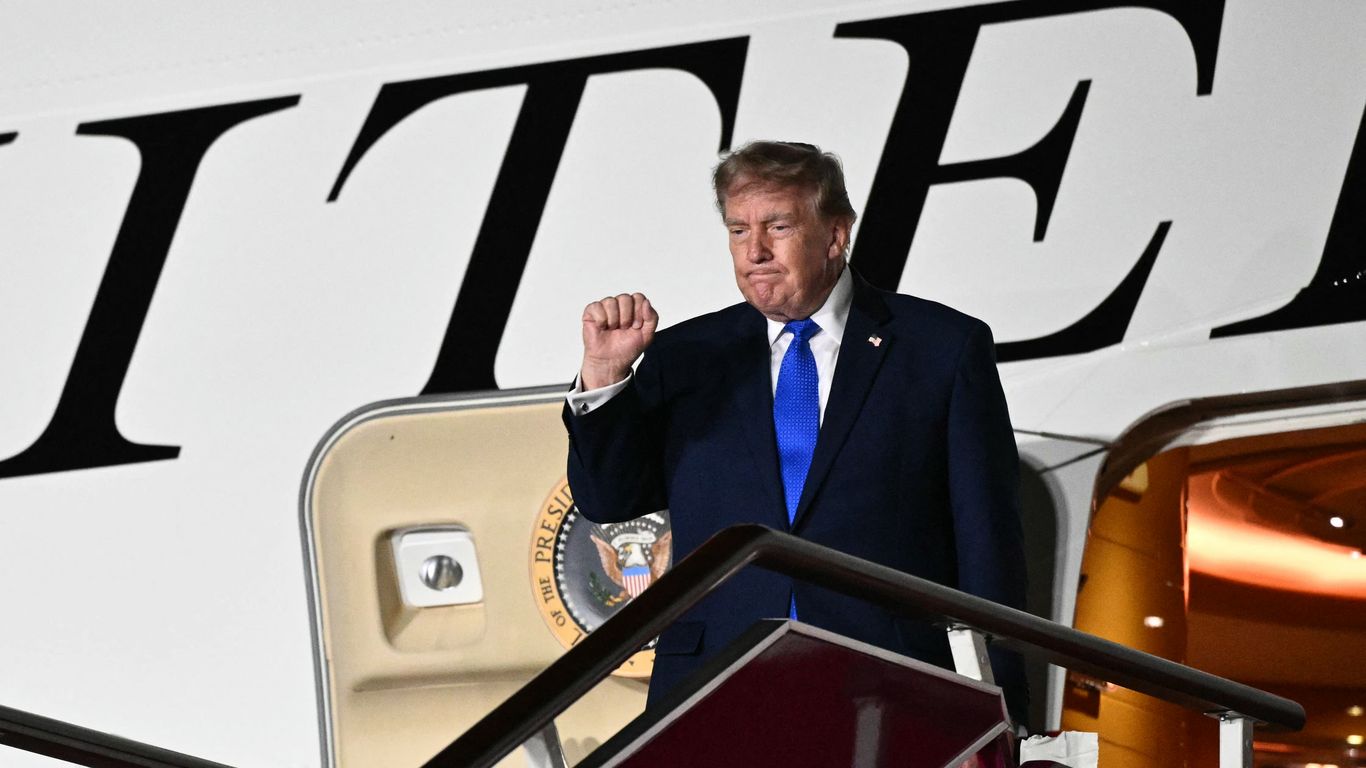
President Donald Trump said on Thursday that he will wait until after the new year before deciding on renewed major strikes against Iran, pushing the decision into next year. [1]
Speaking from Air Force One as he returned to Washington from a trip to China, Trump told Reuters: "Well, I'll talk to you about it after the beginning of the year." He gave similar timelines in interviews with Fox News and Axios, saying "We'll see what happens after January 1" and "I'm not rushing to make any decisions on Iran." [2] [3]
The conflict has been in limbo for nearly nine months since the joint US-Israeli attack began in February. In recent weeks, Trump has alternated between threats of escalation and indications he could wind down hostilities, while the two sides remain in a standoff over efforts to resolve the conflict. [4]
Trump had previously suggested the decision could come to a head after the November 3 midterm elections, repeatedly stating that Iran would be more willing to strike a deal after the vote. But after Republicans lost control of both chambers of Congress, his administration said last week that its naval blockade and economic sanctions against Iran are working. [1]
The Senate on Thursday rejected a war powers resolution aimed at forcing Trump to halt fighting with Iran, with the measure failing 48-51 largely along party lines. Trump has acknowledged that Iran played a role in the Republican losses but said he would not have changed course, adding that he would hold off on fresh strikes for now. [5] [2]
Vice President JD Vance, a possible 2028 presidential candidate, publicly distanced himself from the war, which he blamed for the party's political rout. Trump later directed Vance away from Iran diplomatic efforts to focus on domestic matters, telling Reuters: "JD was fine... He said that the whole situation is one of the reasons certainly that the election didn't go our way." [1]
The president faces pressure from Israeli Prime Minister Benjamin Netanyahu to unleash a decisive bombing campaign soon. The head of Israel's Mossad spy agency, Roman Gofman, visited Washington this month to press for resuming joint US-Israeli strikes, according to Reuters. [3]
Trump also addressed allegations that Iran was pursuing chemical and biological weapons, saying there were indications Iran was "looking at gases, looking at bio," while downplaying a CNN report about a planned "dirty bomb" attack on Washington. Iran's Foreign Ministry rejected the accusations, saying they were intended to create fear and justify military action. [2] [6]
The war has cost the United States $48.3 billion as of November 13, according to a Pentagon official. [7]


![House Democrats recoil at forcing December shutdown to cut Iran war funding House Democrats are largely steering clear of threats to shut the government down in December if Republicans put forward legislation that maintains funding for the war in Iran.Why it matters: Much of the party's left flank — including some members of Congress — think it's a fight they need to pick after their midterm landslide."The American people were loud and clear on November 3rd: they want an immediate end to Donald Trump's reckless war in Iran," Reps. Yassamin Ansari (D-Ariz.) and Ro Khanna (D-Calif.) said in a joint statement on Wednesday.The pair said they will "oppose any funding package that does not explicitly prohibit funds from being used for offensive operations in Iran" because it would "defy the demands of Americans who want this war to end—now."State of play: The Democrats' majority doesn't officially begin until Jan. 3, while federal funding is set to run out on Dec. 11.Republican leaders are struggling to pass party-line procedural votes and will probably bring up their funding patch under a fast-track process that requires bills to pass with a two-thirds majority.In other words: The GOP will almost certainly need a large number of Democratic votes to pass any funding bill, especially if some of their own members defect.What they're saying: "Whatever they have to do to get it through they should do it, but I hope there's not a shutdown," said Rep. Brad Schneider (D-Ill.), the outgoing chair of the center-left New Democrat Coalition."I don't think we should shut down the government, we take that way too casually as it is, so I'd be leaning into not doing it," said Rep. Scott Peters (D-Calif.).Said Rep. Greg Landsman (D-Ohio): "Everyone should do whatever they can to avoid a shutdown. The impact it has on the economy, but workers in particular, it's just not fair."Between the lines: Even some progressives acknowledged their imminent House majority takes a lot of the pressure off the December fiscal deadline."If I can defund [the war] in December, I'd vote to defund it. But if I can't, then I'll vote to defund it in January," said Rep. Jim McGovern (D-Mass.). "We still have a month left of these guys."Said Rep. Delia Ramirez (D-Ill.): "One would argue that we can move a CR, maybe keep it at base [funding levels] ... but then we negotiate the kind of budget we know we expect."Yes, but: "I think we should do everything in our power to keep it in there, and we should also figure out how to claw back some of this ICE funding," Ramirez added.Said Rep.-elect Angela Gonzales-Torres (D-Calif.): "The American people have waited too long, they want to see us try now. ... When we fight we win, and we certainly don't win unless we try. I think we should try."Joseph Geevarghese, executive director of left-wing group OurRevolution, said in a statement: "Voters gave Democrats more power because they wanted a change in direction.""This is a chance to show them, before January, that their votes changed what Congress is willing to do," he said.The bottom line: Ansari told Axios in an interview on Thursday that she is "personally drawing a hard line on any funding for the war" but agrees "with the sentiment that, especially during the holidays, we are concerned about our federal workers.""Nobody wants a government shutdown. There's no question of that. I don't want there to be a government shutdown," she said."I just think we should be able to both: Not have a government shutdown and ... deliver on what I think was the resounding message from voters, which is that the war in Iran needs to end."](https://images.axios.com/DY6fHo14EcwhLOxCmneVBaNHV0o=/0x0:1920x1080/1366x768/2025/10/02/1759428229267.jpeg)


![Trump to Axios: I'm "not rushing into a decision" on Iran President Trump said in a brief phone interview Thursday that he won't make a determination on his next step in the Iran war until the new year. "I am not rushing into any decision [on Iran]. We will see what happens after the beginning of the year," Trump told Axios from Air Force One, on his way back to the U.S. from China.Why it matters: The president's comments come as he faces heavy pressure from Israeli Prime Minister Benjamin Netanyahu to unleash a decisive bombing campaign soon. Yes, but: Trump could change his mind at any moment. And he wouldn't telegraph plans for an imminent attack even if that's what he was intending to do. A day before the war began in February, Trump said he hadn't made a decision, when in fact he had already ordered strikes. Between the lines: Trump's stated timing could mean he's giving more time for the naval blockade and the economic pressure campaign to play out, as many of his advisers and leaders of Gulf countries are urging.But it could also indicate that if Iran doesn't make concessions by the end of the year, Trump wants to leave himself enough time for military action before the new Democratic-controlled Congress settles in.Driving the news: While stating last week that a major new round of strikes on Iran was "quite unlikely," Trump is still considering a joint attack with Israel, Axios reported on Wednesday.The president's deliberations are likely to pick up when he returns from Asia.Any U.S. operation would involve Israel and could include strikes on suspected Iranian nuclear facilities such as Pickaxe Mountain. Bridges and power plants could also be targeted, as well as Iranian military and civilian leaders.Behind the scenes: The White House has asked the Pentagon and intelligence experts for their assessments of how Iran would respond to each of the strike scenarios the U.S. military has prepared, according to two sources with knowledge of the matter.The White House has asked whether any of the options would avoid triggering a devastating Iranian retaliation against Gulf countries' oil and gas facilities.The intrigue: The director of the Israeli spy agency Mossad, Roman Gofman, visited Washington and Miami last week for talks with CIA Director John Ratcliffe and White House envoy Steve Witkoff.Gofman, one of Netanyahu's closest confidants, was sent by the Israeli prime minister to press for resuming the war against Iran, an Israeli source said.The Mossad director relayed Israel's concerns about Iranian activities related to chemical weapons development, U.S. and Israeli sources said.Israel claims it has intelligence showing that Iran has stepped up its research and development of chemical weapons as well as conducted tests.Trump was briefed about this new intelligence, a U.S. official said.](https://images.axios.com/ws-8KdamSWnJr1tJaZs1DtFgbVs=/0x0:4480x2520/1366x768/2026/11/19/1795111766325.jpeg)