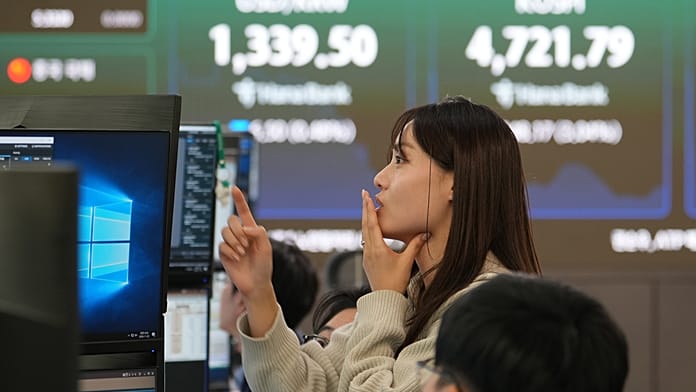
Nvidia's stock has collapsed amid a scandal alleging its former chief executive Jensen Huang had an affair with a woman in contact with Chinese intelligence, as US tech stocks enter a bear market. [1] [2]
The Nasdaq Composite has lost almost a fifth of its value since hitting a record high last month and turned negative for the year on Friday, when Nvidia shares plunged 14 percent. [1] US tech stocks entered a bear market after steep losses, with the Philadelphia semiconductor index falling 10.7 percent on Friday for a weekly loss of 17.1 percent. [3] Nvidia has lost nearly half its market value, according to Slovak media. [4]
The New York Times reported that Alice Huang, who had a secret affair with Jensen Huang from spring 2025 to autumn 2026, maintained regular contact with an officer of China's Ministry of State Security. [5] Her business partner Kang Wei, often presented as her husband, also worked with the same intelligence service. [6] Huang initially described the relationship as routine business contacts and admitted to the affair only after the New York Times revealed last month that US authorities had linked the woman to Chinese intelligence. [6] US authorities are investigating whether advanced Nvidia chips obtained by Huang's company Megaspeed reached data centers in Southeast Asia serving Chinese firms like Alibaba or were smuggled to China. [6]
President Donald Trump called on Nvidia's board to rehire Jensen Huang, writing that it "would be the best thing for the Company, and also, for the U.S.A." [7] Senator John Kennedy characterized the affair as "the most expensive sex since Helen of Troy" during an interview on NBC's Meet the Press. [2]
US securities regulators are investigating Nvidia's accounting practices, according to US media. [8] The Commerce Department moved to close a loophole allowing Chinese companies remote access to Nvidia's AI chips. [1] Regulators in Taiwan, China and South Korea rolled out emergency measures including tighter short-selling rules and easier margin buying to arrest the turmoil. [9]
Asian markets continued falling on Monday, with Seoul's Kospi down 4.4 percent and Hong Kong's Hang Seng down 1.3 percent. [1] The VIX volatility index spiked to its highest level since April last year. [1]