
Europe adopts 'military Schengen' to speed troop movements: but national divisions risk blunting EU defence push
Story Timeline
3 months · 15 summary articles
Europe’s defence ambitions face a stark reality check as the European Parliament on Tuesday approved sweeping new rules to accelerate military mobility across the bloc, yet warnings grow that political hesitation and industrial fragmentation could still blunt the push for strategic autonomy. The vote in Strasbourg on Tuesday green-lit a “military Schengen” framework designed to slash red tape for troop and equipment movements during crises, with lawmakers from the transport, tourism, security and defence committees backing the plan by a large majority . The legislation aims to let battle tanks and heavy weaponry cross internal EU borders without delay, a capability Brussels now brands essential after Ukraine’s war exposed the bloc’s logistical bottlenecks.
Yet even as MEPs act, defence ministers and analysts warn that ambition is colliding with entrenched national interests. German Defence Minister Boris Pistorius told the *Süddeutsche Zeitung* on Tuesday that Germany’s new military strategy must foster a broader “security culture” because “the military alone cannot guarantee freedom” . His remarks underscored Berlin’s reluctance to shoulder leadership without deeper societal buy-in, a hesitation that risks diluting Europe’s collective deterrent. The *War on the Rocks* analysis published the same day argued that Germany’s new strategy risks becoming “a claim to lead, a hesitation to act,” leaving the EU without a clear centre of gravity in a continent where the next battlefield may already be forming .
The urgency is underscored by the Baltic states. Latvia’s government said on Tuesday it will press the European Council to fast-track defence projects along the eastern flank, warning that delays in funding and procurement could leave NATO’s eastern members exposed . The call comes as France and Germany on Tuesday relaunched their defence-industrial partnership after the collapse of the SCAF next-generation fighter programme, a move analysts say signals a pivot from grand joint ventures to pragmatic bilateral deals .
Meanwhile, the European People’s Party group argued on Tuesday that Europe’s troops must “move, not wait at internal borders,” echoing warnings from the *Baltic Times* that the continent’s security architecture is entering a phase where the line between war and crisis readiness is blurring faster than institutions can adapt . The bloc’s push for industrial defence autonomy—less regulation, more production—is gaining ground, yet the absence of a unified strategic vision risks turning capability into fragmentation. As budgets rise and some governments dust off conscription plans, the pacifist movement remains notably muted, leaving Europe to navigate a perilous middle ground between deterrence and division.
Follow us for live European news
- 3
- 2
- 1
- 1
- 1
2 further sources not geolocated
Articles

Défense : après labandon du Scaf, la France et lAllemagne relancent leur partenariat
lexpress · 2 months ago

Totale Zerstörung – Warum dieses Szenario Europa mit am härtesten treffen würde Immer wieder warnt Taiwan vor den katastrophalen Folgen, sollte China die demokratisch regierte Insel angreifen. Aber der Westen hält sich zurück und wiegelt ab, um Peking nicht zu verärgern. Und begeht dabei einen schweren Fehler.
welt.de · 2 months ago

Woran militärische Großmächte wie die USA, Russland oder Israel scheitern: „Zerstören reicht nicht, um politisch zu gestalten Die Welt ist geprägt von Konflikten. Doch selbst hochgerüstete Staaten haben oft nur wenig Erfolg mit ihren Feldzügen. Zwei Experten sagen, warum es so schwierig ist, Kriege siegreich zu beenden.
tagesspiegel · 2 months ago

Pourquoi le mouvement pacifiste est-il si inaudible ? Les budgets militaires augmentent, les gouvernements rétablissent progressivement le service militaire : la petite musique belliciste est partout. Pourtant, dans ce contexte qui devrait lui donner loccasion de se mobiliser, on nentend pratiquement pas la voix du camp pro-paix, observe-t-on dans la presse belge.
courrier international · 2 months ago
A Claim to Lead, a Hesitation to Act: Germanys New Military Strategy
gdeltproject.org · 2 months ago
Europes defense ambitions get reality check
gdeltproject.org · 2 months ago

Avrupanın güvenliğinde stratejik sorumluluk çağı
gdelt bot · 2 months ago

Análisis | La Europa de la defensa entra en fase industrial : menos regulación y más producción
gdelt bot · 2 months ago
Latvia will emphasize at European Council need to accelerate implementation of defense projects aimed at strengthening Eastern Flank - The Baltic Times RIGA - At the upcoming European Council meeting, Latvia will emphasize the need to accelerate the implementation of European Union (EU) defense ......
baltic times · 2 months ago
The next battlefield may be closer than expected – Ukraine already has the lessons - The Baltic Times The European security architecture is entering a phase in which the line between active warfare and a potential theatre of ......
baltic times · 2 months ago

Neue Helis für Deutsche Marine – „Wenn wir ein U-Boot orten, hat es keine Chance, zu entkommen Deutschlands neuer Marinehubschrauber soll U-Boote aufspüren und bekämpfen. Der NH-90 MRFH „Sea Tiger löst den „Sea Lynx ab und stärkt die Flotte. Nun kam er erstmals in einer Übung zum Einsatz.
welt.de · 2 months ago

Diese Kreuzfahrerburg ist bis heute militärisch wertvoll Mindestens seit dem Hochmittelalter thront die Festung Beaufort im Südlibanon über dem Fluss Litani. Errichtet von den Kreuzfahrern, war sie seit 1268 in muslimischer Hand. Einer der berühmtesten Araber-Freunde Europas besuchte und beschrieb sie 1909.
welt.de · 2 months ago
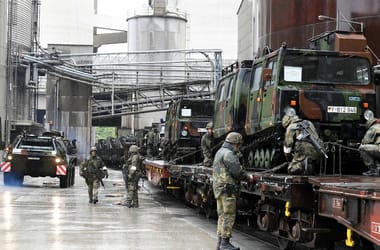
Jöhet a „katonai Schengen: az EP jelentősen felgyorsítaná a katonai mobilitás fejlesztését A közlekedési és idegenforgalmi, valamint a biztonság- és védelempolitikai bizottság nagy többséggel fogadta el álláspontját az új uniós szabályokról, amelyek célja, hogy egy esetleges válság vagy konfliktus esetén gyorsabban lehessen csapatokat, haditechnikát és katonai felszerelést mozgatni az Európai Unión belül.
hvg.hu · 2 months ago
Bundeswehr: Pistorius zweifelt an Deutschlands Verteidigungswillen Militär allein reicht nicht: Verteidigungsminister Boris Pistorius wirbt für eine neue Sicherheitskultur in Deutschland. Die ganze Gesellschaft solle bereit sein, für ihre Freiheit einzustehen.
sueddeutsche · 2 months ago
Europes troops must move, not wait at internal borders
gdeltproject.org · 2 months ago
Finnish military allows long hair and earrings for men The move is part of a raft of measures aimed at improving gender equality within the armed forces.
yle.fi · 2 months ago