Apple posted record quarterly revenue on Monday but warned that unprecedented memory chip costs will squeeze profit margins, sending its shares down in after-hours trading.
The iPhone maker reported revenue of $114.5 billion for the three months to 26 September, up 12 percent from $102.5 billion a year earlier. Net profit reached $30.71 billion, or $2.10 per share, beating analyst expectations of $1.99 per share on $113.4 billion in revenue, according to FactSet. Shares fell around 3 percent in after-hours trading on Monday as investors weighed the strong results against pressure on profit margins.
Chief Executive John Ternus said memory pricing is "unprecedented" and warned that costs will rise further in the December quarter. Apple expects gross margin to fall to between 45 and 46 percent in the current quarter, below the 46.3 percent analysts had forecast, with higher memory chip costs accounting for most of the pressure. The company said recent price increases partly offset the impact, and it expects revenue to grow 7 to 10 percent in the December quarter.
The September quarter included tariff refunds that added $0.05 per share to earnings and lifted gross margin by about one percentage point to 47.9 percent. Apple's inventory surged 154 percent to $14.5 billion as memory chip costs climbed. Services revenue reached a record $31.6 billion, up 9.8 percent, but growth is expected to slow to 8 to 9 percent in the December quarter.
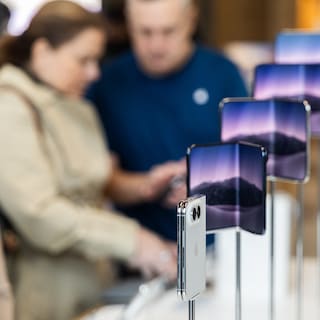
iPhone revenue rose 17.5 percent to $57.6 billion, while Mac sales increased almost 24 percent. Revenue in Greater China rose 21 percent in the quarter and 28 percent over the full fiscal year, Ternus said. The quarter included only the first days of sales of the premium iPhone 18 Pro models; the new foldable iPhone Duo began selling in the current quarter.
This was Ternus's first earnings call since taking over from Tim Cook on 1 September. He said Apple cannot predict when supply constraints on the iPhone Duo will lift, with some shipments expected to arrive in 2027. The company has raised prices across its product lineup this year, including higher starting prices for the iPhone 18 Pro and Pro Max.
Apple confirmed in September that the models powering its new Siri were built with Google, following a multi-year agreement announced in January. Capital spending fell 29 percent to $9 billion over the full fiscal year, while research and development spending rose 32 percent to $45.8 billion.