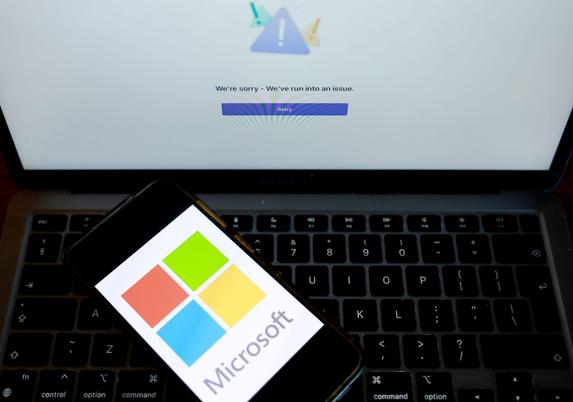
Microsoft said on Friday that its email and collaboration services had fully recovered after a 24-hour global outage that disrupted millions of users across 74 countries.
The outage began around 16:00 GMT on Thursday. Microsoft said overloaded servers became "unexpectedly unavailable" after an earlier network-capacity upgrade, a failure that Rui Coutinho, a professor at Nova SBE, compared to closing seven of eight lanes on a highway. The company ruled out a cyberattack or involvement by AI tools. The disruption affected Outlook, Teams and Copilot, among other Microsoft 365 services.
Services were declared fully recovered at 16:10 GMT on Friday. Microsoft said it would not declare the incident resolved until the backlog of undelivered messages was cleared. The company increased the queue time for emails to 48 hours. Independent researcher Jonathan Leitschuh warned that users may receive "a flood of notifications" as subsystems come back online.
The outage disrupted governments worldwide. Norway's parliament and several ministries lost email access, while 80 to 90 Danish municipalities were affected. In the United Kingdom, the National Health Service pivoted to paper records and a Manchester criminal trial was delayed. The US House of Representatives and Maine's judicial branch also reported disruptions, and the US Department of Defense did not comment on whether it was affected.
Businesses resorted to alternative methods. Foreign banks in Taiwan used fax machines, while Euronext told companies to phone in trades. Rail operators in Germany, the United Kingdom and Canada reported impacts on timetables. Hospitals in Britain returned to paper documentation.
The incident renewed calls for digital sovereignty among EU leaders meeting in Dublin. Officials highlighted systemic risks from concentrated infrastructure, noting that only a fraction of European digital services run on domestic infrastructure. German IT expert Dennis-Kenji Kipker said the outage exposed a massive "cluster risk," stating that companies must secure their most important systems twice in the future.
Microsoft security products including Defender and Intune were also impacted, creating a window for hackers, according to Computer Weekly. Microsoft, which has more than 450 million Microsoft 365 commercial subscribers, said it would provide a full post-incident report. Its stock was mostly flat in US trading on Friday. Walter Pasquarelli, a strategy adviser to governments on AI and affiliated researcher at the University of Cambridge, said: "What we do know so far is that this is first and foremost a communication risk."