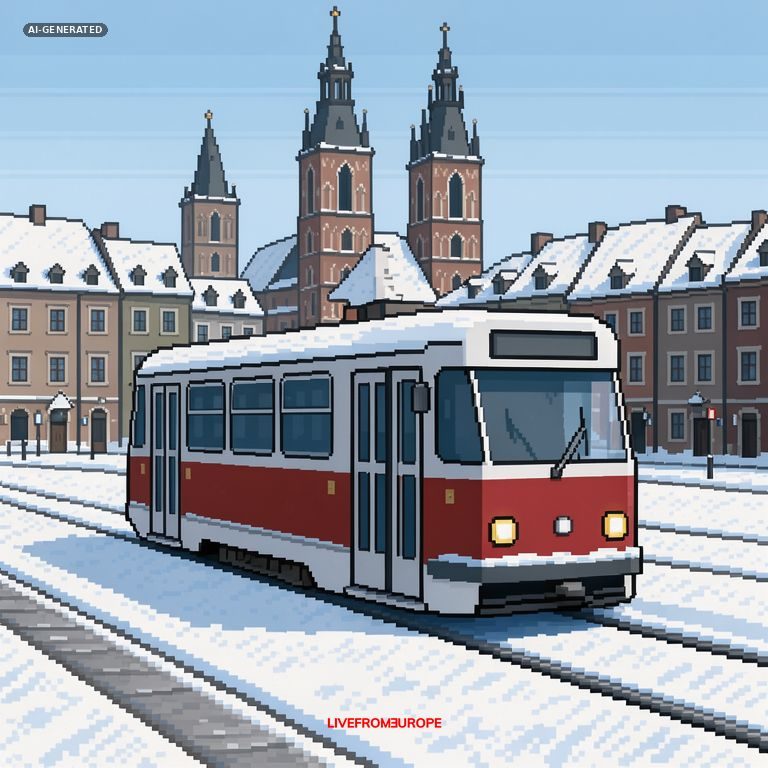
Heavy snowfall struck Poland, Slovakia, Hungary and Austria, triggering weather warnings and disrupting transport across Central Europe.
Polish meteorologists issued first-degree alerts for heavy snow in five southern regions from 3pm on Thursday to 6pm on Friday, forecasting 10 to 20 centimetres of accumulation [1]. The alerts cover parts of the Lower Silesian, Opole, Silesian, Subcarpathian and most of the Lesser Poland voivodeships [1]. In Slovakia, Bratislava is under a second-level warning with up to 15 centimetres expected in 12 hours [2]. Hungarian authorities warned two counties could see up to 10 centimetres [3]. Austria reported snow across the country, with Vienna expecting up to 15 centimetres [4].
In Budapest, numerous bus routes faced disruptions on Wednesday evening despite Mayor Gergely Karácsony's announcement on Tuesday that the city was prepared for the snowfall [5]. The snow caused serious delays on the Buda side, and accidents occurred on highways [6]. Karácsony had asked drivers to use public transport during the snowfall [7].
Poland expects temperatures to fall to minus 10 degrees Celsius in the south by Sunday night [1]. In southern Poland, snowfall is expected to add 2 to 4 centimetres during the day and 7 to 12 centimetres overnight in Małopolska and Upper Silesia [8]. Black ice warnings are in place for six Polish voivodeships [9]. Slovak police warned that braking distances on snow or ice can be significantly longer [10].
In Vienna, the early snow prompted residents to buy sleds and ice skates [11]. Residents questioned whether trams would run, children would reach school, roads would be cleared and salt supplies would suffice [4]. Slovak meteorologists forecast snow or sleet in many areas on Thursday with possible black ice [12]. Temperatures there will range between 0 and 5 degrees Celsius [12].